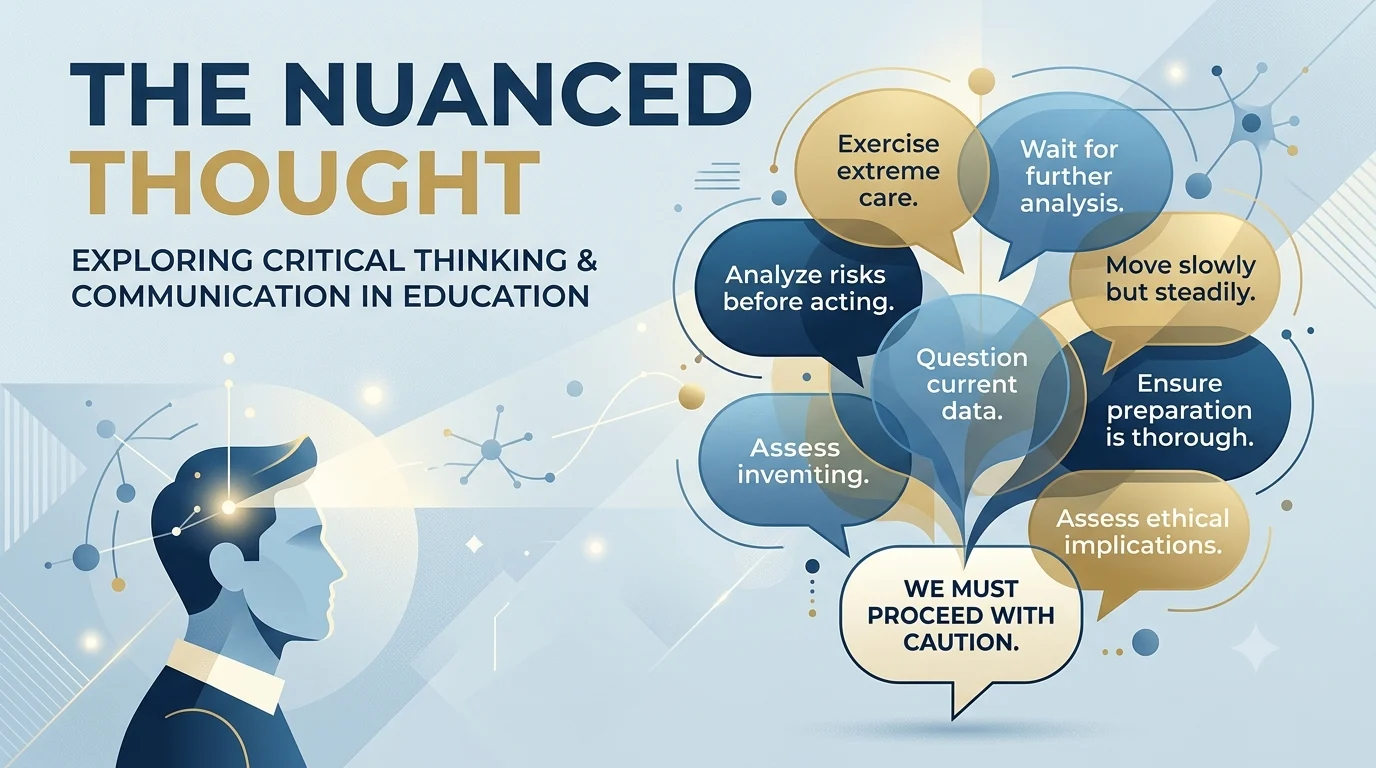
Ever seen the word “nuanced” in discussions, articles, or debates and wondered what it actually means? Nuanced (pronounced NOO-ahnst) means something that is detailed, subtle, and not simple or one-sided. It is used when an idea, opinion, or explanation includes multiple layers of meaning or different perspectives instead of being overly basic or black-and-white.
In simple terms, nuanced means having depth and subtle differences rather than being overly simple. For example, a nuanced opinion considers both sides of an issue instead of a strict yes-or-no answer, while a nuanced character in a story feels realistic because they have mixed emotions, strengths, and flaws.
Unlike simple explanations, nuance focuses on small but important details, which is why the word is commonly used in writing, education, media, and everyday conversations where deeper understanding is needed.
Nuanced Meaning Definition
Dictionary-Style Definition
Nuanced meaning refers to a subtle, layered, and context-dependent interpretation of words, actions, ideas, or situations that goes beyond their most obvious or literal meaning.
Key Characteristics of Nuanced Meaning
A nuanced meaning often includes:
- Context
- Emotion
- Perspective
- Hidden implications
- Cultural understanding
- Multiple interpretations
- Subtle distinctions
Because of these elements, nuanced meanings are common in literature, communication, psychology, politics, law, and everyday conversation.
Origin and History of the Word Nuance
Many people understand what nuanced means but never learn where the word comes from.
The word nuance originates from the French word nuance, which means a slight difference in shade, tone, or color.
It entered the English language during the 18th century and was originally used to describe subtle variations in artistic and visual expression.
Over time, its meaning expanded beyond colors and art. Writers, philosophers, linguists, and scholars began using the word to describe small differences in ideas, emotions, opinions, and communication.
Today, the concept of nuance is widely used in:
- Literature
- Journalism
- Psychology
- Research
- Business communication
- Politics
- Law
- Social media discussions
The growing popularity of critical thinking and media literacy has made understanding nuanced meaning even more important in modern communication.
Nuanced Meaning in Simple Words
Many people search:
“What does nuanced mean in simple terms?”
The simplest answer is:
Nuanced means having small but important details that affect the overall meaning.
A nuanced statement is not always completely obvious. It may require deeper thinking to understand what is really being communicated.
Easy Example
Someone says:
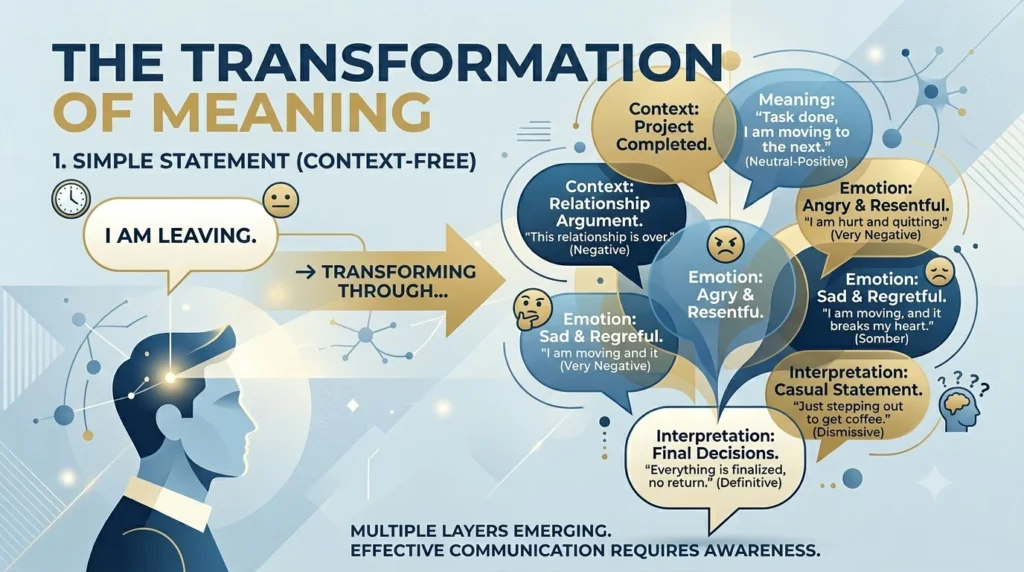
“I’m okay.”
Literal meaning:
The person is fine.
Nuanced meaning:
The person may actually feel sad, stressed, disappointed, or frustrated but doesn’t want to discuss it.
This hidden emotional layer creates nuance.
Another Simple Example
Statement:
“You did better than expected.”
Literal interpretation:
A compliment.
Possible nuanced interpretation:
The speaker may also be implying that expectations were initially low.
Nuanced Meaning in English
In English, the word nuanced is used to describe ideas, opinions, conversations, arguments, emotions, and interpretations that contain subtle distinctions.
Example 1
“The article presents a nuanced discussion of climate policy.”
Meaning:
The article considers multiple perspectives instead of offering an overly simple argument.
Example 2
“Her opinion on the issue is nuanced.”
Meaning:
Her viewpoint recognizes complexity and different factors rather than seeing the issue in black-and-white terms.
Example 3
“The movie offers a nuanced portrayal of family relationships.”
Meaning:
The film explores emotional depth and complexity instead of presenting simplistic characters.
Nuanced Meaning Pronunciation
Pronunciation
Nuanced
/ˈnuː.ɑːnst/
or
/ˈnuː.ænst/
Easy Pronunciation Guide
NOO-ahnst
Syllables
Nu-anced
Pronunciation Example
“The professor gave a nuanced explanation of the topic.”
Common Pronunciation Mistake
Many learners pronounce it as:
❌ “new-ance-ed”
Correct pronunciation is:
✅ “NOO-ahnst”
C’est La Vie Meaning: What This Famous French Phrase Really Means
Nuanced Meaning Synonyms
People frequently search:
- What is a nuanced synonym?
- What is another word for nuance?
- Nuanced meaning and synonyms
Although no synonym perfectly matches the word nuanced, several alternatives share similar meanings.
Common Synonyms of Nuanced
- Subtle
- Sophisticated
- Layered
- Refined
- Detailed
- Multifaceted
- Thoughtful
- Insightful
- Contextual
- Complex
Related Words
- Distinction
- Subtlety
- Refinement
- Variation
- Interpretation
- Perspective
Which Synonym Is Closest?
The closest synonym is usually:
Subtle
However, nuanced often implies a deeper and more structured complexity than simply being subtle.
Nuanced Meaning in Different Languages
Understanding nuanced meaning becomes easier when we see how different languages express the idea of subtlety, depth, and layered interpretation. Although exact translations may vary, the central concept remains the same: recognizing meanings that go beyond the obvious.
Nuanced Meaning in Urdu
Nuanced meaning in Urdu can be expressed as:
- باریک مفہوم
- لطیف معنی
- گہرا مطلب
- تہہ دار مفہوم
These expressions describe meanings that require careful thought and attention to context.
Urdu Example
“اس جملے کا ایک باریک مفہوم ہے جو پہلی نظر میں سمجھ نہیں آتا۔”
Translation:
“This sentence has a nuanced meaning that is not immediately obvious.”
Nuanced Meaning in Arabic
Nuanced meaning in Arabic:
معنى دقيق ومتعدد الطبقات
This phrase refers to a meaning that contains subtle distinctions and deeper layers of interpretation.
Arabic Example
قد يحمل هذا التصريح معنى دقيقاً يعتمد على السياق.
Translation:
“This statement may carry a nuanced meaning that depends on context.”
Nuanced Meaning in Punjabi
Nuanced meaning in Punjabi can be understood as:
- باریک مطلب
- گہرا مفہوم
These terms describe meanings that go beyond a simple interpretation.
Punjabi Example
“اس گل دا اک باریک مطلب وی اے۔”
Translation:
“This statement also has a deeper, more subtle meaning.”
Nuanced Meaning in Bengali
Nuanced meaning in Bengali:
- সূক্ষ্ম অর্থ
- গভীর অর্থ
These phrases describe a subtle or layered interpretation.
Bengali Example
“তার কথার একটি সূক্ষ্ম অর্থ ছিল।”
Translation:
“His words carried a nuanced meaning.”
Nuanced Meaning in Chinese
Nuanced meaning in Chinese:
- 细微含义
- 微妙意义
These expressions describe meanings that contain delicate distinctions or subtle implications.
Chinese Example
这句话有微妙的含义。
Translation:
“This sentence has a nuanced meaning.”
Nuanced Meaning in Nepali
Nuanced meaning in Nepali:
- सूक्ष्म अर्थ
- गहिरो अर्थ
These phrases refer to subtle or deeply layered interpretations.
Nepali Example
यो वाक्यको सूक्ष्म अर्थ छ।
Translation:
“This sentence has a nuanced meaning.”
Nuanced Meaning in Farsi
Nuanced meaning in Farsi:
- معنای ظریف
- مفهوم عمیق
These expressions describe meanings that contain subtle distinctions and deeper understanding.
Farsi Example
این جمله دارای معنای ظریف است.
Translation:
“This sentence contains a nuanced meaning.”
Succubus Meaning: The Dark Truth Behind the Myth
Nuanced Meaning in English with Examples
Many English learners search for “nuanced meaning in English with example” because understanding the word becomes easier when it is used in real sentences.
Example 1
“The author’s argument is nuanced and balanced.”
Meaning:
The author considers multiple perspectives rather than presenting a simplistic opinion.
Example 2
“Her response was nuanced.”
Meaning:
Her answer reflected complexity and thoughtful consideration.
Example 3
“The documentary offers a nuanced view of history.”
Meaning:
The documentary explores different viewpoints instead of presenting a one-sided narrative.
Example 4
“The manager took a nuanced approach to the problem.”
Meaning:
The manager considered several factors before making a decision.
More Nuanced Meaning Explained
When people use the phrase more nuanced, they are usually describing an understanding that goes deeper than a basic explanation.
A more nuanced interpretation considers:
- Context
- Perspective
- Emotion
- Evidence
- Multiple viewpoints
Example
Basic opinion:
“Social media is harmful.”
More nuanced opinion:
“Social media can be beneficial for communication and learning, but it may also contribute to misinformation and mental health challenges.”
The second statement is more nuanced because it recognizes both advantages and disadvantages.
Emotionally Nuanced Meaning
An emotionally nuanced meaning contains multiple emotional layers at the same time.
Human emotions are rarely simple. A person can feel happy and sad, excited and nervous, or grateful and disappointed simultaneously.
Example
A parent says:
“I’m proud of you.”
The statement may also contain:
- Love
- Relief
- Nostalgia
- Concern about the future
These emotional layers create a nuanced meaning.
Another Example
A friend says:
“I’m happy for your success.”
Depending on the situation, the statement might also contain:
- Genuine happiness
- Inspiration
- Bittersweet feelings
- Envy
This demonstrates emotional nuance.
Culturally Nuanced Meaning
Culture strongly influences how people interpret language, gestures, humor, and social behavior.
A phrase that sounds polite in one culture may seem distant or overly formal in another.
Understanding cultural nuance is essential for:
- International business
- Translation
- Travel
- Global communication
- Cross-cultural relationships
Example
In some cultures, direct criticism is considered honest and efficient.
In others, indirect feedback is preferred because it is viewed as more respectful.
Both approaches communicate a similar message, but the nuanced meaning differs based on cultural expectations.
Being Nuanced Meaning
Many people ask:
What does being nuanced mean?
Being nuanced means thinking beyond simple conclusions and recognizing complexity where it exists.
A nuanced person typically:
- Considers multiple viewpoints
- Avoids extreme thinking
- Appreciates context
- Understands subtle differences
- Thinks critically before forming conclusions
Example
Non-nuanced thinking:
“Everyone who disagrees with me is wrong.”
Nuanced thinking:
“People may disagree because they have different experiences, priorities, or information.”
The second statement demonstrates a more thoughtful and balanced perspective.
Non-Nuanced Meaning
A non-nuanced meaning is a simple interpretation that ignores context, subtle distinctions, or alternative perspectives.
Characteristics of Non-Nuanced Thinking
- Oversimplification
- Lack of context
- One-sided conclusions
- Black-and-white thinking
Example
Non-nuanced statement:
“Technology is bad.”
Nuanced statement:
“Technology offers many benefits, but it can also create challenges depending on how it is used.”
The nuanced version provides a more accurate and balanced understanding.

Nuanced Meaning in Daily Life
Nuance is not limited to books, research papers, or academic discussions. It appears constantly in everyday life.
Understanding nuanced meaning can improve communication, relationships, and decision-making.
Nuanced Meaning in Relationships
People often communicate emotions indirectly.
Example
“I’m fine.”
Literal meaning:
Everything is okay.
Possible nuanced meaning:
The person may be upset, disappointed, or emotionally overwhelmed.
Nuanced Meaning in Family Conversations
Family discussions often contain emotional history and unspoken understanding.
Example
“We’ll talk about it later.”
Literal meaning:
The discussion is postponed.
Nuanced meaning:
The topic may be sensitive or emotionally charged.
Nuanced Meaning in Workplace Communication
Professional communication frequently relies on nuance.
Example
“That’s an interesting idea.”
Depending on tone and context, it may mean:
- Genuine interest
- Skepticism
- Polite disagreement
- Curiosity
Nuanced Meaning in Text Messages
Text messages often create misunderstandings because tone is difficult to interpret.
Example
“Okay.”
Possible meanings:
- Agreement
- Frustration
- Indifference
- Disappointment
The nuanced meaning depends on context.
Nuanced Meaning on Social Media
Social media posts often contain implied meanings, sarcasm, humor, or cultural references.
Understanding nuance helps readers avoid misinterpretation and engage more thoughtfully.
Nuanced Meaning in Movies and Books
Stories often rely heavily on nuance.
A character’s actions, silence, facial expressions, or choices may reveal deeper meanings that are not directly stated.
This is one reason why great literature and films often invite multiple interpretations.
Nuanced Meaning in Research
In academic and professional research, nuance plays a crucial role because most subjects cannot be explained through simple conclusions.
Researchers often examine:
- Multiple variables
- Contextual influences
- Alternative explanations
- Human behavior
- Cultural factors
- Historical background
A nuanced interpretation of research acknowledges complexity rather than forcing a single explanation.
Example
Non-nuanced research conclusion:
“Social media harms mental health.”
Nuanced research conclusion:
“Social media may negatively affect mental health for some individuals, while providing social support, education, and community-building benefits for others.”
The second conclusion is more accurate because it considers different outcomes and contexts.
Why Nuance Matters in Research
Nuance helps researchers:
- Avoid oversimplification
- Improve accuracy
- Present balanced findings
- Recognize limitations
- Build stronger arguments
This is why academic writing often values nuanced analysis over absolute statements.

Nuanced Meaning in Law
Legal language relies heavily on nuance because even small differences in wording can significantly affect interpretation.
Judges, lawyers, and legal scholars often analyze:
- Word choice
- Legislative intent
- Context
- Precedent
- Contract language
Example
A contract may contain language that appears straightforward but carries nuanced legal implications depending on how courts interpret specific terms.
Why Nuance Is Important in Law
Nuance helps legal professionals:
- Interpret statutes accurately
- Resolve ambiguities
- Understand legislative intent
- Apply laws fairly
For this reason, legal writing often emphasizes precision and contextual interpretation.
Nuanced vs Complex
Although people sometimes use these words interchangeably, they are not identical.
| Nuanced | Complex |
|---|---|
| Focuses on subtle distinctions | Focuses on having many parts |
| Usually requires interpretation | Usually requires understanding |
| Can be simple yet layered | May be difficult or complicated |
| Involves context and perspective | Involves structure and difficulty |
Example
A short poem may be highly nuanced but not complex.
A technical engineering manual may be complex but not nuanced.
Nuanced vs Subtle
Nuanced and subtle are closely related but not exactly the same.
| Nuanced | Subtle |
|---|---|
| Contains multiple layers | Often involves one delicate detail |
| Requires interpretation | Requires observation |
| Usually broader in scope | Usually narrower in scope |
Example
A nuanced argument contains multiple perspectives.
A subtle hint contains a single indirect message.
Nuanced vs Detailed
Many people also confuse nuanced with detailed.
| Nuanced | Detailed |
|---|---|
| Focuses on interpretation | Focuses on information |
| Concerned with meaning | Concerned with facts |
| Emphasizes perspective | Emphasizes completeness |
A report can be detailed without being nuanced, and nuanced without being highly detailed.
Real-Life Examples of Nuanced Meaning
Understanding nuance becomes easier when viewed through practical situations.
Example 1
“That’s interesting.”
Possible meanings:
- Curiosity
- Doubt
- Skepticism
- Surprise
Example 2
“I’m happy for you.”
Possible meanings:
- Genuine happiness
- Pride
- Envy
- Mixed emotions
Example 3
“We should talk later.”
Possible meanings:
- Scheduling convenience
- Concern
- Serious discussion ahead
Example 4
“Not bad.”
Possible meanings:
- Mild approval
- Strong praise
- Reserved satisfaction
Example 5
“Do whatever you want.”
Possible meanings:
- Permission
- Frustration
- Resignation
Example 6
“Okay.”
Possible meanings:
- Agreement
- Disappointment
- Anger
- Acceptance
Example 7
A politician’s speech that appeals to different audiences simultaneously.
Example 8
A movie ending that allows multiple interpretations.
Example 9
A teacher’s feedback that is both encouraging and corrective.
Example 10
A social media post containing sarcasm.
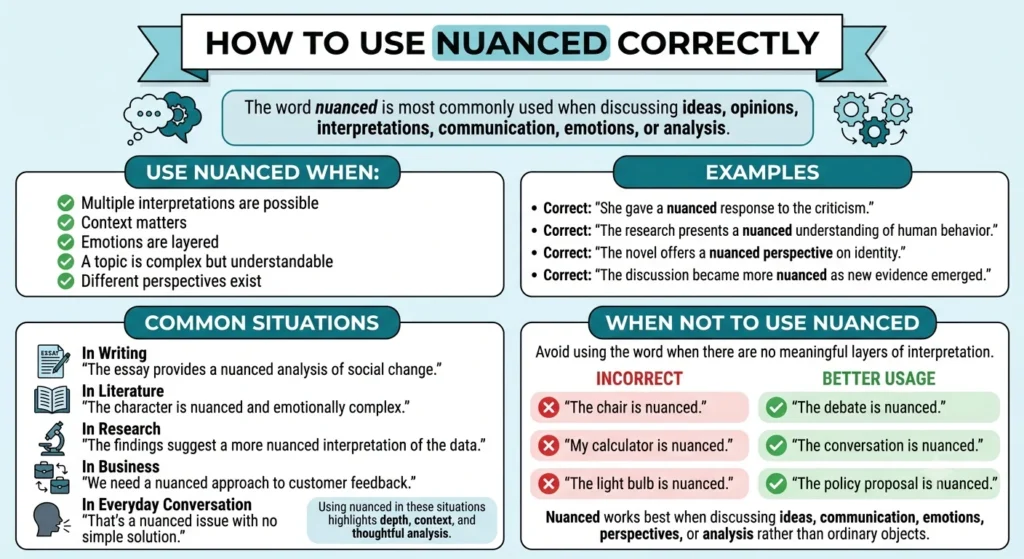
How to Use Nuanced Correctly
The word nuanced is most commonly used when discussing ideas, opinions, interpretations, communication, emotions, or analysis.
Use Nuanced When:
✅ Multiple interpretations are possible
✅ Context matters
✅ Emotions are layered
✅ A topic is complex but understandable
✅ Different perspectives exist
Examples
Correct:
“She gave a nuanced response to the criticism.”
Correct:
“The research presents a nuanced understanding of human behavior.”
Correct:
“The novel offers a nuanced perspective on identity.”
Correct:
“The discussion became more nuanced as new evidence emerged.”
When to Use the Word Nuanced
You should use the word nuanced when describing something that goes beyond a simple explanation.
Common Situations
In Writing
“The essay provides a nuanced analysis of social change.”
In Literature
“The character is nuanced and emotionally complex.”
In Research
“The findings suggest a more nuanced interpretation of the data.”
In Business
“We need a nuanced approach to customer feedback.”
In Everyday Conversation
“That’s a nuanced issue with no simple solution.”
Using nuanced in these situations highlights depth, context, and thoughtful analysis.
When NOT to Use the Word Nuanced
Not everything needs to be described as nuanced.
Avoid using the word when there are no meaningful layers of interpretation.
Incorrect Examples
❌ “The chair is nuanced.”
❌ “My calculator is nuanced.”
❌ “The light bulb is nuanced.”
Better Usage
✅ “The debate is nuanced.”
✅ “The conversation is nuanced.”
✅ “The policy proposal is nuanced.”
Nuanced works best when discussing ideas, communication, emotions, perspectives, or analysis rather than ordinary objects.
Common Mistakes and Misinterpretations
Mistake 1: Thinking Nuanced Means Confusing
Nuance does not mean confusion.
A nuanced idea can be clear while still acknowledging complexity.
Mistake 2: Assuming Every Complex Topic Is Nuanced
Some topics are merely complicated.
Nuance specifically refers to subtle distinctions and layered understanding.
Mistake 3: Ignoring Context
Context is one of the most important elements of nuance.
Without context, nuanced meanings are often misunderstood.
Mistake 4: Treating Nuance as Indecisiveness
A nuanced opinion is not the same as avoiding a conclusion.
It means reaching a conclusion after considering multiple factors.
Mistake 5: Overusing the Word
Not every situation requires the word nuanced.
Use it when genuine layers of interpretation exist.
Why Understanding Nuance Matters
In today’s world, information spreads quickly and opinions are often simplified into extremes.
Understanding nuance helps people:
- Communicate more effectively
- Interpret information accurately
- Improve critical thinking
- Avoid misunderstandings
- Analyze media more carefully
- Build stronger relationships
- Make better decisions
Whether in education, business, research, politics, or everyday conversations, the ability to recognize nuanced meaning is an important skill.
FAQs
What does nuanced mean in simple terms?
It means having subtle details or layers of meaning that go beyond the obvious interpretation.
What is a nuanced synonym?
Common synonyms include subtle, layered, refined, sophisticated, and multifaceted.
What is another word for nuance?
Subtlety, distinction, refinement, variation, and complexity are common alternatives.
What is a nuance in simple words?
A nuance is a small detail that changes how something is understood.
Is nuanced positive or negative?
Usually positive because it suggests thoughtful and balanced understanding.
What does being nuanced mean?
Being nuanced means considering context, complexity, and multiple perspectives before forming conclusions.
What is a nuanced perspective?
A viewpoint that recognizes different factors rather than reducing an issue to a simple answer.
What is nuanced thinking?
Nuanced thinking involves critical analysis, contextual understanding, and openness to multiple interpretations.
What is non-nuanced meaning?
A non-nuanced meaning ignores context and oversimplifies a situation.
Is nuanced the same as complex?
No. Complex refers to difficulty or many parts, while nuanced refers to subtle distinctions and interpretation.
Can a person be nuanced?
Yes. A nuanced person tends to think carefully and appreciate different perspectives.
Why is nuance important?
Nuance improves communication, understanding, and decision-making.
Can social media posts have nuanced meanings?
Yes. Tone, wording, emojis, and cultural references often create nuanced meanings.
How do you use nuanced in a sentence?
Example: “The documentary offers a nuanced perspective on modern society.”
What is culturally nuanced meaning?
It refers to meanings that are influenced by cultural context and social expectations.
What is emotionally nuanced meaning?
It refers to meanings that contain multiple emotional layers or mixed feelings.
Conclusion
The concept of nuanced meaning reminds us that communication is rarely limited to simple, surface-level interpretations. Words, actions, emotions, and ideas often contain subtle distinctions that can only be understood through context, perspective, and careful analysis.
Whether you’re reading literature, conducting research, interpreting legal language, communicating at work, or navigating personal relationships, understanding nuance allows you to think more critically and communicate more effectively.
By recognizing nuanced meanings, you become better equipped to understand people, analyze information, and appreciate the complexity that exists within language and human experience.

Willie Nelson is a skilled and passionate content writer working as an expert author at maeningg.com. With strong knowledge of digital trends, slang meanings, and engaging online content, Willie focuses on creating clear, helpful, and reader-friendly articles.