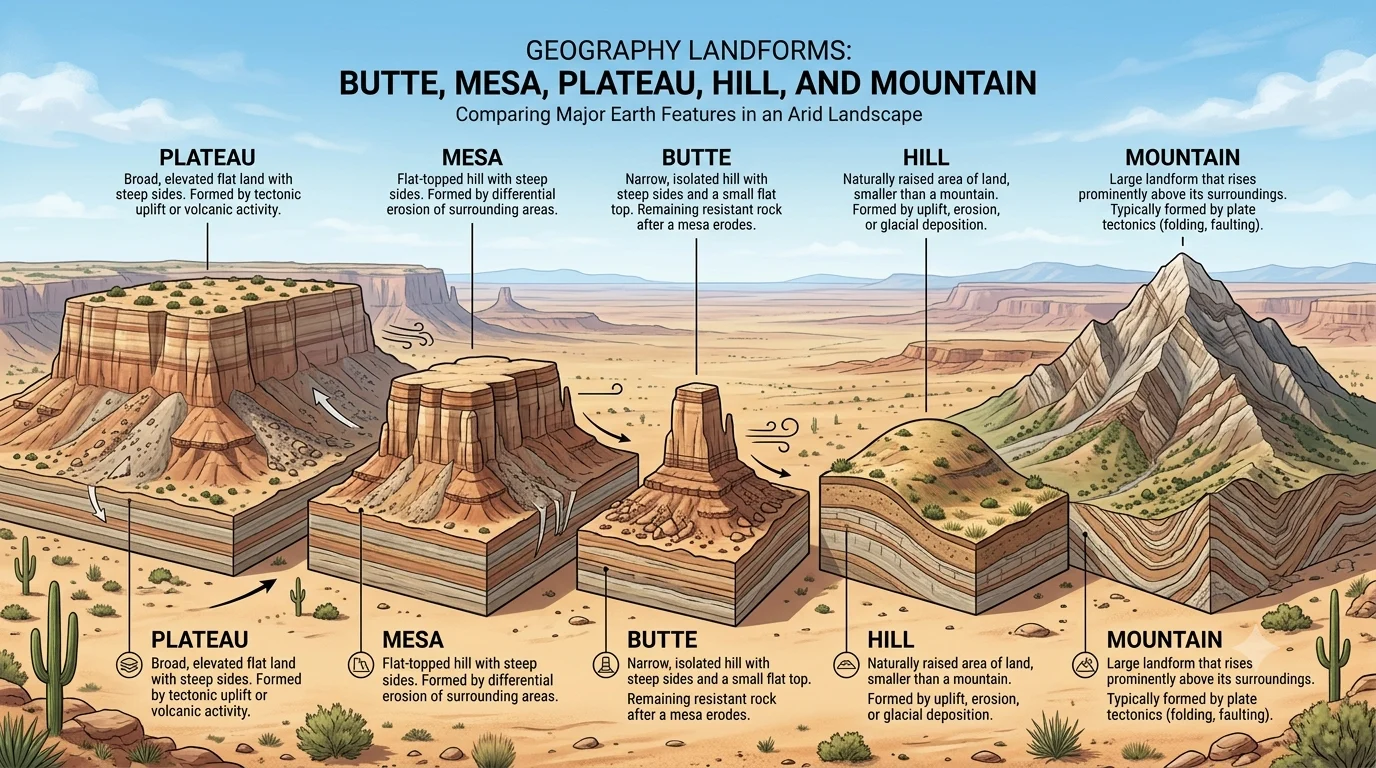
Have you come across the word “butte” in a geography lesson, travel guide, or documentary and wondered what it means? You’re not alone. Although the term is common in descriptions of famous landscapes, many people aren’t sure what makes a butte different from a mesa, plateau, or ordinary hill.
A butte is an isolated hill or mountain with steep sides and a small, flat top, usually formed over millions of years through erosion.
These striking landforms often rise dramatically above the surrounding terrain, making them some of the most recognizable features in desert and canyon landscapes.
Understanding what a butte is can help you make sense of geography, natural landmarks, and travel content. In this guide, you’ll learn the meaning of “butte,” how it forms, real-world examples, and the key differences between buttes, mesas, and plateaus.
What Does Butte Mean?
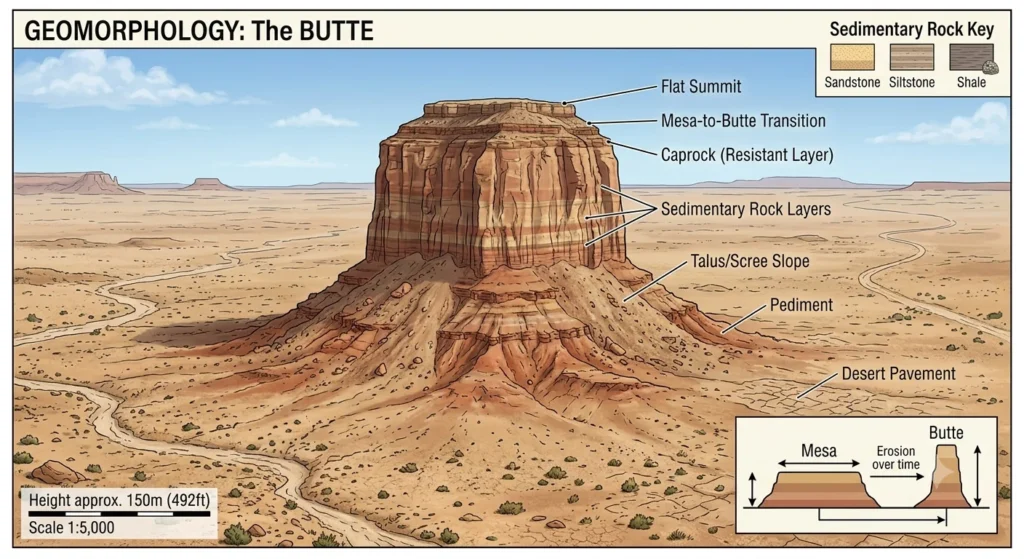
A butte is an isolated hill or rock formation with steep sides and a relatively flat top, formed over millions of years through erosion.
In simple terms, a butte is a natural rock structure that rises abruptly from the surrounding land and stands alone rather than being connected to a larger mountain range.
What Does Butte Mean in English?
The butte meaning in English refers to a steep-sided, isolated landform with a flat or nearly flat summit.
Unlike ordinary hills, buttes have dramatic cliffs and are usually created when softer surrounding rock erodes away while harder rock remains intact.
Key Characteristics of a Butte
A true butte usually has:
- A flat or nearly flat top
- Steep vertical sides
- An isolated position
- Resistant rock layers on top
- Evidence of long-term erosion
Because of these characteristics, buttes are among the most recognizable geological formations in arid regions.
Butte Pronunciation
One of the most common questions people ask is about butte pronunciation.
How Do You Pronounce Butte?
The correct pronunciation is:
/byoot/
It sounds similar to:
- cute
- mute
- beaut
Common Mispronunciations
Many people incorrectly pronounce butte as:
❌ Butt
❌ Boot
❌ But-ee
The correct pronunciation is:
✅ Byoot
Example Sentence
“The hikers climbed the butte before sunrise to enjoy panoramic views of the desert landscape.”
Learning the correct pronunciation helps avoid confusion, especially when discussing famous landmarks such as Monument Valley or Butte, Montana.
Butte Meaning in Geography
The butte meaning in geography refers to a specific type of erosional landform.
Geographers define a butte as an isolated rock formation with steep sides and a small flat summit that rises prominently above surrounding terrain.
Why Is a Butte Considered a Geological Formation?
A butte is classified as a geological formation because it develops through natural geological processes over millions of years.
These processes include:
- Wind erosion
- Water erosion
- Weathering
- Sediment deposition
- Differential erosion
The result is a striking landform that remains after surrounding softer rock has gradually disappeared.
Where Are Buttes Commonly Found?
Buttes are most common in:
- Arizona
- Utah
- New Mexico
- Montana
- Wyoming
- South Dakota
They are especially associated with the desert landscapes of the American West.
Why Are They Called Buttes?
Many readers ask:
Why Are They Called Buttes?
The term comes from the French word butte, which originally meant:
- Small hill
- Mound
- Raised earth
French explorers traveling across North America used the word to describe isolated hills and rock formations they encountered.
Over time, English-speaking settlers adopted the term, and it eventually became an official geological classification.
Today, geologists worldwide use the word to describe similar landforms.
Butte Meaning in French
Understanding the butte meaning in French helps explain the word’s modern usage.
In French, butte traditionally refers to:
- A mound
- A hill
- Raised ground
Although modern geology uses a more specific definition, the original French meaning still reflects the basic concept of elevated land.
What Does “La Butte” Mean?
The phrase La Butte Meaning simply translates to:
“The Hill” or “The Mound”
This phrase appears in various French place names and cultural references.
La Complainte de la Butte Meaning
Many people search for La Complainte de la Butte Meaning after hearing the famous French song from the film Amélie.
The title translates roughly to:
“The Ballad of the Hill”
In this context, “butte” refers to the elevated Montmartre district of Paris rather than a geological butte.
How Does a Butte Form?
The formation of a butte is one of the most fascinating examples of erosion in action.
Millions of years ago, many landscapes consisted of vast plateaus made up of different rock layers.
Over time:
- Rainwater cut channels into the rock.
- Wind carried away loose material.
- Rivers eroded softer layers.
- Weathering weakened exposed surfaces.
- Harder rock resisted erosion longer.
Eventually, large plateaus became mesas.
As erosion continued, mesas became smaller and narrower.
The remaining isolated formations became buttes.
Differential Erosion
The primary process responsible for butte formation is known as differential erosion.
This occurs when:
- Hard rock erodes slowly.
- Soft rock erodes quickly.
The harder caprock protects the summit while surrounding material disappears.
Why Do Buttes Have Flat Tops?
The flat summit represents a remnant of the original land surface that existed before extensive erosion occurred.
This preserved layer often consists of highly resistant sandstone, limestone, or volcanic rock.
Butte vs Mesa: What Is the Difference?
One of the most searched questions online is:
Butte vs Mesa
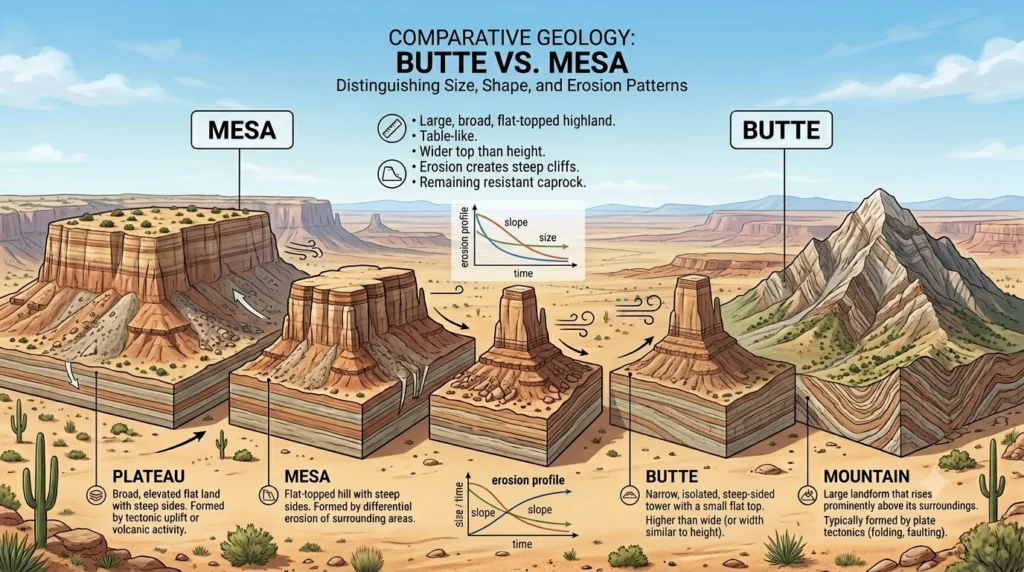
Although they look similar, they are not the same.
Quick Comparison
| Feature | Butte | Mesa |
|---|---|---|
| Size | Smaller | Larger |
| Top Surface | Narrow | Broad |
| Shape | Tall and isolated | Wide and expansive |
| Formation | Erosion | Erosion |
| Appearance | Steep and narrow | Broad and table-like |
Easy Way to Remember
Think of a mesa as the “parent” landform.
As erosion continues:
Plateau → Mesa → Butte
In other words, many buttes began as parts of larger mesas millions of years ago.
Which Is Bigger?
A mesa is significantly larger.
If the width of the top surface is greater than its height, geologists usually classify it as a mesa.
If the formation becomes narrower and more isolated, it is classified as a butte.
Why People Confuse Them
Both landforms have:
- Flat tops
- Steep sides
- Similar geological origins
However, size and isolation are the key differences.
This distinction is essential when studying desert landscapes and geological formations throughout the western United States.
What Does Nuanced Mean? The Tiny Detail Most People Miss
Famous Butte Examples Around the World
One of the best ways to understand the butte meaning is by looking at real-world examples. These landforms can be found in several countries, but they are most famous in North America.
West Mitten Butte
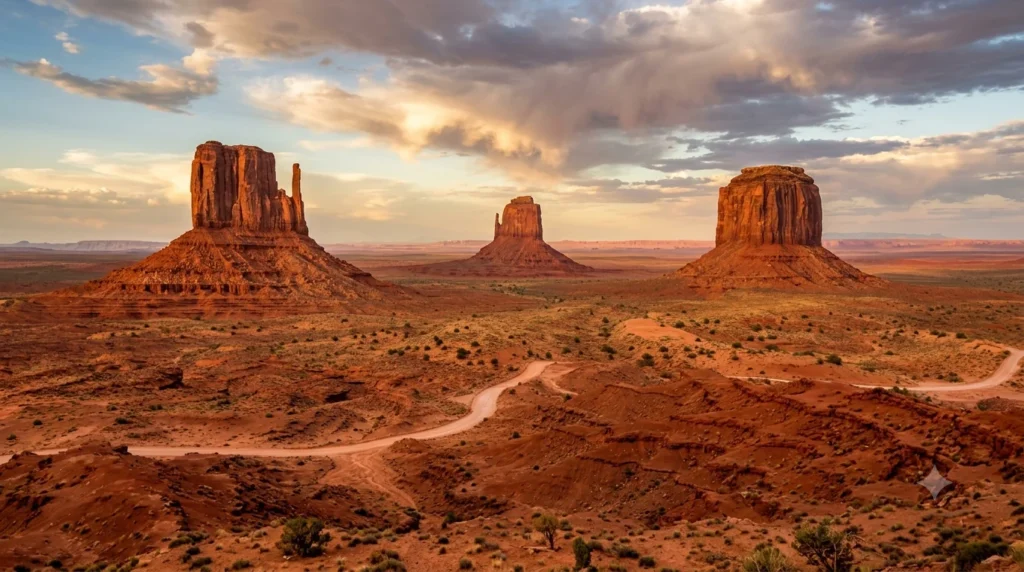
West Mitten Butte is one of the most recognizable rock formations in Monument Valley, located on the Arizona–Utah border. Its distinctive shape has appeared in countless photographs, movies, and travel guides.
Merrick Butte
Located near West Mitten Butte, this impressive formation is another classic example of a butte created through millions of years of erosion.
Red Butte Meaning
The term Red Butte generally refers to a butte composed of reddish rock layers or iron-rich sandstone. Several locations across the United States carry this name because of their distinctive red color.
Bald Butte Meaning
A Bald Butte typically refers to a butte with little or no vegetation on its summit. The word “bald” describes its bare appearance rather than a separate geological category.
Crested Butte Meaning
Many people search for Crested Butte Meaning because of the famous Colorado mountain town. The name comes from a nearby butte that features a distinctive crest-like shape at the top.
Today, Crested Butte is widely known for skiing, outdoor recreation, and mountain scenery.
Butte Meaning in USA
The butte meaning USA search query is common because buttes are strongly associated with American landscapes.
Across the western United States, buttes serve as important landmarks and tourist attractions. They are particularly common in:
- Arizona
- Utah
- New Mexico
- Colorado
- Montana
- Wyoming
- South Dakota
Many American towns, parks, and natural landmarks are named after nearby buttes.
Butte, Montana
One of the best-known examples is the city of Butte, Montana. The city received its name from a nearby isolated hill that early settlers described as a butte.
Today, the city is known for its mining history and cultural significance.
Butte Synonym and Related Terms
Many readers ask:
What Is a Synonym for Butte?
There is no perfect synonym because a butte has a very specific geological definition.
However, related words include:
- Hill
- Knoll
- Bluff
- Mesa
- Plateau
- Rock formation
- Promontory
- Ridge
While these terms share similarities, they should not be used interchangeably in scientific or geographical writing.
Butte vs Hill
A hill is generally rounded and less steep.
A butte is usually:
- More isolated
- Steeper
- Flat-topped
- Formed through erosion
Butte Meaning Slang
Another common search query is butte meaning slang.
In modern English, “butte” does not have a widely accepted slang meaning.
Most uses of the word refer to:
- Geography
- Geology
- Place names
- Travel discussions
If you encounter the term online, it is almost always referring to a landform rather than slang.
Butte Meaning Ship
Many users search for butte meaning ship or butte meaning boat.
Does Butte Have a Nautical Meaning?
No.
In standard maritime, naval, or boating terminology, “butte” is not a recognized technical term.
These searches often occur because:
- People confuse the spelling with another word.
- They encounter a place name associated with a harbor.
- They are looking for an unfamiliar historical term.
Butte Meaning Boat
Like “butte meaning ship,” this search usually results from spelling confusion rather than an actual nautical definition.
The accepted meaning of butte remains the geological landform described throughout this article.
C’est La Vie Meaning: What This Famous French Phrase Really Means
Interesting Facts About Buttes
Here are some fascinating facts that make buttes unique.
1. Most Buttes Were Once Part of Larger Landforms
Many buttes began as sections of plateaus or mesas before erosion separated them.
2. Some Buttes Are Millions of Years Old
The geological processes responsible for creating a butte often take millions of years.
3. Buttes Are Natural Landmarks
Because they rise dramatically above surrounding terrain, buttes have historically served as navigation points for travelers and explorers.
4. They Are Popular Photography Subjects
Their dramatic appearance makes them some of the most photographed landforms in the world.
5. They Help Scientists Understand Geological History
Rock layers exposed on buttes provide valuable clues about ancient environments and climate conditions.
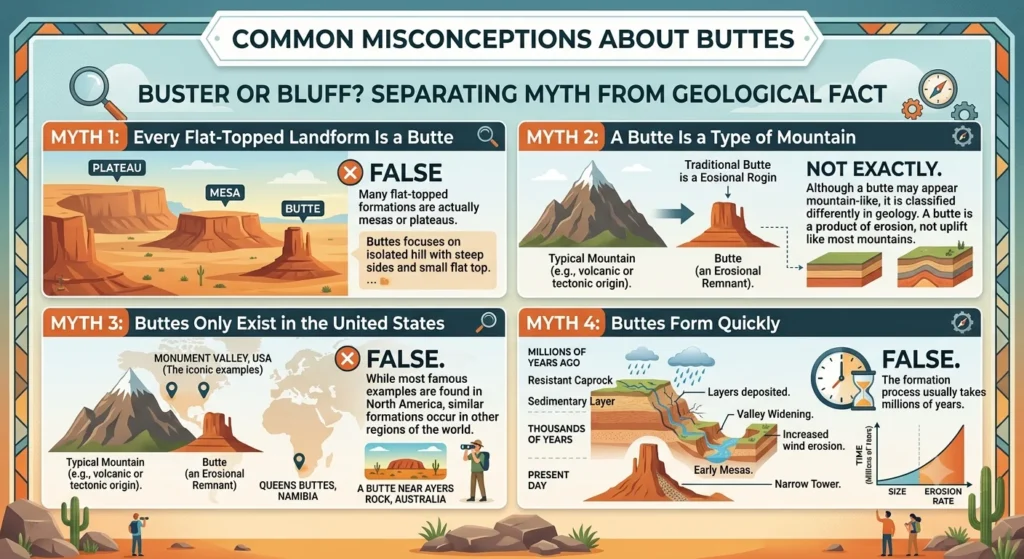
Common Misconceptions About Buttes
Myth 1: Every Flat-Topped Landform Is a Butte
False.
Many flat-topped formations are actually mesas or plateaus.
Myth 2: A Butte Is a Type of Mountain
Not exactly.
Although a butte may appear mountain-like, it is classified differently in geology.
Myth 3: Buttes Only Exist in the United States
False.
While most famous examples are found in North America, similar formations occur in other regions of the world.
Myth 4: Buttes Form Quickly
False.
The formation process usually takes millions of years.
Frequently Asked Questions
What does butte mean in geography?
A butte is an isolated, steep-sided rock formation with a relatively flat top that forms through erosion.
What does butte mean in English?
In English, a butte refers to a solitary hill or rock formation rising sharply above surrounding land.
How do you pronounce butte?
The correct pronunciation is “byoot.”
What is a synonym for butte?
Related terms include hill, bluff, mesa, and plateau, although none are exact synonyms.
Why are they called buttes?
The word comes from the French term “butte,” meaning a hill or mound.
What is the difference between a butte and a mesa?
A mesa is larger and wider, while a butte is smaller, narrower, and more isolated.
What causes a butte to form?
Wind, water, and weathering gradually erode softer rock layers, leaving harder rock standing.
Can a butte become smaller over time?
Yes. Continued erosion can eventually wear away even the resistant caprock.
Is Butte, Montana named after a butte?
Yes. The city was named after a nearby isolated hill.
What does Crested Butte mean?
The name refers to a butte with a crest-like appearance and is now associated with the Colorado town of Crested Butte.
Does butte have a slang meaning?
No widely recognized slang meaning exists.
Does butte mean ship or boat?
No. It is not an established maritime term.
Conclusion
Understanding the butte meaning goes beyond learning a simple definition. A butte is a remarkable geological formation that tells the story of erosion, time, and the natural forces that shape our planet.
From the famous landscapes of Monument Valley to the historic city of Butte, Montana, these isolated rock formations continue to capture the imagination of travelers, geologists, and photographers alike.
Whether you were searching for butte meaning in geography, butte pronunciation, butte meaning in French, butte vs mesa, or real-world butte examples, you now have a complete understanding of this fascinating landform and its place in both language and science.

Willie Nelson is a skilled and passionate content writer working as an expert author at maeningg.com. With strong knowledge of digital trends, slang meanings, and engaging online content, Willie focuses on creating clear, helpful, and reader-friendly articles.