
Have you ever heard someone described as “aloof” and wondered whether it meant they were shy, confident, unfriendly, or simply quiet? Aloof (pronounced uh-LOOF) is an adjective that describes someone who appears emotionally distant, reserved, detached, or not eager to engage with others.
Although the word often has a negative meaning, suggesting that someone seems cold or difficult to approach, it can also describe a person who is calm, independent, private, or emotionally composed. Whether “aloof” is considered positive or negative depends entirely on the context, the person’s behavior, and the speaker’s intention, which is why the word is frequently misunderstood.
In simple terms, aloof means keeping an emotional or social distance from other people. For example, a coworker who rarely joins conversations, a person on a first date who seems emotionally reserved, or a fictional character who avoids showing their feelings may all be described as aloof, even if they are simply quiet, focused, or naturally introverted. Because aloof describes how someone appears rather than who they truly are, different people may interpret the same behavior in different ways.
Whether you’ve seen aloof in books, movies, conversations, personality descriptions, workplace discussions, or social media, this guide explains its meaning, pronunciation, origin, synonyms, real-life examples, and how to tell from the context whether the word is being used positively, neutrally, or negatively, so you can understand and use aloof naturally and confidently in any situation.
What Does “Aloof” Mean?
Aloof is an adjective used to describe someone who is emotionally or socially distant. It refers to a person who does not easily express feelings, avoids too much interaction, or keeps a certain emotional distance from others.
Simple Definition
Aloof means emotionally distant, reserved, or not openly friendly.
But this definition is only part of the story. In real usage, the word is more about behavioral distance, not emotional absence.
Important Understanding
An aloof person:
- May still care deeply about others
- May simply express emotions privately
- May prefer observation over participation
- May take time to trust people
So, being aloof is not always negative. It depends on context and tone.

Pronunciation and Word Details
Understanding pronunciation helps you use the word confidently in speech.
- Word: Aloof
- Pronunciation: uh-LOOF
- IPA: /əˈluːf/
- Part of Speech: Adjective
Word Forms
| Form | Type | Meaning |
|---|---|---|
| Aloof | Adjective | Emotionally distant |
| Aloofness | Noun | Quality of being distant |
| Aloofly | Adverb | In a reserved manner |
Origin of the Word “Aloof”
The history of aloof is surprising because it did not originally describe personality at all.
The word comes from an old nautical expression influenced by Dutch language. Sailors used a term meaning “to keep to the windward side,” which essentially meant to stay away from danger or distance a ship from something risky.
Over time, this physical idea of “keeping distance” slowly turned into a metaphor for human behavior.
Meaning Shift Over Time
- Originally: A sailing/navigation instruction
- Later: Physical distance from something
- Modern use: Emotional or social distance from people
This evolution is why the word still carries the idea of distance, even in emotional contexts today.
Aloof Meaning in Simple Everyday English
In modern English, the word is commonly used in these situations:
- Describing personality
- Talking about behavior in social groups
- Explaining emotional communication style
- Describing characters in books or movies
Natural Examples
- She stayed aloof during the meeting and didn’t join the discussion.
- He seems aloof, but he’s actually very thoughtful.
- The new student appeared aloof on the first day.
Notice something important: in all these cases, the word describes how someone appears, not necessarily how they feel inside.
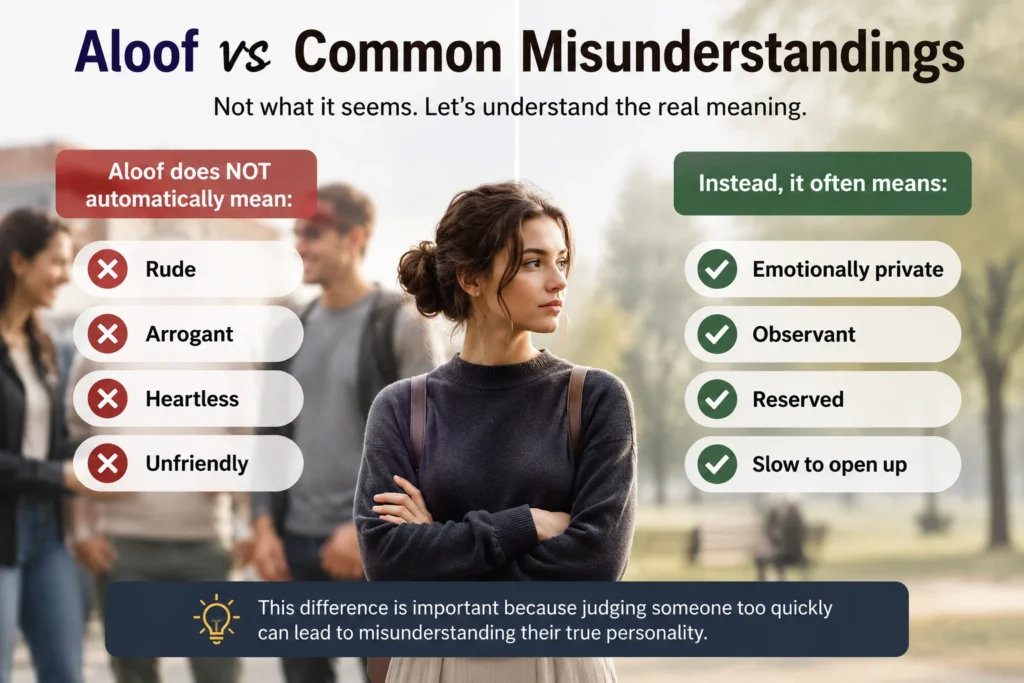
Aloof vs Common Misunderstandings
Many people misunderstand this word. Let’s clear that up early.
Aloof does NOT automatically mean:
- ❌ Rude
- ❌ Arrogant
- ❌ Heartless
- ❌ Unfriendly
Instead, it often means:
- ✔ Emotionally private
- ✔ Observant
- ✔ Reserved
- ✔ Slow to open up
This difference is important because judging someone as “unfriendly” just because they are quiet is often incorrect.
First Impressions vs Reality
A key reason the word aloof is often misunderstood is because of first impressions.
A person who doesn’t talk much in a new environment may seem distant. But over time, the same person may turn out to be warm, funny, and deeply caring.
This is why aloofness is better understood as:
A communication style, not a character judgment.
People often reveal their true personality only after they feel safe and comfortable.
Aloof in Modern Language Use
Today, the word is used in many different contexts:
- Everyday conversation
- Workplace communication
- Literature and storytelling
- Social media personality descriptions
- Psychology discussions
It can even appear in a positive sense, such as describing someone who is calm, independent, and emotionally stable.
What We Now Understand
At this stage, we can clearly say:
- Aloof = emotionally or socially distant behavior
- It does not automatically indicate negativity
- It is often misunderstood in social situations
- It is closely related to personality and comfort level
Aloof vs Shy vs Introverted vs Reserved
One of the biggest reasons people get confused about the word aloof is because it is often mixed up with similar personality terms. While they may look similar on the surface, they actually describe very different behaviors.
1. Aloof vs Shy
A shy person usually wants to interact but feels nervous, anxious, or uncomfortable in social situations. Their silence comes from fear or hesitation.
An aloof person, on the other hand, is not necessarily afraid. They simply appear emotionally distant or prefer to stay reserved in social interaction.
Simple difference:
- Shy = wants interaction but feels nervous
- Aloof = appears distant or emotionally reserved
2. Aloof vs Introverted
An introvert prefers solitude because it helps them recharge energy. It is a personality type, not emotional distance.
An aloof person may or may not be introverted. Aloofness is more about how someone appears, not how they recharge.
3. Aloof vs Reserved
A reserved person is private and calm but still warm and approachable once you get to know them.
Reserved = socially controlled but friendly
Aloof = emotionally distant or harder to read
Reserved is usually more positive in tone than aloof.
What Does OOTD Mean? The Fashion Trend Everyone’s Posting ⭐
Why Do People Seem Aloof?
There is no single reason why someone may appear aloof. Human behavior is complex, and emotional expression varies from person to person.
Here are some common reasons:
1. Personality Style
Some people are naturally quiet and observant. They prefer listening instead of talking and do not feel the need to express everything openly.
2. Emotional Boundaries
Some individuals protect their emotions by keeping distance until they fully trust someone.
3. Overthinking or Awareness
Highly analytical people may appear aloof because they are focused on observing rather than reacting.
4. Social Comfort Level
In unfamiliar environments, many people appear distant until they feel safe.
5. Life Experience
Past emotional experiences can make people more careful about opening up.
Aloof Personality Traits
An aloof personality is not about being “bad” or “good”—it is simply a pattern of behavior.
Common traits include:
- Calm and composed behavior
- Limited emotional expression
- Preference for observation over participation
- Strong sense of personal space
- Slow emotional opening
- Independent mindset
- Low need for social validation
These traits can be positive or negative depending on context.
For example:
- In leadership, aloofness may look like confidence and control
- In relationships, it may feel like emotional distance
Aloof Meaning in Psychology
In psychology, aloofness is not a disorder. It is considered a behavioral style related to emotional expression and social interaction.
Psychologists may associate aloof behavior with:
- Emotional self-control
- Introversion (in some cases)
- Attachment styles (such as avoidant tendencies)
- Personal boundaries
However, it is important not to label someone too quickly. A person who appears aloof may still have deep emotional connections—they just express them differently.
Emotional Aloof Meaning
When someone is described as emotionally aloof, it means they:
- Do not openly express feelings
- Keep emotional distance in relationships
- Prefer internal processing over verbal sharing
- May struggle with emotional expression
But this does not always mean lack of emotion. In many cases, emotions exist internally but are not openly shown.
Socially Aloof Meaning
A socially aloof person tends to remain distant in group settings.
They may:
- Avoid unnecessary social interaction
- Prefer small groups over large gatherings
- Observe conversations instead of joining quickly
- Speak only when necessary
This behavior is often mistaken for arrogance, but it is usually just a comfort preference.
What Does ICYMI Mean? Text, Social Media & More
Acting Aloof Meaning
Acting aloof means deliberately behaving in a distant or reserved way.
People may do this to:
- Appear confident
- Hide nervousness
- Maintain mystery
- Protect emotional vulnerability
- Avoid appearing too eager
However, acting aloof can sometimes create misunderstandings in relationships if it is misinterpreted as disinterest.
Is Being Aloof a Personality Trait?
Yes, in many cases aloofness can be part of a personality style. However, it is not fixed or permanent.
A person may be:
- Aloof in new environments
- Warm with close friends
- Reserved at work
- Open in comfortable settings
This shows that aloofness often depends on context rather than identity.
Is Being Aloof Attractive?
In modern social perception, aloofness is sometimes seen as attractive because it can signal:
- Confidence
- Independence
- Emotional control
- Mystery
However, balance is important. Healthy relationships usually require emotional openness. Too much distance can create misunderstanding or emotional disconnect.
Real-Life Understanding of Aloof Behavior
To truly understand the word, it helps to see how it appears in real life.
- A coworker who rarely joins office gossip may seem aloof
- A student who listens quietly in class may seem aloof
- A new friend who takes time to open up may seem aloof
- A partner who expresses love through actions instead of words may seem aloof
In many cases, first impressions are misleading.
Key Insight of This Section
Aloofness is not a fixed label—it is a behavioral impression shaped by communication style, personality, and comfort level.
Understanding this helps avoid misjudging people based on surface-level behavior
Aloof Meaning in Relationships
In relationships, the word aloof is often used when someone appears emotionally distant or less expressive. However, this does not always mean lack of love or interest.

An aloof partner may:
- Not express feelings verbally very often
- Prefer showing care through actions instead of words
- Need personal space even in close relationships
- Take time to open up emotionally
- Avoid overly emotional conversations
Important Understanding
Being aloof in a relationship is not always negative. Some people are naturally private and express affection in quieter ways.
For example, a person may not say “I miss you” often but will consistently show support, loyalty, and presence. Their love is real—it is just not loud.
Aloof Meaning in Texting
In modern digital communication, especially WhatsApp, Instagram, or Snapchat, someone may seem aloof if they:
- Reply with short messages
- Take time to respond
- Avoid deep conversations over text
- Don’t use many emojis or emotional expressions
- Rarely initiate chats
Example
“Don’t take it personally, he just texts in an aloof way. He’s much more expressive in person.”
👉 Important point: texting style is not always a reflection of personality. Many people appear aloof online but are very open in real life.

Aloof Meaning on Social Media
On platforms like TikTok or Instagram, aloof is sometimes used in a different, more aesthetic way.
It can describe someone who appears:
- Calm and unbothered
- Emotionally controlled
- Mysterious or hard to read
- Independent and confident
In this context, aloofness is often seen as a “vibe” or personality aesthetic, not a negative trait.
Aloof Meaning for Dogs
In animal behavior, especially in dog breed descriptions, aloof has a very specific meaning.
An aloof dog:
- Does not immediately trust strangers
- Observes before interacting
- Stays close to its owner or family
- Remains calm but cautious in new environments
👉 Important: Aloof does NOT mean aggressive.
It simply means the dog is selective, confident, and not overly social with unfamiliar people.

Aloof Meaning for Cats
Cats are often naturally described as aloof because of their independent behavior.
An aloof cat may:
- Choose when to receive affection
- Spend time alone comfortably
- Observe people before interacting
- Show affection in subtle ways
However, this does not mean cats are uncaring. Many cats form strong emotional bonds but express them differently from dogs or humans.
Synonyms of Aloof
Here are some common synonyms used depending on context:
- Reserved
- Distant
- Detached
- Withdrawn
- Self-contained
- Guarded
- Cool
- Unapproachable
- Standoffish (slightly negative tone)
Example
“He is reserved but not rude.”
“She seems distant but is actually kind.”
Antonyms (Opposite of Aloof)
- Friendly
- Warm
- Open
- Sociable
- Approachable
- Expressive
- Outgoing
- Affectionate
Common Mistakes About “Aloof”
❌ Mistake 1: Thinking aloof means rude
✔ Reality: Aloof people may simply be quiet or private.
❌ Mistake 2: Confusing aloof with shy
✔ Reality: Shyness comes from nervousness, aloofness from emotional distance.
❌ Mistake 3: Assuming aloof is always negative
✔ Reality: It can also suggest confidence, independence, or emotional control.
❌ Mistake 4: Judging too quickly
✔ Reality: Many people appear aloof at first but become warm later.
Simple Examples of Aloof in Sentences
- She remained aloof during the discussion and didn’t comment.
- He may seem aloof, but he is very caring once you know him.
- The teacher appeared aloof but was actually very supportive.
- My cat behaves aloof but follows me everywhere at home.
- The manager keeps an aloof attitude in meetings but listens carefully.
Frequently Asked Questions
1. What does aloof mean in simple words?
Aloof means emotionally or socially distant. It describes someone who does not openly express feelings or interact much, but it does not always mean they are unfriendly.
2. Does aloof mean shy?
No. Shy means nervous in social situations, while aloof means emotionally reserved or distant.
3. Is aloof a bad word?
Not always. It can be neutral or even positive depending on context. It only sounds negative when it implies coldness.
4. What is the synonym of aloof?
Reserved, distant, detached, and guarded are common synonyms.
5. What is the opposite of aloof?
Friendly, warm, sociable, and outgoing are opposites.
6. Can a person act aloof intentionally?
Yes. Some people act aloof to appear confident, protect emotions, or maintain mystery.
7. Why do people seem aloof?
Because of personality style, emotional boundaries, past experiences, or comfort level in social situations.
8. Is aloof the same as introvert?
No. Introversion is a personality type, while aloofness is a communication or behavior style.
9. Can animals be aloof?
Yes. Dogs and cats are often described as aloof when they are reserved or independent.
10. How do you pronounce aloof?
It is pronounced as uh-LOOF (/əˈluːf/).
Conclusion
Understanding the word aloof helps us see people more clearly and judge less quickly. While it often describes emotional distance, it does not automatically mean someone is cold, rude, or unfriendly.
In reality, aloof behavior is usually a reflection of personality, comfort level, or communication style. Some people are naturally expressive, while others are more reserved and observant.
The key takeaway is simple: aloofness is about distance in expression, not distance in heart. Once you understand this, you’ll be able to interpret behavior more accurately in relationships, conversations, workplaces, and everyday life.

Dolly Parton is a professional content writer at maeningg.com, specializing in clear, engaging, and well-researched digital content. With strong expertise in writing about text slang, meanings, lifestyle, and informative articles, Dolly focuses on helping readers understand internet language in a simple and relatable way.