
You might not realize it, but one small word—“concur”—can instantly make someone sound more formal, precise, and even more authoritative in writing. Yet most people see it and think: what does that even mean?
Concur means to agree with someone or share the same opinion. It is a formal way of saying “agree,” often used in professional, academic, or official communication.
Here’s the interesting part: while most people casually say “I agree,” words like concur appear in emails, reports, meetings, and legal or academic writing where tone matters. For example, instead of “I agree with you,” someone might say “I concur with your point.”
In this guide, you’ll learn what concur means, how it’s used in real sentences, and simple examples that make it easy to understand and remember.
🧠 What Does Concur Mean?
✔ Simple Definition:
Concur means to agree with someone or share the same opinion, especially after careful thought.
✔ One-line meaning:
👉 Concur = Agree formally
✔ Example:
“I concur with your analysis of the report.”
👉 Meaning: I agree after reviewing it carefully.
💬 What Does “I Concur” Mean?
The phrase “I concur” is a formal expression used to show agreement in a professional or respectful way.
✔ It means:
👉 “I agree with you.”
But the difference is tone:
- “I agree” = casual
- “I concur” = formal / professional / precise
📌 Real-world usage:
✔ Business meetings
✔ Board discussions
✔ Academic debates
✔ Legal communication
✔ Formal emails
✔ Examples:
Business:
“The proposal is acceptable.”
“I concur.”
Academic:
“The findings are accurate.”
“I concur with the research.”
Professional email:
“I have reviewed the document and I concur with the recommendations.”
🗣️ Concur Pronunciation
👉 Pronunciation: kuhn-KUR
👉 IPA: /kənˈkɜːr/
Breakdown:
- con = kuhn
- cur = kur (stressed)
👉 Stress always on second syllable: CUR

📜 Origin of Concur
The word concur comes from Latin:
👉 concurrere
Meaning:
- con = together
- currere = to run
👉 Original meaning:
“to run together” → later evolved into “to agree together”
Historical use:
- Entered English in 15th century
- Used in law, philosophy, and academic texts
- Now common in formal communication
🏢 Concur Meaning in Business
In business communication, concur is used for formal agreement on decisions or strategies.
✔ Example:
“All managers concurred on the new marketing strategy.”
✔ What it means:
👉 Everyone agreed after discussion and evaluation
✔ Why it is used:
- Professional tone
- Formal decision-making
- Clear consensus expression
⚖️ Concur Meaning in Law
In legal systems, concur means when a judge agrees with a ruling or opinion.
✔ Example:
“The judge concurred with the majority decision.”
✔ Meaning:
👉 The judge supports the final verdict
📌 Legal importance:
- Shows agreement among judges
- Strengthens judgment validity
- Used in appellate court decisions
What Does TFW Mean in Text, Memes, and Social Media?

🖥️ SAP Concur Meaning
⚠️ Important: This is NOT the verb meaning.
SAP Concur is a business software platform used for managing:
- Travel bookings
- Expense reports
- Invoice processing
- Reimbursements
✔ Example:
“Our company uses SAP Concur for expense tracking.”
✔ Benefit:
- Automates financial workflow
- Reduces manual errors
- Saves time in reporting
🔁 Concur Synonyms & Antonyms
✔ Synonyms:
- Agree
- Approve
- Consent
- Endorse
- Support
- Accept
- Acknowledge
❌ Antonyms:
- Disagree
- Oppose
- Reject
- Deny
- Refuse
⚖️ Concur vs Agree
| Feature | Agree | Concur |
|---|---|---|
| Tone | Casual | Formal |
| Usage | Daily speech | Professional/legal |
| Depth | Simple opinion | Thoughtful agreement |
| Context | General | Formal environments |
👉 Insight:
“Concur” is used when agreement is carefully considered or officially stated.

❓ Do You Concur Meaning
👉 Means:
Do you agree with this?
✔ Example:
“Do you concur with the decision?”
Used in:
- meetings
- legal discussions
- formal communication
🤝 We Concur Meaning
👉 Means:
A group agrees together
✔ Example:
“We concur that the plan should proceed.”
What Does BCE Mean? The Difference From BC Explained
💯 I Fully Concur Meaning
👉 Means:
Complete agreement without doubt
✔ Example:
“I fully concur with your statement.”
📌 Motion to Concur Meaning
A motion to concur is a formal proposal used in legislative or committee systems.
✔ Meaning:
👉 A motion to approve or agree with a decision
✔ Example:
“The motion to concur was passed unanimously.”
Used in:
- Parliament
- Committees
- Legal bodies
🌍 Concur Meaning in Different Languages
- French: Être d’accord
- Farsi: موافقت کردن
- Chinese: 同意
- Nepali: सहमत हुनु
- Malayalam: സമ്മതിക്കുക
- Kannada: ಒಪ್ಪಿಕೊಳ್ಳುವುದು
- Gujarati: સંમત થવું
- Hindi: सहमत होना
💬 Real-Life Usage Scenarios
Business Email:
“I have reviewed the proposal and I concur with the strategy.”
Meeting:
“All team members concurred on the deadline extension.”
Academic:
“The researchers concur with the hypothesis.”
Legal:
“The judges concurred with the ruling.”
⚠️ Common Mistakes
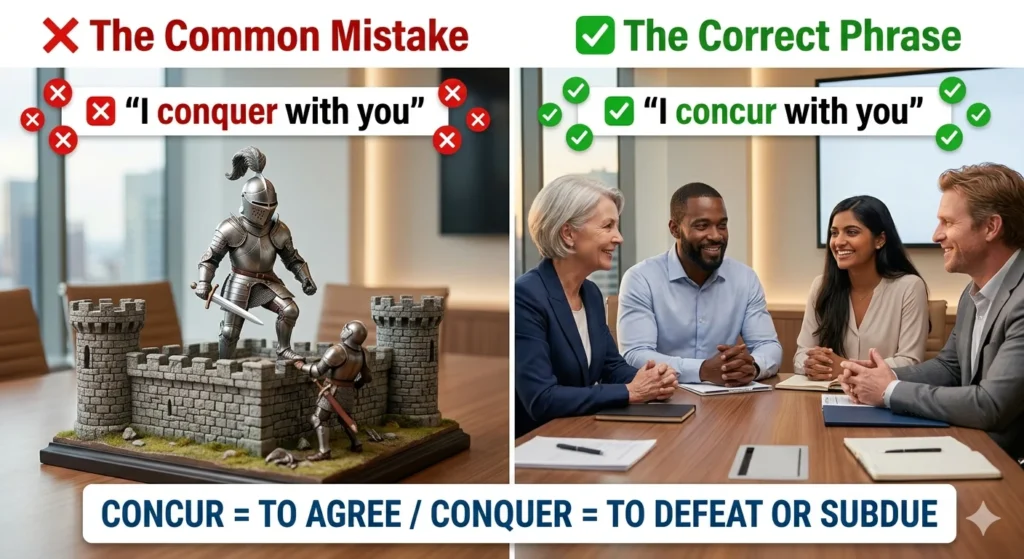
❌ I conquer with you
✔ I concur with you
👉 Difference:
- Concur = agree
- Conquer = defeat
❓ FAQs
1. What does concur mean in simple words?
It means to agree with someone.
2. Is concur formal?
Yes, it is formal.
3. What is synonym of concur?
Agree, consent, approve.
4. What does concur mean in law?
A judge agreeing with a decision.
5. What is SAP Concur?
Expense and travel management software.
6. What is opposite of concur?
Disagree or oppose.
7. What does “do you concur” mean?
It means “Do you agree?”
🏁 Final Conclusion
The word concur is a formal English verb that means to agree or share the same opinion after consideration. It is commonly used in business communication, legal systems, academic writing, and professional discussions.
While “agree” is used in everyday language, concur is preferred in formal environments where precision and professionalism matter.
👉 So when someone says “I concur”, it simply means:
“I agree with you after careful thought.”

Willie Nelson is a skilled and passionate content writer working as an expert author at maeningg.com. With strong knowledge of digital trends, slang meanings, and engaging online content, Willie focuses on creating clear, helpful, and reader-friendly articles.