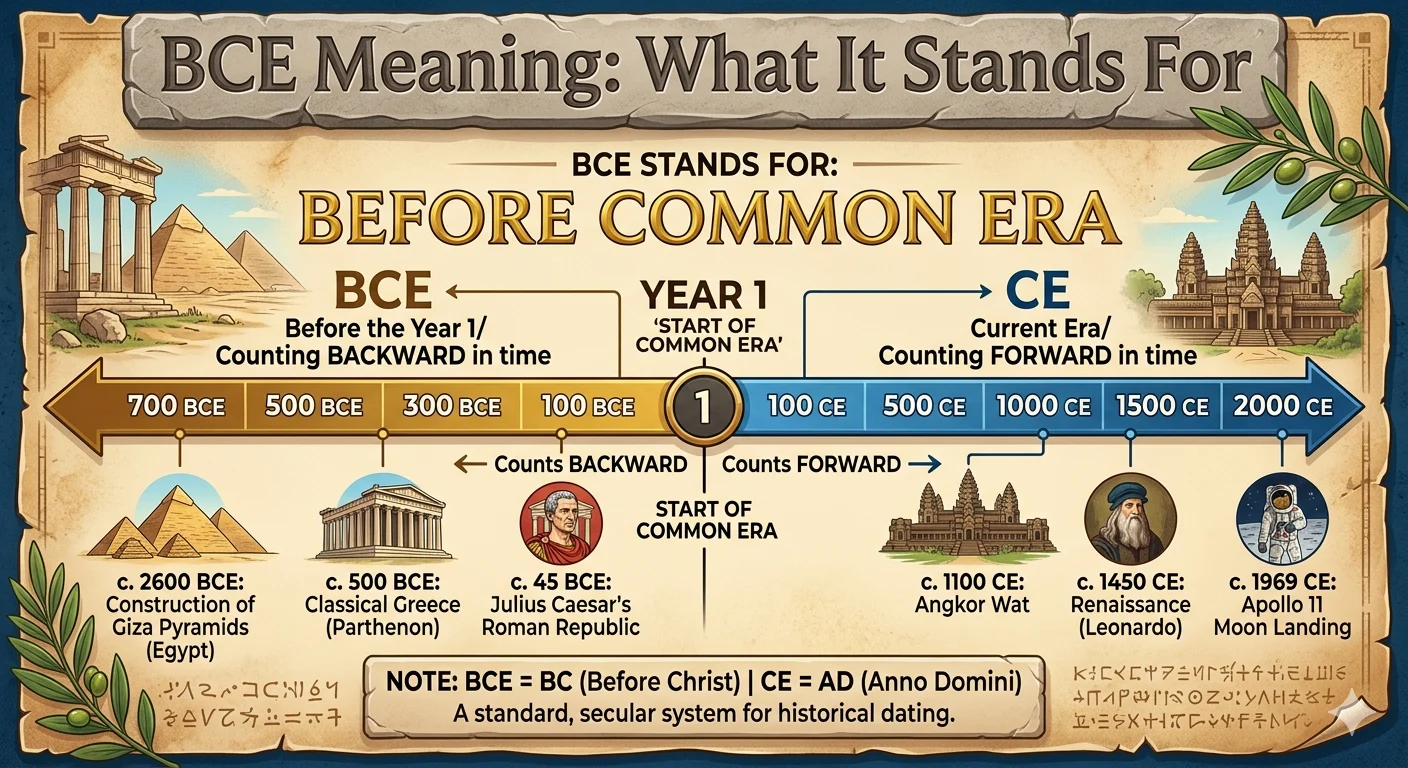
500 BCE and 500 BC are the exact same year—yet many people assume they mean different things. If you’ve seen BCE in a history book, museum, documentary, or classroom and wondered why it’s used instead of BC, you’re not alone. The dates haven’t changed; only the labels have.
BCE stands for “Before Common Era.” It refers to the years before year 1 and is equivalent to BC (Before Christ). Although the names are different, both systems use the exact same timeline.
For example, 500 BCE and 500 BC refer to the same year in history. The distinction is purely one of terminology. Today, many historians, educators, and academic institutions use BCE and CE (Common Era) because they are considered more religiously neutral while preserving the traditional dating system.
In this guide, you’ll learn what BCE means, how it compares to BC, why it’s used, and how to read BCE dates correctly.
What Does BCE Mean?
Definition of BCE
BCE stands for Before Common Era.
It is part of a historical dating system used to organize events in chronological order before year 1 of the Common Era calendar.
Historians, archaeologists, researchers, and educators use BCE when discussing ancient civilizations, historical records, archaeological discoveries, and major events in world history.
Featured Snippet Answer
What does BCE stand for?
BCE stands for Before Common Era, a secular alternative to BC (Before Christ) used to identify years before year 1 in the modern calendar system.
Why Is BCE Important?
The BCE dating system helps historians:
- Organize historical timelines
- Record ancient events accurately
- Compare civilizations across regions
- Create consistent historical chronology
- Communicate dates using internationally accepted terminology
Without a standardized dating system, studying world history and ancient civilizations would be much more difficult.
Examples of BCE Dates
Here are some common examples:
| Historical Event | Approximate Date |
|---|---|
| Great Pyramid of Giza | 2560 BCE |
| Code of Hammurabi | 1750 BCE |
| Traditional Era of Abraham | Around 2000 BCE |
| Founding of Rome | 753 BCE |
| Death of Julius Caesar | 44 BCE |
These dates all occurred before year 1 CE and are therefore written using BCE.
BCE Meaning in English
If you’re searching for BCE meaning in English, the full form is:
Before Common Era
In simple terms:
- BCE = Before Common Era
- CE = Common Era
The phrase is used to describe years that occurred before the start of the Common Era calendar.
For example:
- Ancient Greece flourished around 500 BCE.
- The Great Pyramid was completed around 2560 BCE.
- Alexander the Great was born in 356 BCE.
The term has become increasingly common in textbooks, academic journals, museums, and educational resources worldwide because it is considered neutral and inclusive.
Quick FAQ
Is BCE the same as BC?
Yes. BCE and BC refer to the same years in history. The only difference is terminology. BCE is a secular term, while BC has Christian origins.
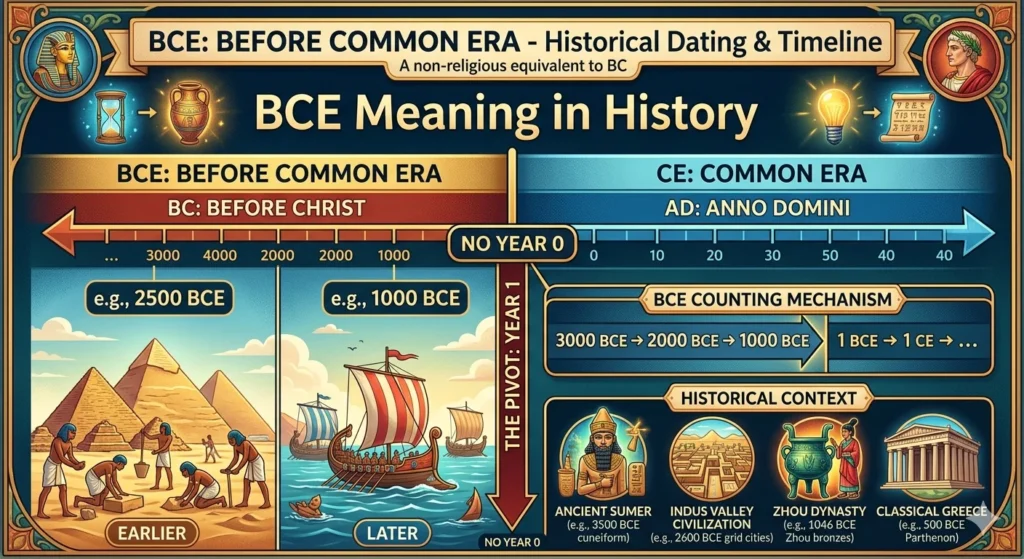
BCE Meaning in History
The BCE meaning in history goes beyond a simple abbreviation. It forms part of the global historical dating system used to place events in chronological order.
Historians study thousands of years of human development, including:
- Ancient Egypt
- Mesopotamia
- Ancient China
- Ancient India
- Ancient Greece
- Ancient Rome
- Early biblical civilizations
Because these events occurred before year 1, BCE provides a consistent way to record and compare dates.
Why Historians Prefer BCE
Many modern historians use BCE because:
- It promotes cultural neutrality.
- It is widely accepted internationally.
- It supports academic consistency.
- It works across different religious and cultural backgrounds.
- It aligns with modern educational standards.
Today, BCE and CE are commonly found in:
- University textbooks
- Museum exhibits
- Archaeological publications
- Historical databases
- Educational websites
- Academic research papers
As a result, students studying world history are more likely to encounter BCE than BC.
AD and BCE Meaning Explained
One of the most common questions people ask is: What is the difference between AD and BCE?
The answer is simple.
AD and BCE belong to two different parts of the same historical dating system.
- BCE (Before Common Era) refers to years before year 1.
- AD (Anno Domini) refers to years after year 1.
AD and BCE Meaning Table
| Term | Full Form | Time Period |
|---|---|---|
| BCE | Before Common Era | Before Year 1 |
| CE | Common Era | After Year 1 |
| BC | Before Christ | Before Year 1 |
| AD | Anno Domini | After Year 1 |
For example:
- 500 BCE = 500 years before year 1
- AD 500 = 500 years after year 1
Although BCE and AD are sometimes discussed together, modern academic writing typically pairs BCE with CE rather than AD.
CE and BCE Meaning
The CE and BCE meaning system is now widely used in schools, universities, museums, and academic publications.
What Does CE Mean?
CE stands for Common Era.
It refers to all years after year 1.
Examples:
- 1066 CE
- 1492 CE
- 2027 CE
What Does BCE Mean?
BCE stands for Before Common Era.
It refers to all years before year 1.
Examples:
- 44 BCE
- 500 BCE
- 2000 BCE
Together, BCE and CE create a complete historical timeline used across much of the world today.
What Does Mhm Mean in Text, Chat, and Social Media?
Anno Domini Meaning
Many readers searching for Anno Domini meaning are surprised to learn that it is a Latin phrase.
What Does Anno Domini Mean?
Anno Domini means:
“In the Year of Our Lord.”
Historically, it was used to identify years after the estimated birth of Jesus Christ.
For example:
- AD 100
- AD 476
- AD 2027
Modern historians often use CE (Common Era) instead of AD because CE is considered more neutral in international and academic contexts.
AD vs CE
| AD | CE |
|---|---|
| Anno Domini | Common Era |
| Traditional Christian term | Modern secular term |
| Same years | Same years |
For example:
- AD 2027 = 2027 CE
- AD 500 = 500 CE
The year remains identical. Only the label changes.
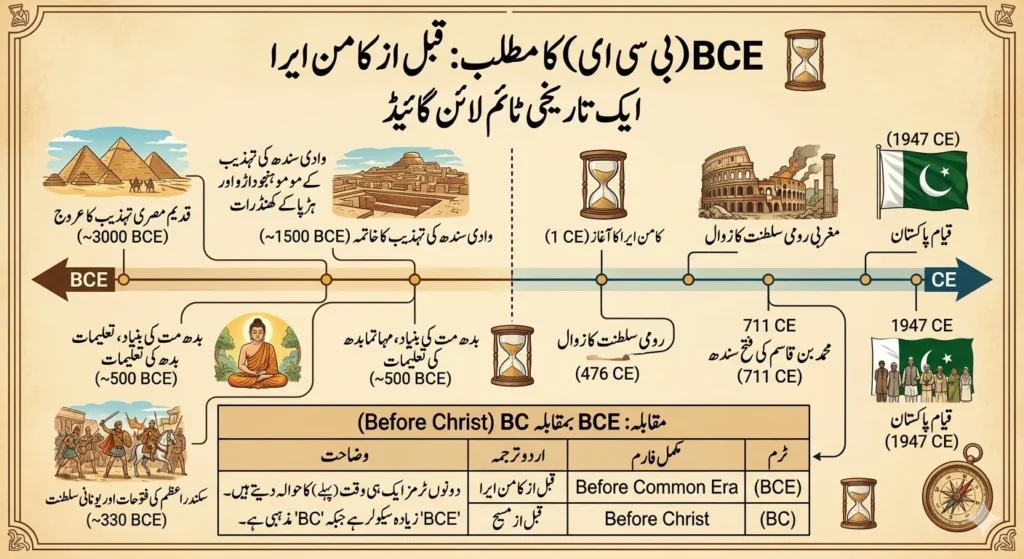
BCE Meaning in Urdu
If you’re looking for BCE meaning in Urdu, it can be understood as:
“مشترکہ دور سے پہلے”
or
“عام دور سے پہلے”
In simple Urdu, BCE refers to all years that occurred before year 1 in the historical calendar.
Example
- 500 BCE = مشترکہ دور سے 500 سال پہلے
- 2000 BCE = مشترکہ دور سے 2000 سال پہلے
Urdu history books may sometimes use BC, while modern educational resources increasingly use BCE.
BCE Meaning in the Bible
A common search query is “BCE meaning in Bible” or “BCE meaning biblical studies.”
The term BCE itself does not come from the Bible.
Instead, it is a modern academic label used by historians, theologians, and researchers when discussing events that occurred before year 1.
BCE Meaning in Biblical Context
Examples often include:
- Abraham (around 2000 BCE)
- Moses (traditionally associated with the 2nd millennium BCE)
- King David (around 1000 BCE)
- Babylonian Exile (586 BCE)
The historical events remain the same whether someone uses BC or BCE.
Only the terminology changes.
Is BCE Anti-Religious?
No.
Many people mistakenly believe BCE was created to oppose religion.
In reality, BCE is simply a neutral dating term designed for international and academic communication.
Many Christian scholars, universities, and biblical researchers also use BCE and CE.
Apateu Meaning: Everything You Need to Know
Was Jesus Born in BCE or CE?
This is one of the most frequently searched questions online.
Short Answer
Most historians believe Jesus was likely born between 6 BCE and 4 BCE.
Why?
The calendar system used today was created centuries after Jesus lived.
Historical evidence suggests the estimated birth year may have been slightly earlier than originally calculated.
As a result, many scholars conclude that Jesus was probably born during the BCE period rather than CE.
This does not change Christian beliefs; it simply reflects modern historical research.
What Does 2027 CE Mean?
Many students ask:
What does 2027 CE mean?
The answer is straightforward.
2027 CE means the year 2027 in the Common Era calendar.
It is exactly the same year as:
AD 2027
Examples:
- 2025 CE
- 2026 CE
- 2027 CE
All refer to years within the Common Era.
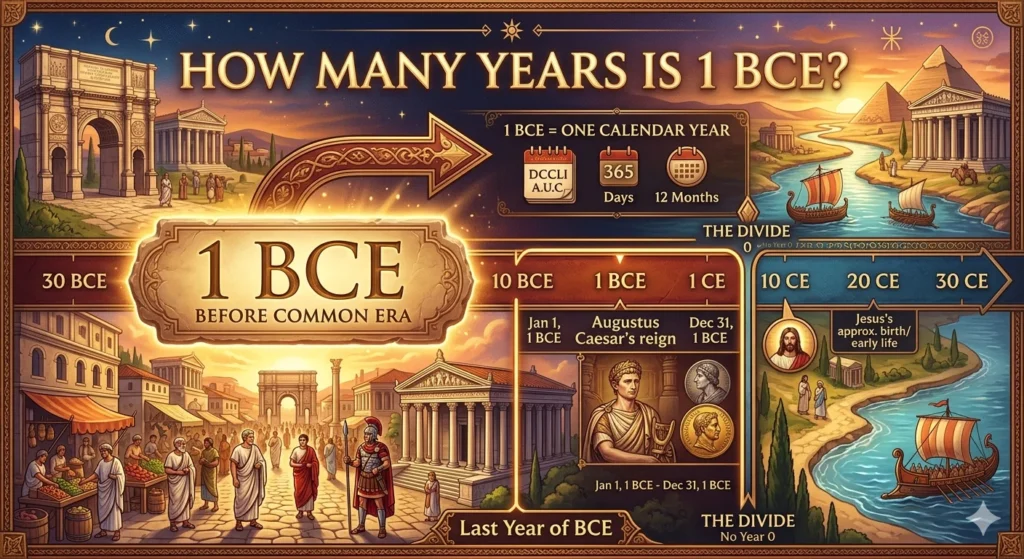
How Many Years Is 1 BCE?
One of the most confusing aspects of historical chronology is the transition between BCE and CE.
Important Fact
There is no year 0 in the traditional BCE/CE system.
The sequence is:
- 2 BCE
- 1 BCE
- 1 CE
- 2 CE
Because year 0 does not exist, historical calculations sometimes require special attention.
Quick Answer
1 BCE is the year immediately before 1 CE.
500 BCE Meaning
When someone refers to 500 BCE, they mean:
The year 500 before the start of the Common Era.
This period is associated with major developments in:
- Ancient Greece
- Persian civilization
- Philosophy
- Trade networks
- Early democratic institutions
2000 BCE Meaning
2000 BCE refers to a year approximately four thousand years ago.
During this period:
- Ancient Mesopotamian civilizations flourished.
- Early Egyptian kingdoms were active.
- Long-distance trade expanded.
- Important developments occurred in agriculture and urban life.
This makes 2000 BCE one of the most significant periods in early human history.
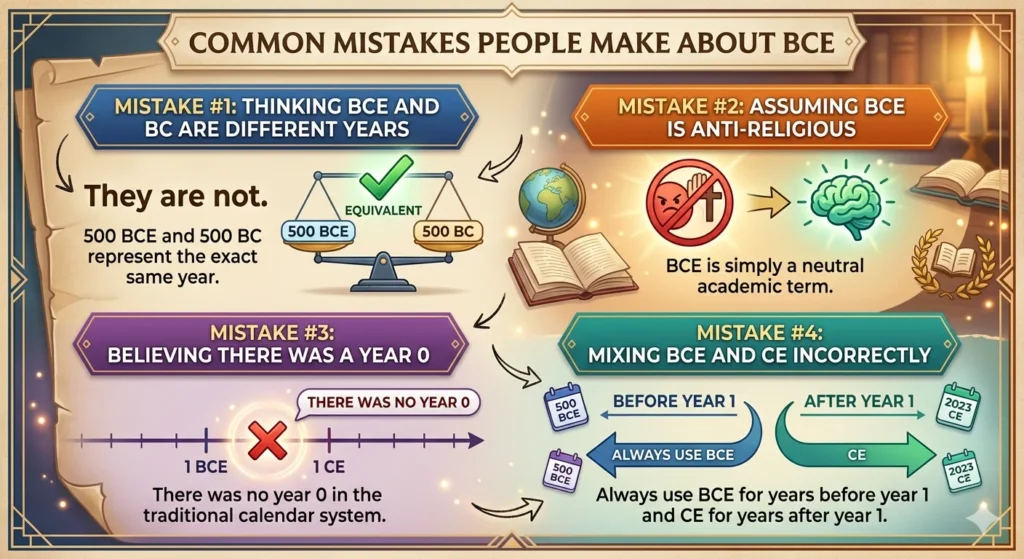
Common Mistakes People Make About BCE
Mistake #1: Thinking BCE and BC Are Different Years
They are not.
500 BCE and 500 BC represent the exact same year.
Mistake #2: Assuming BCE Is Anti-Religious
BCE is simply a neutral academic term.
Mistake #3: Believing There Was a Year 0
There was no year 0 in the traditional calendar system.
Mistake #4: Mixing BCE and CE Incorrectly
Always use BCE for years before year 1 and CE for years after year 1.
Frequently Asked Questions
What does BCE mean in history?
BCE stands for Before Common Era and refers to years before year 1 in the historical dating system.
Is BCE the same as BC?
Yes. BCE and BC represent the same years. Only the terminology differs.
What comes after BCE?
CE (Common Era) comes after BCE.
Why do we say CE instead of AD?
Many educational institutions prefer CE because it is considered more neutral and internationally inclusive.
Can BCE be used in academic writing?
Yes. BCE is widely used in universities, museums, and scholarly publications.
What is the difference between BCE and CE?
BCE refers to years before year 1, while CE refers to years after year 1.
Conclusion
Understanding the BCE meaning is essential for studying history, archaeology, religion, and ancient civilizations. BCE stands for Before Common Era and refers to all years before year 1 in the modern historical dating system. While BCE and BC describe the same dates, BCE has become increasingly popular because it offers a neutral and globally recognized way to discuss historical chronology.
Whether you’re reading about the pyramids of Egypt, the Roman Republic, biblical events, or early world civilizations, you’ll frequently encounter BCE and CE. Knowing the difference between BCE, BC, CE, and AD helps you interpret historical timelines accurately and understand how scholars organize events across thousands of years of human history.
The next time you see a date like 500 BCE, 2000 BCE, or 44 BCE, you’ll know exactly what it means and where it fits within the broader story of world history.

Dolly Parton is a professional content writer at maeningg.com, specializing in clear, engaging, and well-researched digital content. With strong expertise in writing about text slang, meanings, lifestyle, and informative articles, Dolly focuses on helping readers understand internet language in a simple and relatable way.