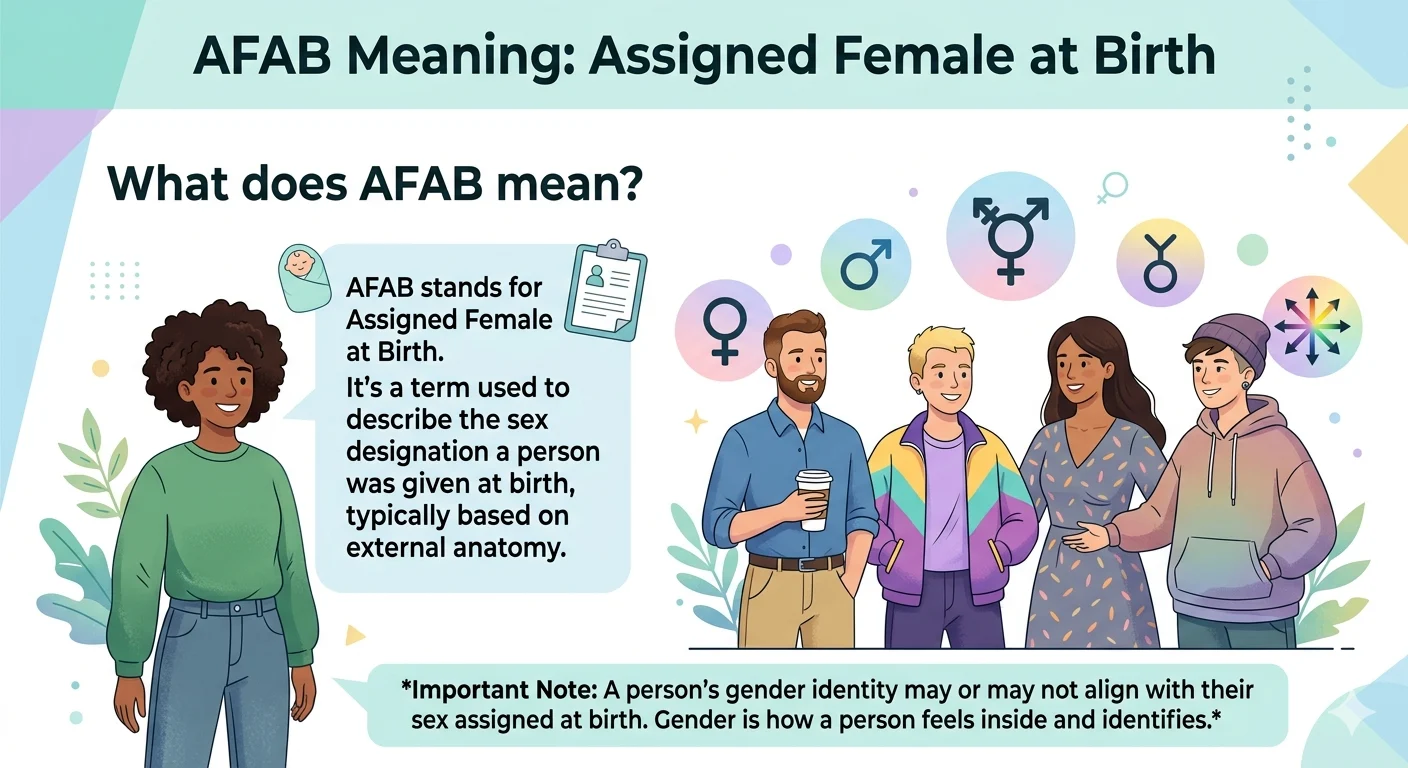
AFAB is one of those terms that seems to appear everywhere online, yet many people have no idea what it means the first time they see it. If you’ve come across it in a profile, social media post, or discussion and felt confused, you’re definitely not alone.
AFAB stands for “Assigned Female At Birth.” It describes a person who was identified as female when they were born, regardless of their current gender identity.
The term is widely used in conversations about gender, identity, healthcare, and lived experiences because it focuses on a person’s birth assignment rather than who they are today.
In this guide, you’ll learn what AFAB means, why people use it, and how to understand it correctly when you encounter it online or in everyday conversations.
What Does AFAB Mean?
AFAB stands for Assigned Female at Birth.
The term describes a person who was identified and recorded as female when they were born. This assignment is usually based on physical anatomy observed at birth.
However, being AFAB does not automatically tell you a person’s current gender identity.
For example:
- A woman can be AFAB.
- A transgender man can be AFAB.
- A nonbinary person can be AFAB.
- An agender person can be AFAB.
This distinction is important because gender identity and birth assignment are not always the same thing.
Simple Example
Someone may say:
“I am nonbinary and AFAB.”
This means they were assigned female at birth but do not identify exclusively as a woman.
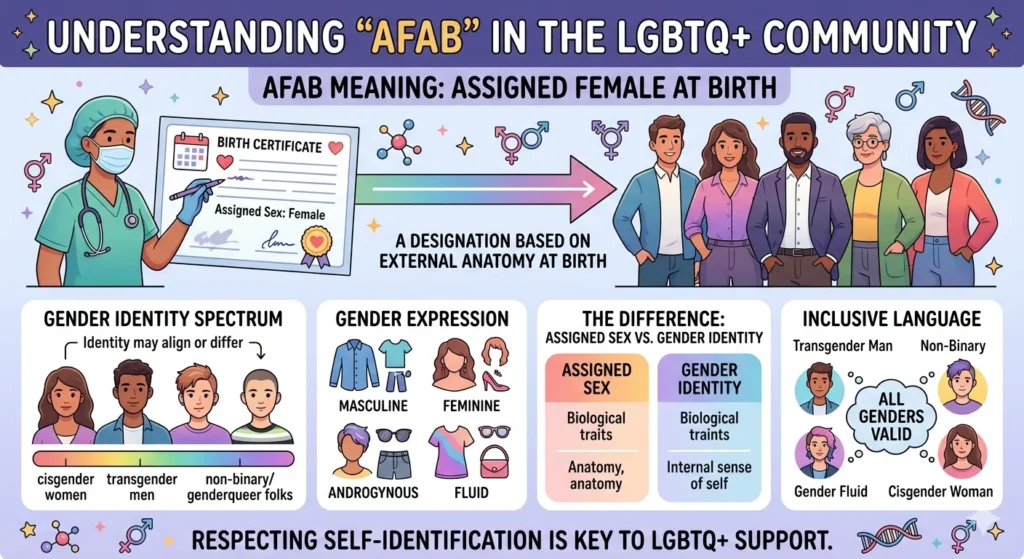
AFAB Meaning in LGBTQ+ Communities
The term AFAB is widely used in LGBTQ+ and gender-diverse communities because it provides a neutral way to discuss experiences related to birth assignment without assuming a person’s identity.
Instead of saying “biologically female” in situations where gender identity matters, many people prefer AFAB because it is more precise and inclusive.
AFAB helps describe certain experiences, such as:
- Social expectations during childhood
- Healthcare experiences
- Gender-related discussions
- Personal identity journeys
The term itself does not define who someone is today. It only describes what was assigned at birth.
Origin and History of AFAB
The term AFAB emerged from gender studies, LGBTQ+ advocacy, and academic discussions during the late 20th century.
As understanding of gender diversity expanded, people needed language that could distinguish between:
- Sex assigned at birth
- Gender identity
- Gender expression
AFAB became a useful term because it focuses on the assignment made at birth rather than making assumptions about a person’s current identity.
Timeline
1990s
- Appears in academic and gender studies discussions.
2000s
- Used more frequently in LGBTQ+ communities.
2010s
- Popularized through Tumblr, forums, and social media.
2020s
- Becomes common in educational content, healthcare discussions, and online communities.
Today, AFAB is recognized globally and used in both formal and informal conversations.
AFAB vs AMAB Meaning
One of the most common questions is the difference between AFAB and AMAB.
| Term | Meaning |
|---|---|
| AFAB | Assigned Female at Birth |
| AMAB | Assigned Male at Birth |
Both terms describe birth assignment rather than gender identity.
Example
A person may be:
- AFAB and nonbinary
- AFAB and transgender
- AMAB and transgender
- AMAB and nonbinary
Neither term tells you someone’s gender identity by itself.
What Does YNS Mean in Text? Hidden Slang Revealed
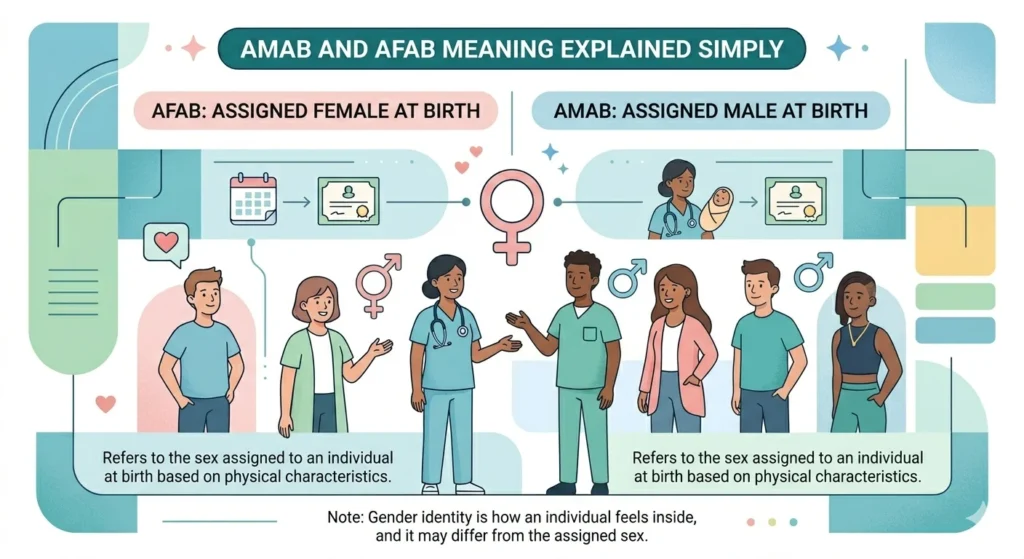
AMAB and AFAB Meaning Explained Simply
Think of AFAB and AMAB as descriptive terms.
They answer:
“What sex was recorded at birth?”
They do not answer:
“What gender does this person identify as today?”
That’s why these terms are commonly used in educational and healthcare settings.
AFAB vs Cisgender
Many people confuse AFAB with cisgender, but they are not the same thing.
AFAB
Describes birth assignment.
Cisgender
Describes a person whose gender identity matches the sex assigned at birth.
For example:
A woman who was assigned female at birth and identifies as a woman is:
- AFAB
- Cisgender
A transgender man may also be:
- AFAB
- Not cisgender
This distinction is important when discussing identity respectfully.
AFAB vs Female: What’s the Difference?
AFAB means “Assigned Female at Birth,” while female can refer to biological sex, gender identity, or social categories depending on context. A person can be AFAB and identify as a woman, but not everyone who is AFAB identifies as female. For example, some AFAB individuals identify as nonbinary, transgender, or agender. This is why AFAB is considered a descriptive term rather than a gender label.
What Does Humble Mean? Simple Meaning You Should Know
What Is AGAB Meaning?
AGAB stands for:
Assigned Gender At Birth
It is an umbrella term that includes:
- AFAB (Assigned Female at Birth)
- AMAB (Assigned Male at Birth)
When people discuss AGAB, they are referring broadly to birth assignment rather than a specific category.
Nonbinary AFAB Meaning
You may see phrases like:
- Nonbinary AFAB
- NB AFAB
This means the person:
- Was assigned female at birth
- Does not identify exclusively as male or female
Many nonbinary individuals use AFAB or AMAB when discussing their experiences because certain life experiences can be influenced by birth assignment.
However, AFAB does not define their gender.
Trans AFAB Meaning
A transgender person can also be AFAB.
For example:
A transgender man may say:
“I’m trans and AFAB.”
This means:
- Assigned female at birth
- Gender identity differs from that assignment
The term simply provides context without replacing the person’s identity.
AFAB Meaning in Medical Contexts
AFAB meaning medical discussions often appears in healthcare, research, and educational materials.
Medical professionals sometimes use AFAB because certain health conditions, screenings, or treatments may relate to anatomy rather than gender identity.
For example:
- Reproductive health discussions
- Hormonal health topics
- Certain medical screenings
Using AFAB can help healthcare providers communicate accurately while respecting diverse identities.
However, modern healthcare increasingly recognizes that not all AFAB individuals identify as women.
Why Does the Term AFAB Matter?
The term AFAB helps people discuss gender, identity, healthcare, and personal experiences with greater accuracy. Rather than making assumptions about someone’s identity, AFAB simply describes the sex assignment recorded at birth. This makes conversations more inclusive and respectful, especially in healthcare, education, research, and online communities where clear language matters.
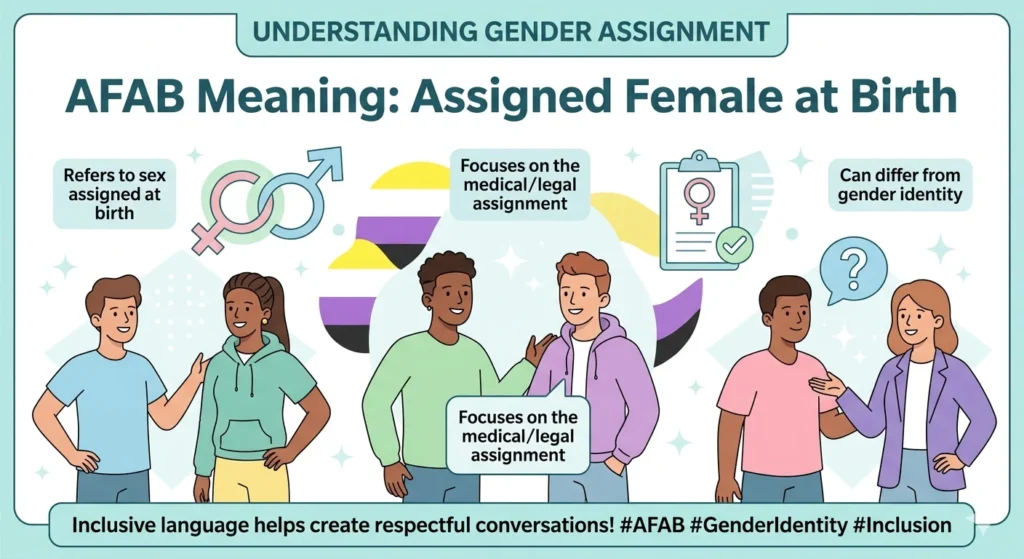
AFAB Meaning in Social Media
On platforms like TikTok, Instagram, Reddit, and Twitter/X, AFAB is often used in:
- Bios
- Identity discussions
- Educational posts
- Community spaces
Example bio:
AFAB | Nonbinary | They/Them
This provides information about the person’s background without fully defining their identity.
AFAB Meaning in Fanfiction
A growing search term is:
AFAB Reader Meaning
In fanfiction and fandom communities, AFAB reader usually indicates that a story is written with readers assigned female at birth in mind.
Writers may use tags such as:
- AFAB Reader
- AFAB Character
- AFAB OC
These tags help readers understand how the character or audience is being represented within the story.
Usage varies across fandoms, but the purpose is usually clarity and audience targeting.
AFAB Meaning in Urdu
AFAB کا مطلب ہے:
“پیدائش کے وقت عورت قرار دیا گیا”
یا
“پیدائش کے وقت مؤنث جنس تفویض کی گئی”
یہ اصطلاح اس جنس کو بیان کرتی ہے جو پیدائش کے وقت درج کی گئی تھی، نہ کہ ضروری طور پر موجودہ صنفی شناخت کو۔
اسی لیے AFAB اور عورت (Female/Woman) ہمیشہ ایک ہی چیز نہیں ہوتے۔
Common Misunderstandings About AFAB
AFAB Does Not Mean Woman
Many AFAB people identify as women.
However, not all AFAB individuals are women.
AFAB Is Not a Gender
AFAB is a descriptor.
It explains birth assignment, not identity.
AFAB Does Not Determine Pronouns
Pronouns depend on how someone identifies.
You cannot assume pronouns based on AFAB status.
Examples of AFAB in Conversations
Example 1
Person A:
I’m AFAB and nonbinary.
Person B:
Thanks for explaining.
Example 2
This health guide focuses on AFAB individuals because of specific reproductive health topics.
Example 3
Bio:
AFAB | Queer | She/They
Related Terms
| Term | Meaning |
|---|---|
| AFAB | Assigned Female at Birth |
| AMAB | Assigned Male at Birth |
| AGAB | Assigned Gender At Birth |
| Cisgender | Identity matches assignment |
| Transgender | Identity differs from assignment |
| Nonbinary | Gender outside male/female categories |
| Genderfluid | Gender may change over time |
FAQs
What is the meaning of AFAB?
AFAB stands for Assigned Female at Birth. It describes someone who was designated female when they were born.
Is AFAB a gender?
No. AFAB is not a gender identity. It only describes birth assignment.
What is an AFAB female?
The phrase usually refers to a person who was assigned female at birth. However, AFAB and female are not always identical concepts because gender identity may differ.
What is the difference between cisgender and AFAB?
AFAB describes birth assignment. Cisgender describes a person whose gender identity matches that assignment.
What does nonbinary AFAB mean?
It means someone was assigned female at birth but identifies as nonbinary.
Where is AFAB commonly used?
AFAB is commonly used in LGBTQ+ discussions, healthcare, educational content, social media, and online communities.
What famous people are nonbinary?
Several public figures have identified as nonbinary, including Emma Corrin, Sam Smith, and Janelle Monáe. However, being nonbinary is separate from being AFAB or AMAB, as these terms describe different aspects of a person’s experience.
Conclusion
Understanding AFAB is about more than learning a modern acronym. It reflects how language has evolved to describe people’s experiences more accurately and respectfully. AFAB simply means “Assigned Female at Birth,” referring to the sex designation recorded when someone was born, but it does not define a person’s gender identity, pronouns, or how they identify today.
As conversations about gender continue to grow online and offline, terms like AFAB, AMAB, and AGAB help create clearer and more inclusive discussions. They allow people to talk about healthcare, identity, and lived experiences without making assumptions about who someone is.
Whether you encountered AFAB in a TikTok bio, a medical article, a fanfiction tag, or an LGBTQ+ discussion, you now understand its meaning, context, and correct usage. The most important takeaway is simple: AFAB describes a birth assignment, while a person’s identity is determined by how they understand and describe themselves.

Willie Nelson is a skilled and passionate content writer working as an expert author at maeningg.com. With strong knowledge of digital trends, slang meanings, and engaging online content, Willie focuses on creating clear, helpful, and reader-friendly articles.