Have you ever seen “SNAFU” in a text message, military story, workplace conversation, or online discussion and wondered what it means? You’re not alone. At first glance, it looks like a random word, but it’s actually a famous acronym with an interesting history and a meaning that surprises many people.
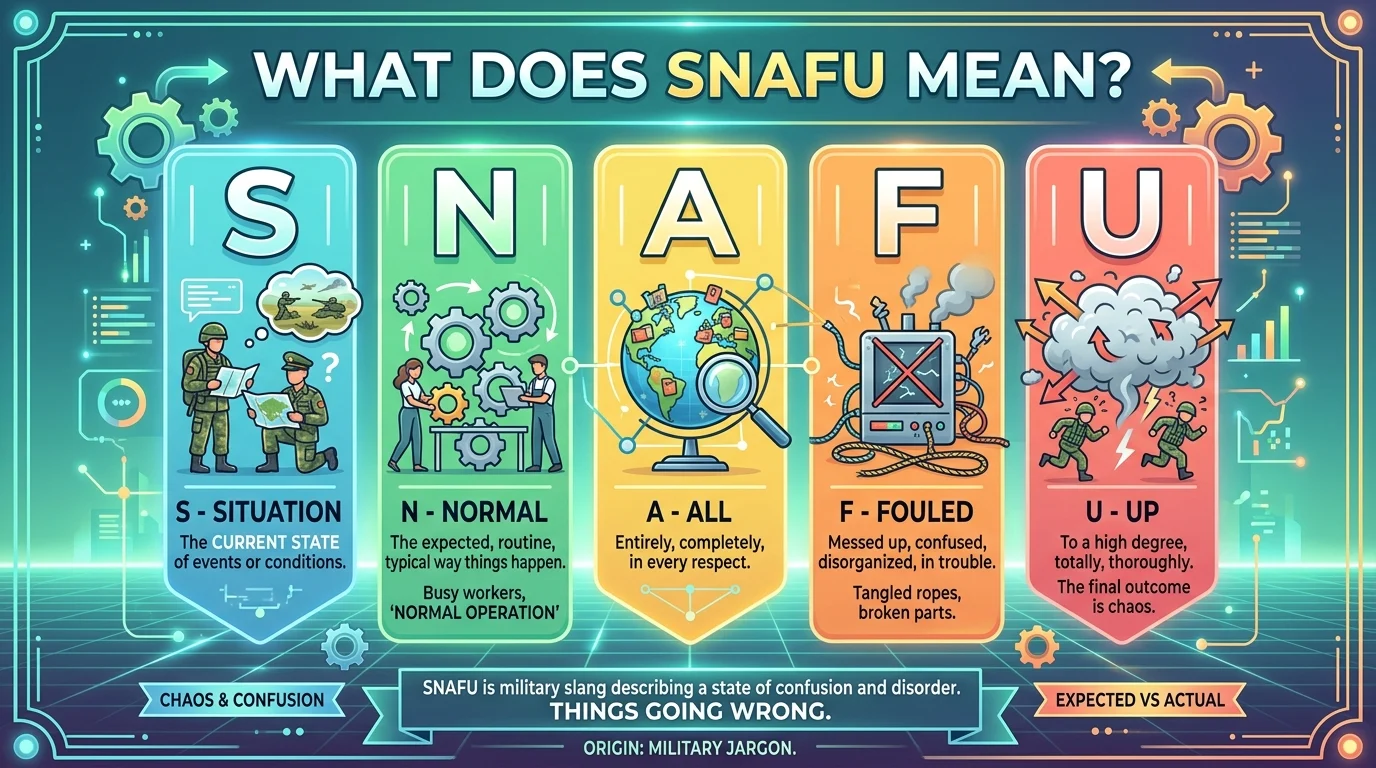
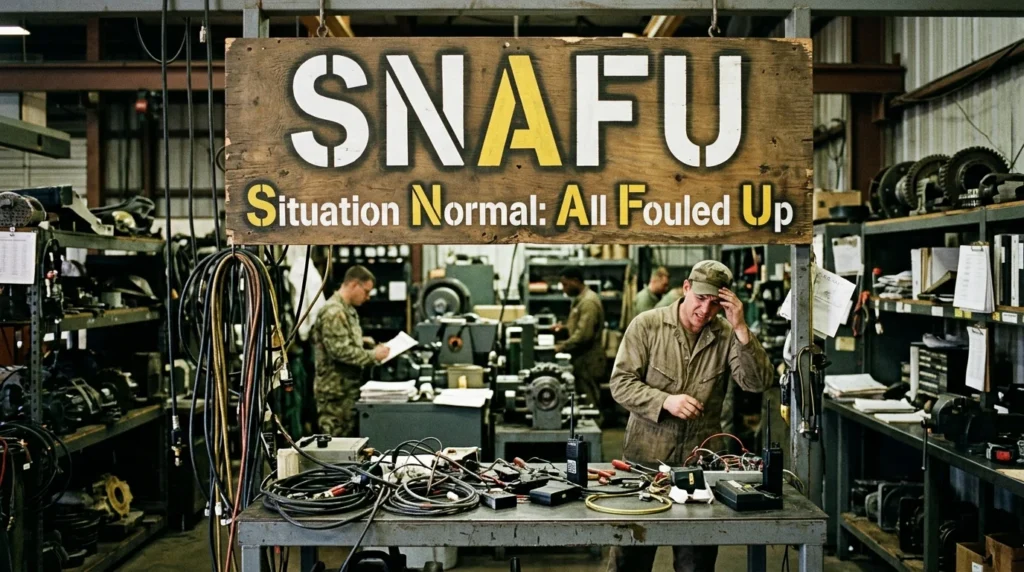
SNAFU stands for “Situation Normal: All Fouled Up” and is used to describe a chaotic, confused, or badly managed situation.
Originally popularized by the military, the term is now widely used in everyday conversations, business settings, and online discussions whenever things go wrong despite appearing normal on the surface.
For example, a delayed project, a communication breakdown, or an unexpected mix-up might be called a SNAFU. In this guide, you’ll learn the meaning of SNAFU, where it came from, how it’s used today, and examples that make the term easy to understand.
What Does SNAFU Mean?
SNAFU is a slang acronym that means “Situation Normal, All Fouled Up.” It describes a chaotic, disorganized, or messed-up situation — but with a key twist: the chaos feels completely normal and expected.
That’s what makes SNAFU so unique compared to words like “disaster” or “crisis.” When someone says SNAFU, they’re not panicking. They’re shrugging. They’re essentially saying: “Yeah, things are a mess — but honestly, what did you expect?”
The word carries a tone of dark humor, sarcasm, and resigned acceptance. It acknowledges that systems fail, plans fall apart, and bureaucracy is a nightmare — and somehow, everyone just keeps moving.
SNAFU in one sentence: “Our website crashed during the product launch — classic SNAFU.”
Type: Acronym / Slang
Register: Informal to semi-formal
Pronunciation: Snah-foo (one word, not spelled out)
Part of Speech: Noun, verb, or adjective depending on context
SNAFU Full Form Explained
| Letter | Stands For |
|---|---|
| S | Situation |
| N | Normal |
| A | All |
| F | Fouled (originally a stronger word in military slang) |
| U | Up |
Important note: The original WWII version used a more explicit word starting with “F” in place of “Fouled.” When SNAFU entered mainstream civilian use, “Fouled” became the polite, widely accepted substitute. Today, the civilian version — “Situation Normal, All Fouled Up” — is completely appropriate in professional settings, emails, news articles, and casual conversation.
This makes SNAFU one of the rare military slang terms that cleaned itself up and became respectable over time.
Origin and History of SNAFU
Where Did SNAFU Come From?
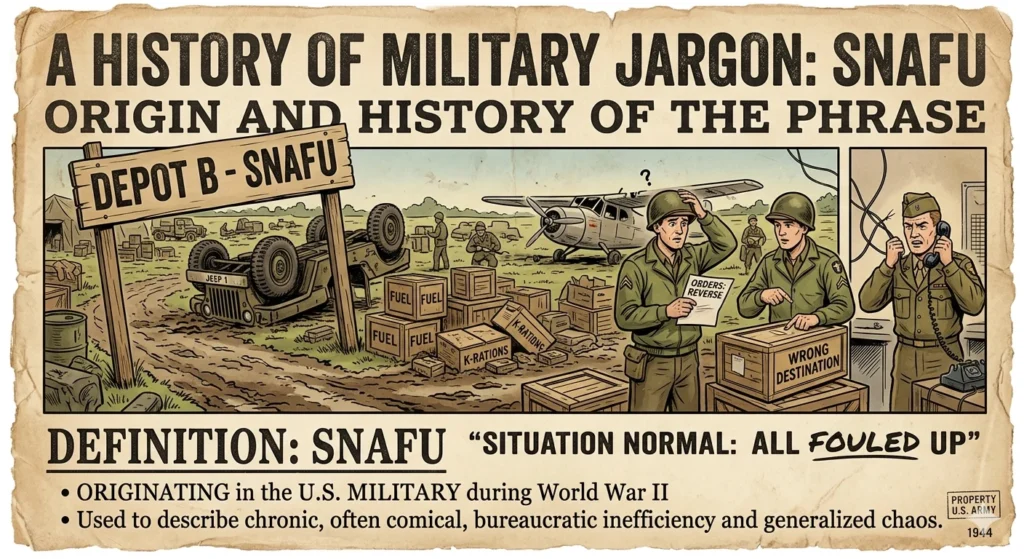
SNAFU was born during World War II (early 1940s) among U.S. military personnel. Soldiers and officers needed a way to describe the constant bureaucratic chaos, communication breakdowns, supply failures, and operational confusion that were simply part of daily military life.
The word perfectly captured that feeling: things are going wrong, as usual, and no one is shocked anymore.
Earliest Known Use: The first documented appearance of SNAFU in print dates to 1941, making it one of the earliest modern slang acronyms ever recorded — predating “LOL,” “OMG,” “WTF,” and virtually every internet abbreviation by over 50 years.
How SNAFU Spread Into Everyday Life
After World War II ended, millions of veterans returned home carrying SNAFU with them. The word began appearing in:
- Newspapers covering government and bureaucratic failures
- Hollywood movies featuring war veterans and military culture
- Corporate offices where employees used it to describe management chaos
- Political commentary to describe policy disasters
By the 1960s and 1970s, SNAFU had firmly entered mainstream American English. By the 1990s, it appeared in major dictionaries as a legitimate English word — not just slang.
Today in 2026, SNAFU appears in news headlines, Twitter/X threads, business emails, Reddit posts, and casual text conversations daily. It has transcended its military origins to become a universal expression of organized chaos.
The SNAFU Family of Military Acronyms
SNAFU wasn’t created in isolation. It was part of a whole system of irreverent military acronyms that soldiers coined to cope with frustration:
| Acronym | Stands For | Meaning |
|---|---|---|
| SNAFU | Situation Normal, All Fouled Up | Chaos is normal |
| FUBAR | Fouled Up Beyond All Recognition | Completely broken, no fix possible |
| BOHICA | Bend Over, Here It Comes Again | Used when soldiers expected punishment or bad news |
| SUSFU | Situation Unchanged, Still Fouled Up | Everything is still a mess |
| TARFU | Things Are Really Fouled Up | Worse than SNAFU, not as bad as FUBAR |
| JANFU | Joint Army-Navy Foul Up | When two military branches caused a mess together |
Understanding this family helps you see that SNAFU sits in the middle of the chaos spectrum. It’s not fine, but it’s not catastrophic either.
Private SNAFU: The Famous WWII Cartoon
One of the most fascinating pieces of SNAFU history is a series of military training films produced during World War II featuring a character called Private SNAFU.
These animated shorts were created between 1943 and 1945 by the U.S. Army Signal Corps. The goal was to teach soldiers important lessons — about security, hygiene, morale, malaria prevention, and military discipline — in an entertaining, humorous way rather than dry lectures.
Notable facts about Private SNAFU:
- The character was voiced by Mel Blanc, the legendary voice actor behind Bugs Bunny, Daffy Duck, and Porky Pig.
- Several cartoons were written or storyboarded by Dr. Seuss (Theodor Geisel), who served as a captain in the Army Signal Corps.
- The shorts were restricted to military audiences — the language and adult humor made them unsuitable for public viewing at the time.
- Over 26 episodes were produced in the series.
Private SNAFU was depicted as a bumbling, overconfident soldier who constantly made the wrong decisions — and suffered the consequences. Each episode showed soldiers what not to do, using humor to make the lessons stick.
This cartoon series is a key reason SNAFU became so deeply embedded in American military culture. An entire generation of soldiers grew up watching Private SNAFU, ensuring the word would survive long after the war ended.
Ornery Meaning Explained for Easy Understanding
SNAFU Meaning in Texting and Chat
In modern texting, social media, and online chat, SNAFU is used casually to describe situations where things have gone sideways — often with humor or sarcasm.
SNAFU Texting Examples
Example 1 — Friend group chat:
Friend 1: “Did the party start on time?” Friend 2: “Nope, total SNAFU. The DJ forgot his equipment 😂”
Example 2 — Twitter/X:
“Another day, another government SNAFU. The new transit app is down on its first day 🙃”
Example 3 — Instagram comment:
“Our photoshoot turned into a SNAFU when it started raining mid-session 😅”
Example 4 — Discord server:
“We had a SNAFU with the tournament bracket — rematch scheduled for tomorrow”
When to Use SNAFU in Texts
✅ Use it when:
- Something went wrong in a funny or predictable way
- You want to sound witty rather than frustrated
- The situation is chaotic but not a genuine emergency
- You’re texting with friends, colleagues, or people who know slang
❌ Avoid it when:
- Texting someone who doesn’t know slang or military jargon
- The situation is genuinely serious or emotionally sensitive
- You’re texting in a professional context to someone senior
SNAFU Meaning in the Military
In its original military context, SNAFU wasn’t just slang — it was a psychological coping tool. Military life involves enormous amounts of uncertainty, poor communication between ranks, supply chain failures, and orders that contradict each other. Calling something a SNAFU was a way of saying: “This is bad, but it’s not surprising. Keep moving.”
Military use examples:
- “Command changed the mission three times. Classic SNAFU — we adapt.”
- “Supply drop went to the wrong grid. Another SNAFU. We’ll work with what we have.”
- “Radio’s down again. SNAFU. Use runners.”
The military still uses SNAFU today, both formally and informally. It appears in after-action reports, debriefs, and military journalism to describe operational failures that were the result of confusion, miscommunication, or systemic issues — rather than individual failure or enemy action.
SNAFU in military context signals:
- The problem was caused by the system, not one person’s failure
- It was predictable given the circumstances
- It is solvable or at least survivable
- No extraordinary panic is required
This is how SNAFU differs from FUBAR in military use: FUBAR signals a situation that is beyond saving. SNAFU signals chaos that is unfortunate but manageable.
SNAFU Meaning in Business and the Workplace
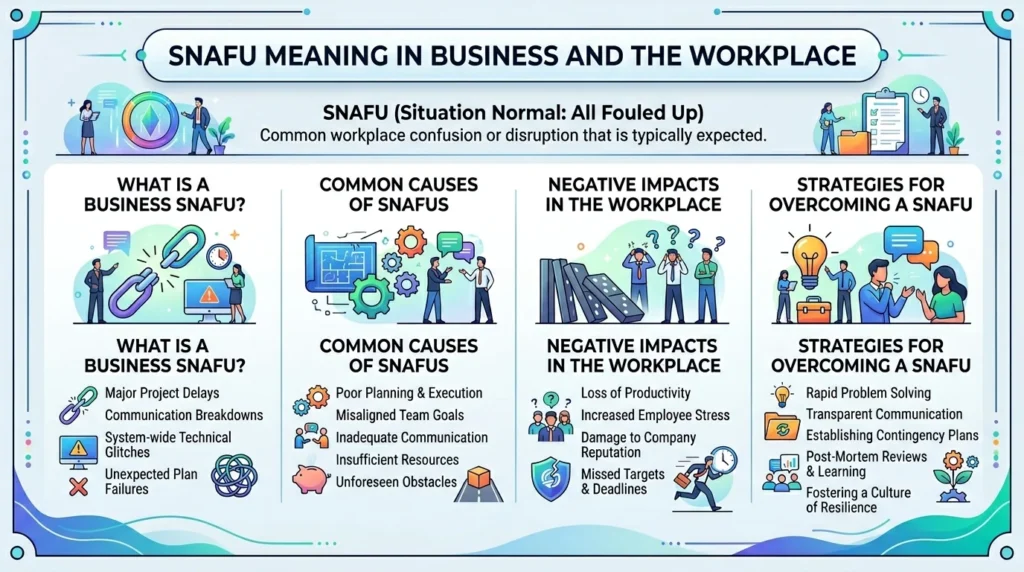
SNAFU has become a staple of workplace language, especially in industries that deal with complex systems, tight deadlines, and cross-team communication.
Business Examples of SNAFU
IT / Tech:
“The server migration ran into a SNAFU — we’ll need 48 hours to restore full functionality.”
Marketing:
“The campaign launch hit a SNAFU when the email list was accidentally sent twice.”
Finance:
“There was a SNAFU with the quarterly report — wrong figures were submitted to the board.”
Project Management:
“The SNAFU in procurement delayed construction by two weeks.”
HR:
“New employee onboarding had a SNAFU — their access credentials weren’t ready on day one.”
Is SNAFU Appropriate in Professional Emails?
Yes — in most semi-formal business contexts, SNAFU is perfectly acceptable. It’s especially common in:
- Tech companies with casual communication cultures
- Startup environments
- Internal team emails and Slack messages
- Industry news articles and business journalism
Avoid SNAFU in:
- Formal reports submitted to executives or boards
- Legal or financial documents
- Communication with clients in formal industries (law, banking, government)
- Performance reviews or official HR documentation
A good rule of thumb: if you’d use the word “issue” in a formal document, use “issue.” If you’re talking to your team on Slack and you want to be direct and slightly casual, SNAFU works perfectly.
Swill Meaning – Quick Definition for Easy Understanding
SNAFU in Pop Culture: XO Kitty, Movies, TV
What Does SNAFU Mean in XO Kitty?
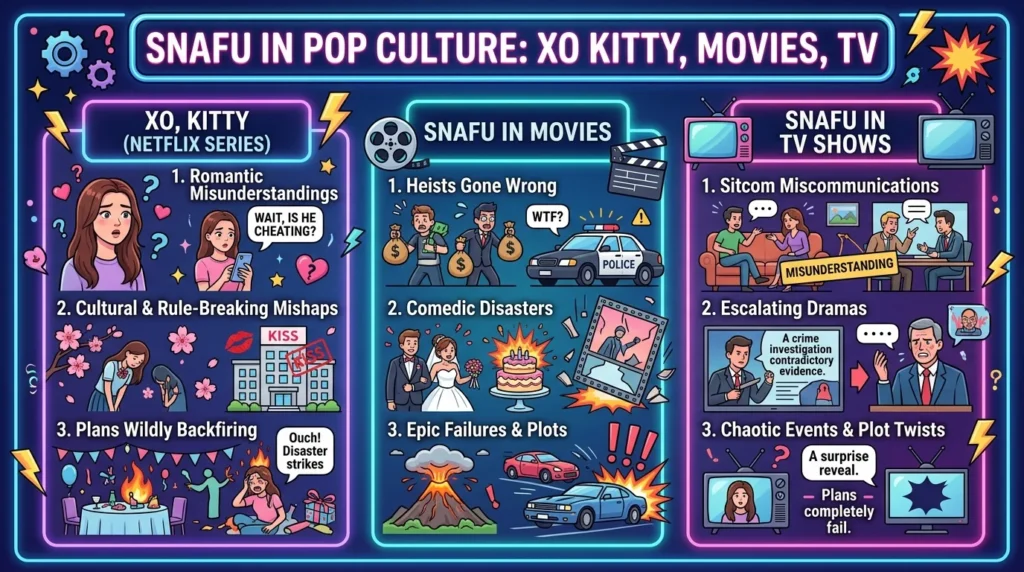
Many people search for “SNAFU meaning XO Kitty” after watching the Netflix series XO, Kitty. In the show, the term is used casually by characters to describe romantic or social situations that went completely off the rails — consistent with its standard meaning of unexpected, chaotic situations.
The use of SNAFU in XO, Kitty is a great example of how the word has migrated from military origins into teen and young adult culture, appearing naturally in dialogue to describe everyday mix-ups and relationship chaos.
SNAFU in Movies and TV
SNAFU has appeared across decades of film and television:
- “SNAFU” (1945) — An early Hollywood film that literally used the military acronym in its title
- The Pacific (HBO miniseries) — Features authentic WWII military slang including SNAFU
- MASH — The classic military comedy series regularly employed SNAFU and related terms
- Catch-22 — Both the novel and adaptations deal heavily with the SNAFU mentality (bureaucratic absurdity as normalcy)
- Modern political satire shows frequently use SNAFU in headlines and commentary segments
SNAFU in News Headlines
Journalists love SNAFU because it captures official failures with just the right amount of irony:
- “Healthcare website launch turns into SNAFU on day one”
- “Election night SNAFU delays results for hours”
- “NASA mission hits SNAFU as satellite misses orbit”
- “Tech giant’s AI rollout a PR SNAFU after controversial output”
SNAFU Meaning in Japanese — Oregairu / My Teen Romantic Comedy SNAFU
Many English speakers searching “SNAFU meaning Japanese” are looking for information about the popular anime series officially titled “Yahari Ore no Seishun Love Comedy wa Machigatteiru” — translated to English as “My Teen Romantic Comedy SNAFU” (also known as Oregairu).
The title is a deliberate and clever use of the acronym. In the English title, “SNAFU” is used to describe the protagonist Hachiman Hikigaya’s approach to high school social life: he expects everything to be a mess, he’s accepted that the social game is broken, and he refuses to be surprised or emotionally devastated by it.
The title captures a key theme of the series: treating the dysfunction of teenage social life as normal and expected — the very definition of SNAFU.
Seasons available:
- Season 1: My Teen Romantic Comedy SNAFU (2013)
- Season 2: My Teen Romantic Comedy SNAFU TOO! (2015)
- Season 3: My Teen Romantic Comedy SNAFU Climax! (2020)
If you’re wondering whether the show is titled SNAFU because something is “wrong” with it — the answer is no. It’s titled SNAFU because the characters live in a world where social chaos and emotional confusion are just the default setting. That’s peak SNAFU energy.
Gold SNAFU Meaning
The phrase “Gold SNAFU” appears in several contexts:
1. Military insignia and collectibles: “Gold SNAFU” sometimes refers to rare or special-edition Private SNAFU memorabilia and collectibles from WWII-era military training films, particularly items with gold coloring or markings.
2. Gaming context: In certain games and online communities, “Gold SNAFU” refers to a high-level or prestigious status, where achieving SNAFU (usually meaning “chaos”) at gold tier suggests elite-level performance within chaotic situations.
3. Slang intensifier: Some users on Reddit and social media use “Gold SNAFU” to mean an especially spectacular or noteworthy mess — a chaos situation so impressive it deserves a gold medal.
If you’ve seen “Gold SNAFU” in a specific game, show, or community context, the meaning is usually tied to that community’s specific usage rather than a universal definition.
SNAFU vs. FUBAR vs. BOHICA: What’s the Difference?
These three acronyms are often confused. Here’s a clear breakdown:
SNAFU vs. FUBAR
| Feature | SNAFU | FUBAR |
|---|---|---|
| Full form | Situation Normal, All Fouled Up | Fouled Up Beyond All Recognition |
| Severity | Moderate — things are messy | Severe — completely broken |
| Fixable? | Usually yes | Usually no |
| Tone | Resigned, sarcastic | Despairing, defeated |
| Example | “The schedule got mixed up — SNAFU.” | “The entire database was corrupted — total FUBAR.” |
SNAFU vs. BOHICA
BOHICA (“Bend Over, Here It Comes Again”) is much more aggressive and cynical than SNAFU. Where SNAFU accepts chaos as normal, BOHICA implies that someone above you is actively making things worse — and you have no power to stop it. BOHICA is rarely used in professional settings.
The Chaos Ladder
Think of military acronyms as a ladder of increasing disaster:
- SUSFU — Situation Unchanged, Still Fouled Up (mild, chronic)
- SNAFU — Situation Normal, All Fouled Up (moderate, expected)
- TARFU — Things Are Really Fouled Up (getting worse)
- FUBAR — Fouled Up Beyond All Recognition (catastrophic)
SNAFU sits comfortably in the middle — bad enough to notice, normalized enough to accept.
Similar Terms and Synonyms for SNAFU
If you need an alternative to SNAFU, here are the closest options depending on context:
| Word/Phrase | Meaning | Formality |
|---|---|---|
| Glitch | Small technical error | Informal to formal |
| Mishap | Minor accidental problem | Semi-formal |
| Blunder | Avoidable, embarrassing mistake | Semi-formal |
| Fiasco | Complete and embarrassing failure | Informal |
| Debacle | Humiliating failure or disaster | Formal |
| Cluster | Disorganized chaotic failure (slang) | Very informal |
| Mix-up | Simple confusion or error | Informal |
| Foul-up | Something gone wrong due to error | Informal |
| Cock-up (British) | Major mistake or failure | Informal (British English) |
| Kerfuffle | Commotion or fuss | Informal |
Best formal alternatives for documents: complication, setback, operational failure, disruption, anomaly
How to Use SNAFU Correctly
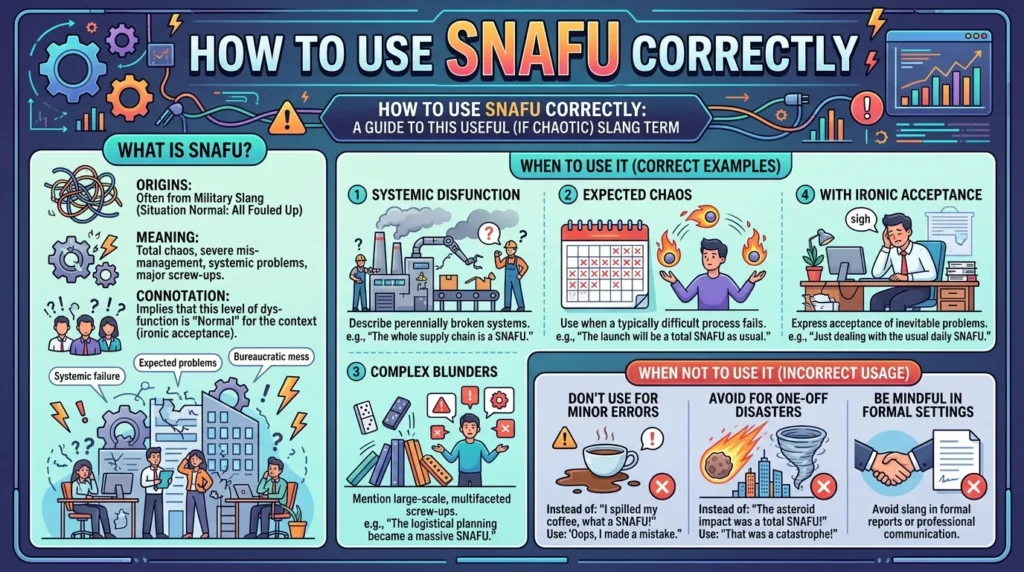
As a Noun (most common)
“The event scheduling was a total SNAFU.” “We ran into a SNAFU with the vendor contract.”
As a Verb (less common but valid)
“The system got completely snafued during the update.” “Our plans were snafued when the permit was denied.”
As an Adjective (informal)
“The whole project is completely snafued.”
Dos and Don’ts
✅ DO:
- Use in casual and semi-formal conversations
- Use to describe systemic or recurring failures
- Use with humor or sarcasm when appropriate
- Use in team emails, Slack, social media captions
❌ DON’T:
- Use in formal reports, legal documents, or academic writing
- Use when describing a genuine tragedy or crisis
- Use with someone who may not know the term
- Overuse it — it loses impact if said every other sentence
Common Mistakes People Make With SNAFU
Mistake 1: Thinking SNAFU Means Total Disaster
SNAFU does not mean “catastrophe.” It means expected, normalized chaos. If a building collapses, that’s not a SNAFU — that’s a crisis. If the office printer breaks on the day of a big presentation, that’s a SNAFU.
Wrong: “The earthquake was a real SNAFU.”
Right: “The permit application got delayed again — another bureaucratic SNAFU.”
Mistake 2: Treating It as a New Internet Term
Some people assume SNAFU is modern internet slang like “LOL” or “SMH.” In reality, SNAFU is over 80 years old — it predates the internet, television, and most people reading this article.
Mistake 3: Confusing SNAFU and FUBAR
These are not interchangeable. SNAFU = fixable mess. FUBAR = beyond repair. Using FUBAR when you mean SNAFU makes the situation sound far more hopeless than it is.
Mistake 4: Spelling It Lowercase Without Context
SNAFU is always written in ALL CAPS in formal contexts because it is an acronym. In casual texting, “snafu” (lowercase) is acceptable, but professionally, maintain the capitalization.
FAQ:
Q: What does SNAFU mean in texting?
In texting, SNAFU means a chaotic or messed-up situation — usually used humorously. Example: “Tried to order pizza online and accidentally ordered 12 — classic SNAFU 😂”
Q: Is SNAFU a bad word?
No. While its original form contained stronger language, the modern version (“Situation Normal, All Fouled Up”) is completely appropriate and workplace-friendly.
Q: What does SNAFU mean in XO Kitty?
In the Netflix series XO, Kitty, SNAFU is used to describe chaotic social and romantic situations that have gone unexpectedly wrong — consistent with its standard meaning.
Q: What does SNAFU mean in Japanese / Oregairu?
The anime My Teen Romantic Comedy SNAFU (Oregairu) uses SNAFU in its English title to reflect the protagonist’s worldview: that social dysfunction is normal and expected.
Q: What is Gold SNAFU?
Gold SNAFU refers to collectible WWII-era Private SNAFU memorabilia, or in gaming/online communities, an especially impressive or elite-level chaotic situation.
Q: What’s the difference between SNAFU and FUBAR?
SNAFU = messy but manageable. FUBAR = completely broken, beyond repair. SNAFU is recoverable. FUBAR is not.
Q: What does BOHICA SNAFU mean?
BOHICA (“Bend Over, Here It Comes Again”) is used alongside SNAFU to describe a situation where leadership is actively making things worse. Combined, they describe chronic institutional dysfunction.
Q: How do you pronounce SNAFU?
Snah-foo. It’s said as one word, not spelled out letter by letter.
Q: When should you NOT use SNAFU?
Avoid it in formal documents, academic writing, legal contexts, or when speaking to someone unfamiliar with military slang. Also avoid it when describing genuine tragedies.
Q: What is a “minor SNAFU”?
A minor SNAFU is a small, easily fixable mistake or confusion — barely worth mentioning but notable enough to acknowledge. “We had a minor SNAFU with the seating arrangements, but it’s sorted now.”
Q: Is SNAFU used in British English?
Yes, though less commonly than in American English. British speakers may prefer “cock-up,” “balls-up,” or “kerfuffle” in casual contexts, but SNAFU is understood and used in British media and military contexts.
Q: What was the Private SNAFU cartoon?
Private SNAFU was a WWII-era animated training film series produced for U.S. soldiers. Voiced by Mel Blanc and partially written by Dr. Seuss, it used humor to teach military personnel what NOT to do.
Conclusion
SNAFU is one of the most enduring pieces of slang in the English language. Born in the chaos of World War II, refined by generations of soldiers, veterans, office workers, and internet users, it has earned its place in modern vocabulary precisely because it captures something true about human experience: systems fail, plans go wrong, and somehow, we keep going.
Understanding SNAFU means understanding more than a word — it means understanding a philosophy. It’s the acknowledgment that chaos is normal, that imperfection is expected, and that the correct response to disorder isn’t panic, but pragmatic, slightly exasperated acceptance.
Whether you’re decoding a military history book, watching XO Kitty or My Teen Romantic Comedy SNAFU, reading a business email, or trying to understand why your friend keeps texting “SNAFU 😅” — now you know exactly what it means, where it came from, and how to use it yourself.
Next time something goes sideways? Just shrug and say it: SNAFU.

Kris Kristofferson is a professional content writer at maeningg.com, specializing in clear, engaging, and well-researched digital content. With strong expertise in writing about text slang, meanings, lifestyle, and informative articles, Kris focuses on helping readers understand internet language in a simple and relatable way.