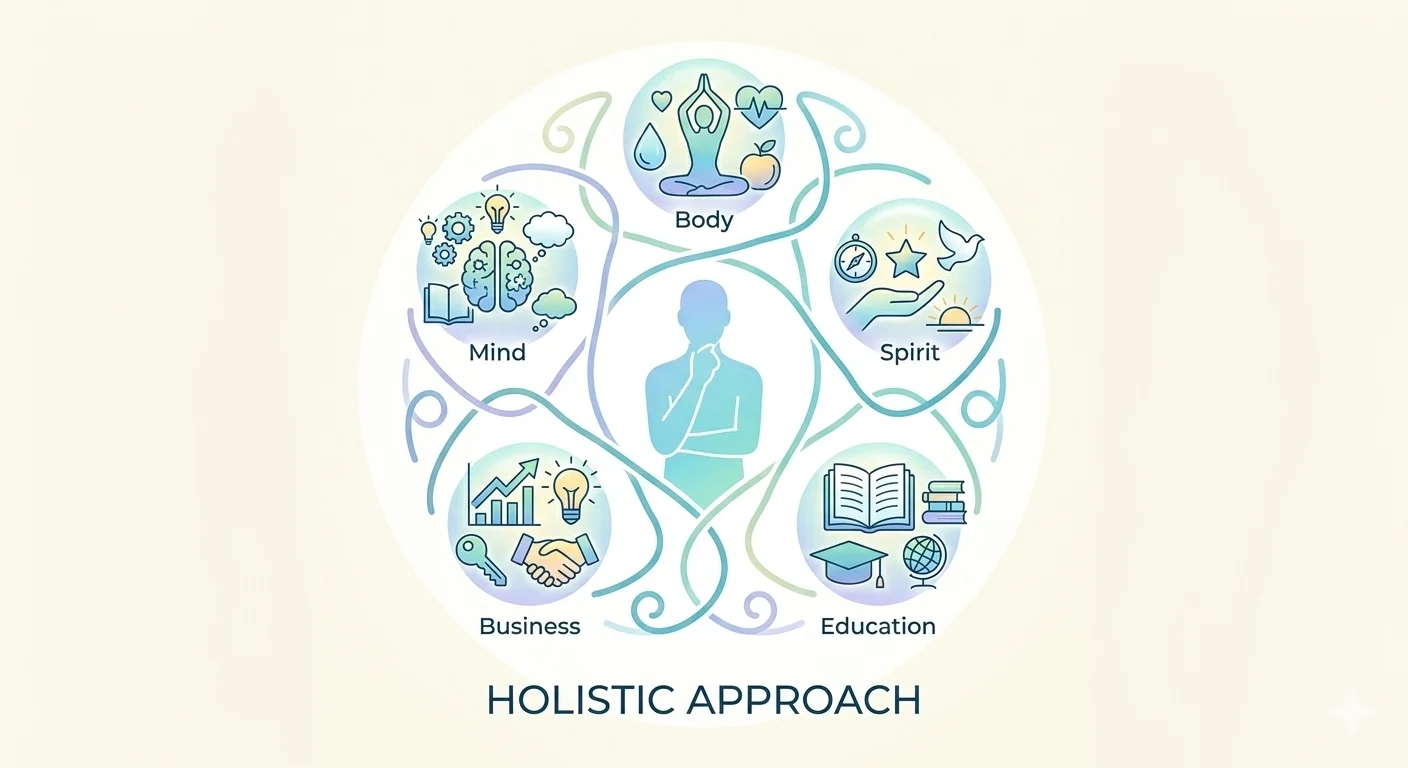
You’ve probably heard the word “holistic” in healthcare, wellness, education, business, or even everyday conversations—but what does it actually mean? Holistic (pronounced hoh-LIS-tik) means considering the whole person, system, or situation rather than focusing on just one part.
Instead of looking at individual pieces in isolation, a holistic approach recognizes that everything is connected and works together to form the bigger picture.
In simple terms, holistic means looking at the complete picture, not just a single piece of it. For example, a holistic doctor may consider a person’s physical health, mental well-being, lifestyle, and environment instead of treating only one symptom. Likewise, a holistic approach to education supports a student’s academic, emotional, and social development rather than focusing only on grades.
This is why the word is widely used across many fields—it emphasizes understanding the whole instead of just the individual parts.
Whether you’ve seen holistic in a health article, workplace discussion, classroom, or social media post, understanding the word is easier than it sounds. In this guide, you’ll learn its meaning, pronunciation, origin, real-life examples, and how it differs from similar terms like comprehensive, integrated, and overall, so you’ll know exactly when and how to use holistic with confidence.
What Does Holistic Mean? (Simple Definition)
Holistic is an adjective meaning: relating to or concerned with complete systems rather than with the analysis or treatment of individual parts.
In the simplest words:
Holistic means looking at the whole, not just the parts.
If something is holistic, it considers all connected elements together — physical, mental, emotional, social, and environmental — because these elements influence each other and cannot be fully understood in isolation.
Holistic simple definition:
- Whole-system thinking
- Interconnected approach
- Big-picture perspective
Part of speech: Adjective Adverb form: Holistically Noun form: Holism / Holistic approach Opposite: Reductionist (focusing on individual parts in isolation)
Etymology: Where Does “Holistic” Come From?
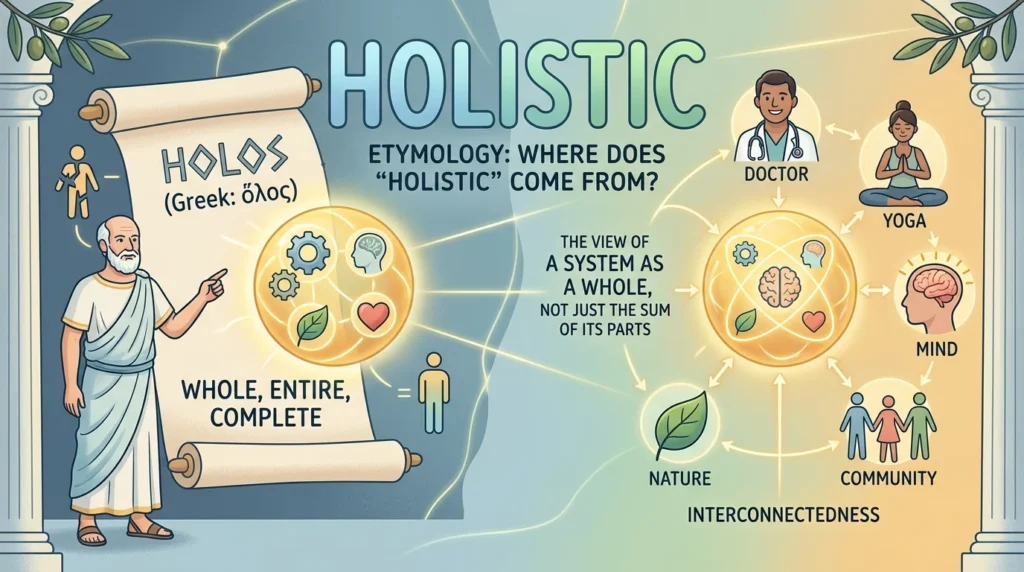
The word holistic comes from the Greek word holos — meaning whole or entire.
Word origin chain:
Greek: holos (whole, entire, complete) English: holism (the theory that wholes are greater than the sum of their parts) English adjective: holistic (of or relating to holism) Adverb: holistically
The term was first used academically in 1926 when South African philosopher Jan Smuts introduced the concept of holism in his book Holism and Evolution — arguing that living systems must be understood as wholes, not just collections of parts.
Historical Timeline
| Era | Development |
|---|---|
| 1926 | Jan Smuts coins “holism” in philosophy |
| 1970s | Holistic medicine gains mainstream attention in the U.S. |
| 1980s | Holistic education movements emerge globally |
| 1990s–2000s | Spreads into business, psychology, and personal development |
| 2026 | Universal term across health, tech, leadership, and lifestyle |
Note on misspellings: Many people search hollistic, holisitic, holidtic, holistic (wrong accent), wholistic, holestic, or hilistic — these are all common misspellings of the correct word: h-o-l-i-s-t-i-c.
Holistic Meaning in Different Contexts
1. Holistic Meaning in Health and Medicine
In health and medicine, holistic meaning refers to treating the whole person — body, mind, emotions, and spirit — rather than only addressing the presenting symptom.
Holistic health is not just about physical symptoms. It considers:
- Physical: nutrition, exercise, sleep, disease
- Mental: stress, thought patterns, cognitive health
- Emotional: feelings, relationships, trauma
- Spiritual: purpose, meaning, connection
“A holistic doctor doesn’t just prescribe medication for your headache — they also explore your sleep quality, diet, emotional stress, and lifestyle.”
Holistic medicine meaning: A system of healthcare that integrates conventional medicine with complementary therapies (acupuncture, yoga, herbal medicine) to treat the whole person.

Examples:
- “She followed a holistic health plan that included therapy, nutrition, and daily meditation.”
- “Holistic nursing care addresses physical recovery and emotional well-being simultaneously.”
2. Holistic Meaning in Psychology
Holistic meaning in psychology refers to understanding human behavior and mental processes by examining the complete person and their environment, not just isolated symptoms or behaviors.
Holistic psychology is rooted in Gestalt psychology (from German Gestalt — “whole form”) — the theory that the mind perceives the whole before its parts, and that the whole experience is greater than the sum of its components.
Key applications in psychology:
- Holistic therapy: Addresses mental, emotional, physical, and spiritual well-being together
- Holistic assessment: Evaluates all aspects of a patient’s life — relationships, environment, past experiences — not just clinical symptoms
- Positive psychology: Focuses on building whole-person flourishing, not just eliminating disorders
“A holistic psychologist treating anxiety doesn’t just prescribe techniques for calming the nervous system — they explore diet, sleep, relationships, work stress, and meaning.”
Holistic psychology definition: An approach to mental health that treats the individual as a unified whole — recognizing that thoughts, emotions, body sensations, relationships, and environment are all interconnected.
3. Holistic Meaning in Education
Holistic meaning in education refers to an approach that develops the whole child — intellectually, emotionally, socially, physically, and creatively — rather than focusing only on academic performance.
A holistic education model recognizes that a child who feels safe, connected, and confident will learn better than one who is academically drilled but emotionally neglected.
Holistic education includes:
- Academic skills (literacy, math, science)
- Emotional intelligence (self-awareness, empathy)
- Creative development (art, music, imagination)
- Physical well-being (movement, play)
- Social skills (collaboration, communication)
- Values and character development
Examples:
- “The school’s holistic learning model integrates mindfulness sessions alongside core academics.”
- “Holistic education ensures no child is reduced to a test score.”
“Finland’s education system is widely cited as holistic — it prioritizes play, creativity, and well-being alongside academic achievement.”
4. Holistic Meaning in Business
Holistic meaning in business refers to managing and strategizing by looking at the organization as a complete, interconnected system — considering employees, culture, customers, operations, finance, and market position together.
A holistic business approach recognizes that changing one department affects others. For example, a customer service problem might be rooted in employee motivation, which connects to management culture, which connects to hiring practices.
Holistic business applications:
- Holistic marketing: Considers internal marketing, integrated marketing, relationship marketing, and socially responsible marketing as one unified strategy
- Holistic leadership: Leaders who consider team well-being, company culture, and business outcomes together
- Holistic strategy: Long-term planning that factors in people, processes, purpose, and profit simultaneously
Examples:
- “Our holistic business strategy improved both employee satisfaction and customer retention.”
- “She took a holistic view of the company’s problems and traced the root cause to onboarding gaps.”
“Holistic management doesn’t ask ‘how do we fix sales?’ — it asks ‘how does everything in our organization connect to sales results?'”
5. Holistic Meaning in Farsi (Persian)
In Farsi (Persian), “holistic” is translated and expressed through several terms:
| Farsi | Transliteration | Meaning |
|---|---|---|
| جامعنگر | Jāme’-negar | Holistic (whole-seeing approach) |
| کلنگر | Kol-negar | Holistic (seeing the whole) |
| یکپارچه | Yekpārche | Integrated / holistic |
| همهجانبه | Hame-jānebe | All-sided / comprehensive-holistic |
| کلگرا | Kol-garā | Holist / holistic thinker |
Holistic approach in Farsi: رویکرد جامعنگر (Ruyakard-e Jāme’-negar) Holistic health in Farsi: سلامت کلنگر (Salāmat-e Kol-negar)
Example sentence: “این رویکرد جامعنگر، جسم و روح را با هم در نظر میگیرد.” Translation: “This holistic approach considers both body and soul together.”
The concept of holistic thinking resonates deeply in Persian culture and Sufi philosophy, which has long emphasized the unity of being (wahdat al-wujud) — the idea that all existence is an interconnected whole.
Clemency Meaning: What Most People Get Wrong

Holistically Meaning — The Adverb Form
Holistically is the adverb form of holistic. It means: in a way that considers the whole system rather than individual parts.
Holistically meaning in simple words: Doing something with a complete, connected, whole-system perspective.
Examples of “holistically” in sentences:
- “The team approached the project holistically, mapping how each department’s work affected the others.”
- “To heal holistically means addressing body, mind, and spirit together.”
- “She thinks holistically — she never solves one problem without considering its ripple effects.”
Holistically meaning in business:
“When we think holistically about our brand, we consider not just the product but the customer experience, employee culture, and social impact.”
Holistic Approach Meaning
A holistic approach is a method or strategy that deliberately considers all parts of a system and their interrelationships, rather than addressing components in isolation.
Holistic approach definition:
A holistic approach is one that integrates all relevant dimensions of a subject — physical, mental, emotional, social, environmental — to understand and address the whole rather than just symptoms or parts.
What does it mean to take a holistic approach? It means asking: “What else is connected to this? What am I missing if I only look here? How do all the parts interact?”
Holistic approach examples:
- Medical: Treating a patient’s chronic pain by examining sleep, posture, diet, stress, and emotional history — not just prescribing painkillers
- Educational: Supporting a struggling student by addressing home environment, emotional state, learning style, and classroom dynamics together
- Business: Solving high employee turnover by examining leadership, compensation, culture, onboarding, and growth opportunities — not just raising salaries
Best Boy Meaning: What This Film Term Really Means
Holistic Person Meaning — What Is a Holistic Person?
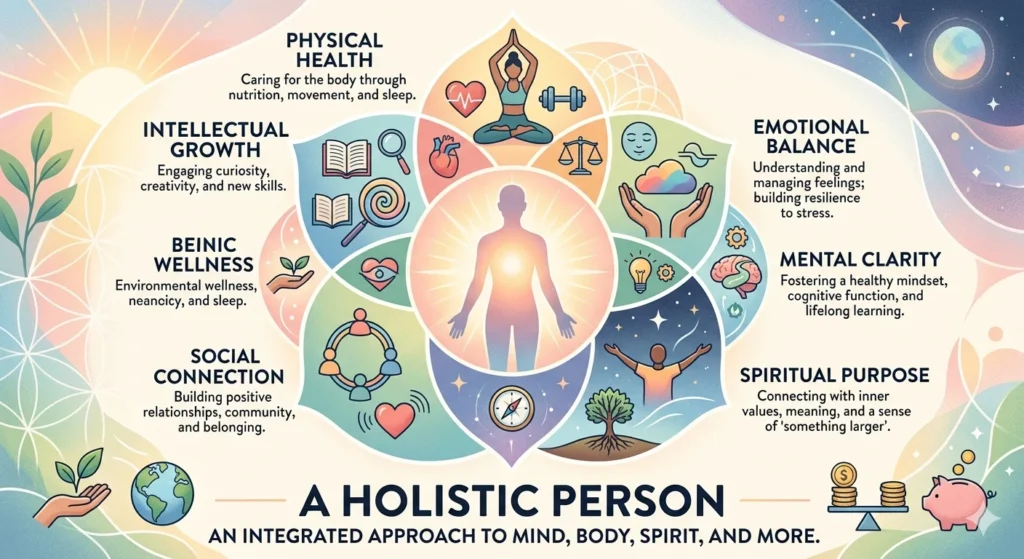
A holistic person is someone who naturally thinks and lives with an awareness of the whole — considering how different aspects of life are interconnected and giving balanced attention to mind, body, emotions, relationships, and purpose.
Signs of a holistic person:
- They consider long-term consequences, not just immediate fixes
- They balance work, relationships, health, and personal growth
- They see problems as interconnected, not isolated
- They practice self-awareness — physically, emotionally, mentally
- They value both logic and intuition in decision-making
“She’s a truly holistic person — she manages her health, relationships, career, and inner growth as one unified life practice.”
Holistic Thinking Meaning and Definition
Holistic thinking is a cognitive style that naturally sees the connections between things — the patterns, relationships, and interdependencies that reductionist thinking misses.
Holistic thinking definition:
Holistic thinking is the ability to see and understand a situation, system, or problem by considering all of its components and their relationships to the whole.
Holistic thinking vs. analytical thinking:
| Holistic Thinking | Analytical Thinking | |
|---|---|---|
| Focus | The whole system and connections | Individual parts in detail |
| Strength | Seeing patterns and context | Precision and technical depth |
| Risk | May miss specific details | May miss the big picture |
| Best used for | Strategy, culture, relationships | Research, diagnosis, engineering |
The most effective thinkers combine both — holistic vision to understand context, analytical precision to solve specific problems.
Holistic Lifestyle Meaning
A holistic lifestyle means intentionally caring for all dimensions of your well-being — not just physical health, but mental clarity, emotional balance, meaningful relationships, spiritual grounding, and environmental awareness.
A holistic lifestyle includes:
- Nourishing food and conscious eating
- Regular movement (yoga, walking, exercise)
- Mental health practices (meditation, journaling, therapy)
- Meaningful relationships and community
- Purposeful work and creative expression
- Connection to nature and environment
- Spiritual or philosophical practice
“Living holistically doesn’t mean being perfect — it means being intentional about all the dimensions of your life, not just the visible ones.”
Holistic Synonyms — Words That Mean the Same Thing
If you need another word for holistic or a holistic approach, here are the best alternatives:
| Synonym | Meaning | When to Use |
|---|---|---|
| Integrative | Combining multiple approaches or methods | Medical, educational contexts |
| Comprehensive | Including all necessary parts | Academic, business contexts |
| All-encompassing | Covering every aspect | Emphasis on completeness |
| Whole-systems | Focused on the whole system | Technical, organizational |
| Big-picture | Seeing broad context | Informal, business conversations |
| Unified | Treating as one connected whole | Strategic, philosophical |
| Total | Complete, entire | General use |
| Inclusive | Taking all factors into account | Education, social contexts |
Best holistic synonym for business: Integrative or comprehensive Best holistic synonym for health: Integrative or whole-person Best holistic synonym for education: Whole-child or comprehensive
Holistic vs. Comprehensive vs. Integrative — Key Differences
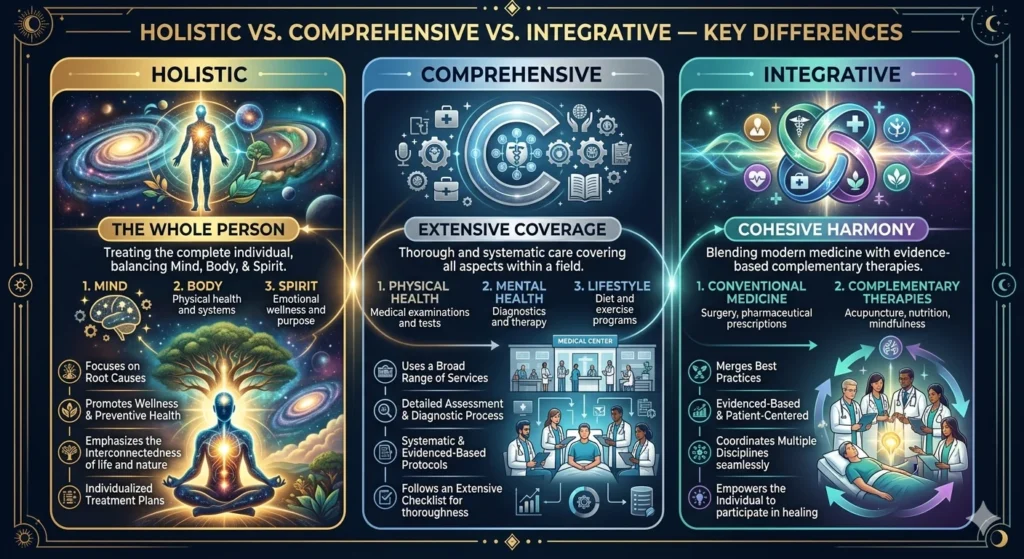
These three words are often confused. Here’s the honest difference:
| Term | Core Idea | Key Difference |
|---|---|---|
| Holistic | The whole is greater than its parts; interconnection matters | Emphasizes relationship between parts |
| Comprehensive | All parts are included | Emphasizes completeness — all parts present |
| Integrative | Different methods or systems combined | Emphasizes combining separate approaches |
Example:
- A comprehensive health plan covers every body system.
- A holistic health plan treats the connections between body, mind, and spirit.
- An integrative health plan combines conventional medicine with alternative therapies.
“Holistic” Used in Sentences — 10 Clear Examples
These examples directly target the keyword “holistic in a sentence” and “easy sentence of holistic”:
- Health: “Her holistic recovery plan included therapy, nutrition coaching, and daily yoga.”
- Education: “The school’s holistic curriculum develops emotional intelligence alongside math and science.”
- Business: “The CEO took a holistic view of declining sales, examining culture, product quality, and market trends.”
- Psychology: “Holistic therapy addresses the root causes of anxiety, not just the symptoms.”
- Lifestyle: “She lives holistically — balancing career ambition with rest, relationships, and spiritual practice.”
- Medicine: “Holistic medicine treats the patient, not just the disease.”
- Leadership: “Great leaders think holistically — they never optimize one department at the cost of the whole.”
- Research: “The study used a holistic research methodology, incorporating quantitative data and lived experience.”
- Simple: “Take a holistic approach: don’t just fix the leak — find out why the pipe broke.”
- Farsi context: “In Persian philosophy, the holistic (کلنگر) view of existence has ancient roots in Sufi tradition.”
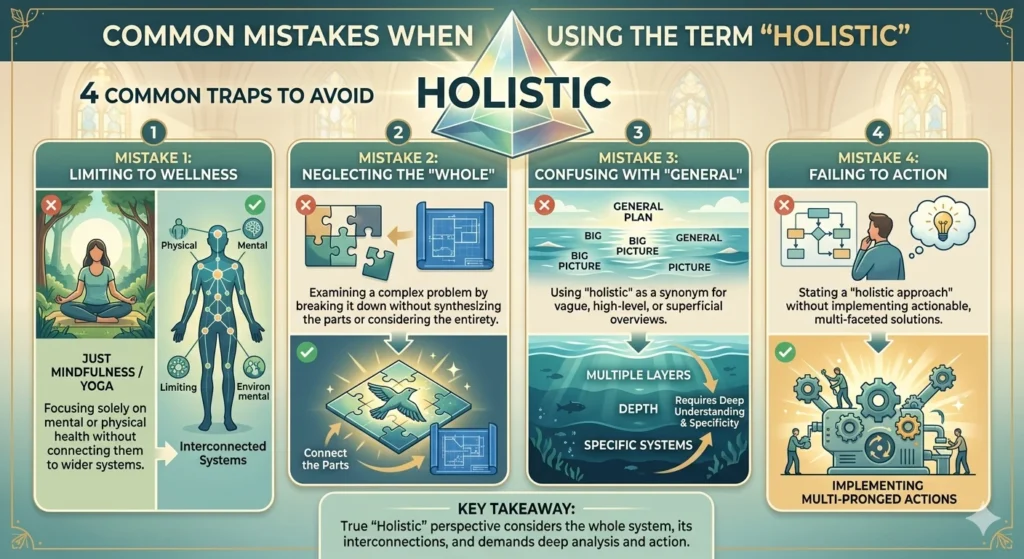
Common Mistakes When Using “Holistic”
Mistake 1 — Using it only for health/alternative medicine Holistic applies broadly — education, business, psychology, research, leadership, and personal life. It is not limited to yoga or herbal medicine.
Mistake 2 — Confusing holistic with comprehensive Comprehensive means all parts included. Holistic means all parts are understood as interconnected. A comprehensive plan may miss relationships between elements; a holistic plan specifically examines those relationships.
Mistake 3 — Wrong spelling The correct spelling is h-o-l-i-s-t-i-c. Common wrong spellings: hollistic, holisitic, holidtic, wholistic, holestic, hilistic, holastic, holisticly. None of these are correct.
Mistake 4 — Using “an holistic” instead of “a holistic” In standard American English, use “a holistic” (not “an holistic”), because “holistic” begins with a consonant sound /h/. British English occasionally uses “an holistic” when the /h/ is silent — but “a holistic” is universally accepted and safest.
FAQs About Holistic Meaning
What does holistic mean in simple words?
Holistic means looking at the whole picture instead of just one part. It’s the opposite of tunnel vision — a holistic thinker always asks, “How does everything connect?”
What is a holistic synonym?
The best synonyms for holistic are: integrative, comprehensive, all-encompassing, whole-systems, unified, and big-picture. In medical contexts, “integrative” is the closest match.
What does it mean to be holistic?
To be holistic means to naturally consider all dimensions of a situation — physical, mental, emotional, social, and environmental — together. A holistic person sees connections that others miss.
What is meant by holistic approach?
A holistic approach is a method that addresses all related dimensions of a problem or system together, rather than treating parts in isolation. It emphasizes that the whole is greater than the sum of its parts.
What does holistic mean in health?
In health, holistic means caring for the whole person — body, mind, emotions, and spirit — rather than only treating the physical symptom. Holistic healthcare integrates conventional and complementary medicine.
What does holistic mean in education?
In education, holistic means developing the whole child — cognitive, emotional, physical, social, and creative — rather than focusing only on test scores and academic performance.
What does holistically mean?
Holistically is the adverb form of holistic. It means “in a whole-system way.” Example: “She approached her career holistically — considering passion, income, impact, and lifestyle together.”
What does holistic mean in Farsi?
In Farsi, “holistic” is most commonly translated as جامعنگر (Jāme’-negar) meaning “whole-seeing,” or کلنگر (Kol-negar) meaning “whole-considering.” A holistic approach in Farsi is رویکرد جامعنگر.
Is “holistic” a slang term?
No. Holistic is a formal academic and professional English term. It is appropriate in medical, educational, business, and philosophical contexts. Avoid using it in very casual or trivial situations.
Conclusion
Now you know that holistic meaning goes far deeper than a wellness buzzword. From holistic health that treats your whole person, to holistic education that develops your whole child, to holistic business strategy that aligns your entire organization — the word carries a powerful and precise idea: the whole is always greater than the sum of its parts.
Whether you’re a student searching for “holistic simple meaning,” a professional building a holistic approach in your organization, a parent researching holistic education, or a Farsi speaker looking up رویکرد جامعنگر — the core truth is the same: when you see the connections, you understand the whole. And when you understand the whole, you can actually change it.

Willie Nelson is a skilled and passionate content writer working as an expert author at maeningg.com. With strong knowledge of digital trends, slang meanings, and engaging online content, Willie focuses on creating clear, helpful, and reader-friendly articles.