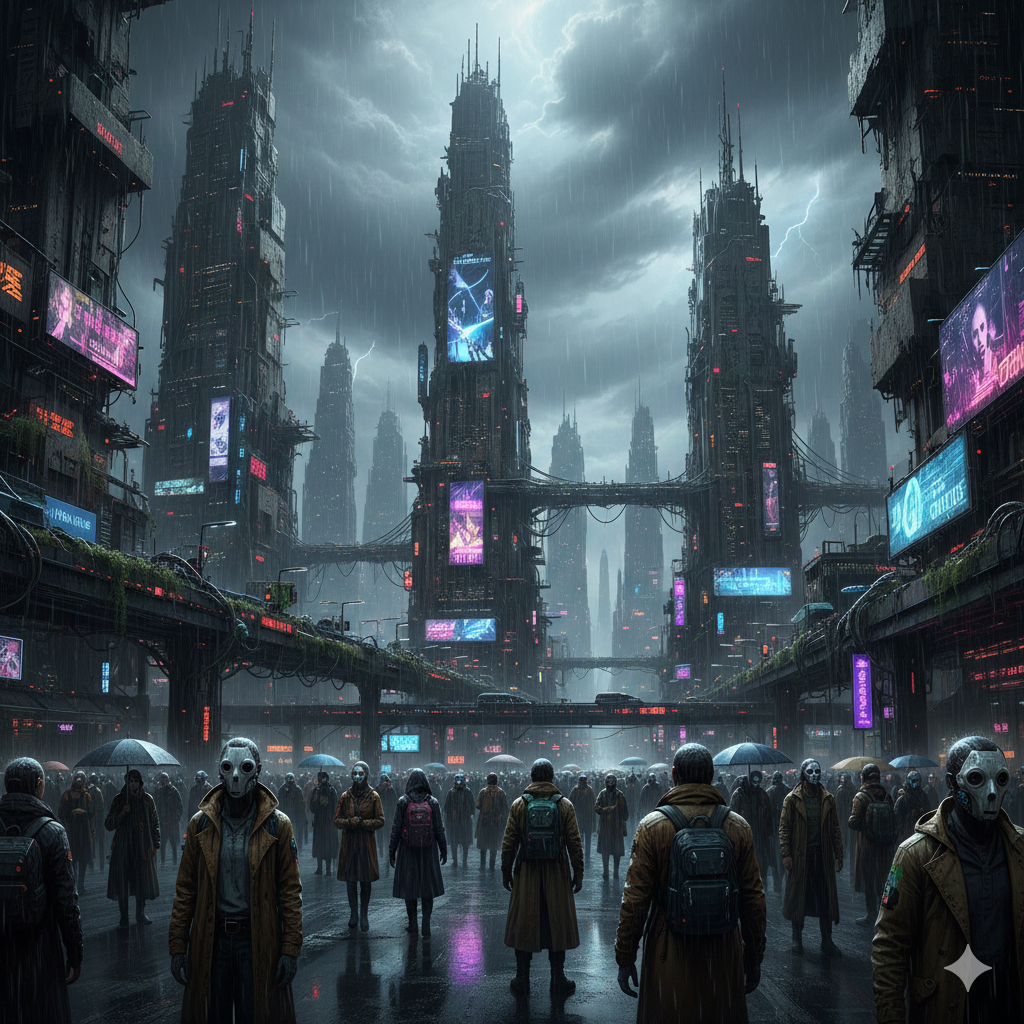
What if you lived in a world where every move was watched, every choice was controlled, and freedom existed only as an illusion? This unsettling idea is exactly what the word “dystopian” is often used to describe—and it’s why the term appears so frequently in books, movies, and discussions about the future.
Dystopian describes an imagined society that is oppressive, frightening, or deeply flawed, often marked by government control, injustice, surveillance, or a loss of personal freedom.
For example, the worlds portrayed in many popular stories are considered dystopian because ordinary people live under harsh rules and limited freedoms. But “dystopian” isn’t used only in fiction.
People also use the word to describe real-life situations that seem disturbing, restrictive, or alarmingly unfair. In this guide, you’ll learn the meaning of “dystopian,” its origins, examples, and how it’s used in everyday English.
What Does Dystopian Mean?
Dystopian meaning: A dystopian society is an imagined or fictional society that is characterized by oppression, government control, social inequality, surveillance, censorship, or loss of personal freedom.
In simple terms, a dystopian world is a place where things have gone seriously wrong.
The word is often used to describe a future society where people live under strict rules, constant monitoring, or unfair systems that benefit only a small group of people.
Dystopian Definition
A dystopian society is a flawed, oppressive, or frightening community in which citizens experience limited freedom, fear, inequality, or excessive control.
Example Sentence
The novel depicts a dystopian future where every citizen is monitored by advanced surveillance technology.
Dystopian Meaning in Simple Words
Many people search for:
“What is dystopian in simple words?”
The simplest answer is:
A dystopian world is a bad version of society where people have fewer rights, less freedom, and often live under strict control.
Imagine a world where:
- Every movement is tracked.
- Freedom of speech is restricted.
- Governments control information.
- Technology is used to monitor citizens.
- Social inequality becomes extreme.
That would be considered dystopian.
Dystopian Meaning at a Glance
| Term | Meaning |
|---|---|
| Dystopian | Describes a bad, oppressive, or controlled society |
| Dystopia | The actual society itself |
| Utopian | Describes a perfect society |
| Dystopian Society | A society marked by control, inequality, and fear |
| Dystopian Future | A future where social conditions have become harmful or oppressive |
Origin and History of the Word Dystopian
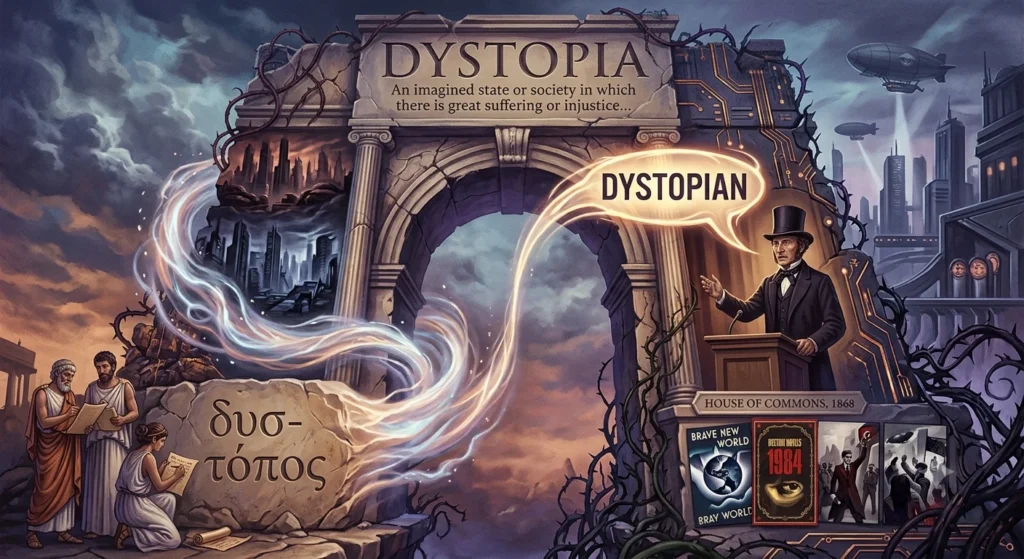
The word dystopian comes from Greek roots:
- Dys = bad
- Topos = place
Together, they mean “bad place.”
The concept developed as the opposite of utopia, a term introduced by Thomas More in 1516 to describe an ideal society.
Historical Timeline
1516 – Thomas More coins the word utopia.
1868 – The term dystopia appears in political discussions.
1900s – Dystopian literature gains popularity.
1949 – George Orwell’s 1984 becomes one of the most influential dystopian novels ever written.
Today – Dystopian themes are widely used to discuss artificial intelligence, surveillance, climate change, censorship, and technological control.
Utopian vs Dystopian Meaning
One of the most common questions is:
What is the difference between utopian and dystopian meaning?
| Utopian Society | Dystopian Society |
|---|---|
| Freedom | Control |
| Equality | Inequality |
| Prosperity | Hardship |
| Hope | Fear |
| Transparency | Propaganda |
| Human Rights | Restricted Rights |
A utopian society represents an ideal world, while a dystopian society represents a world where power, technology, or social systems have created suffering and oppression.
What Is a Dystopian Society?
A dystopian society is a social system where people experience oppression, limited freedoms, or systemic injustice.
Although these societies often claim to create order or security, they usually achieve it through excessive control.
Common Characteristics of a Dystopian Society
Government Control
Authorities hold overwhelming power over citizens.
Mass Surveillance
People are constantly watched through cameras, technology, or digital tracking systems.
Censorship
Information is restricted or manipulated.
Propaganda
Governments shape public opinion through controlled messaging.
Social Inequality
Resources and opportunities are distributed unfairly.
Fear and Punishment
Citizens are controlled through intimidation or harsh consequences.
Technological Control
Advanced technology is used to monitor behavior and limit freedom.
These characteristics appear repeatedly throughout dystopian fiction.
Dystopian Meaning in Literature
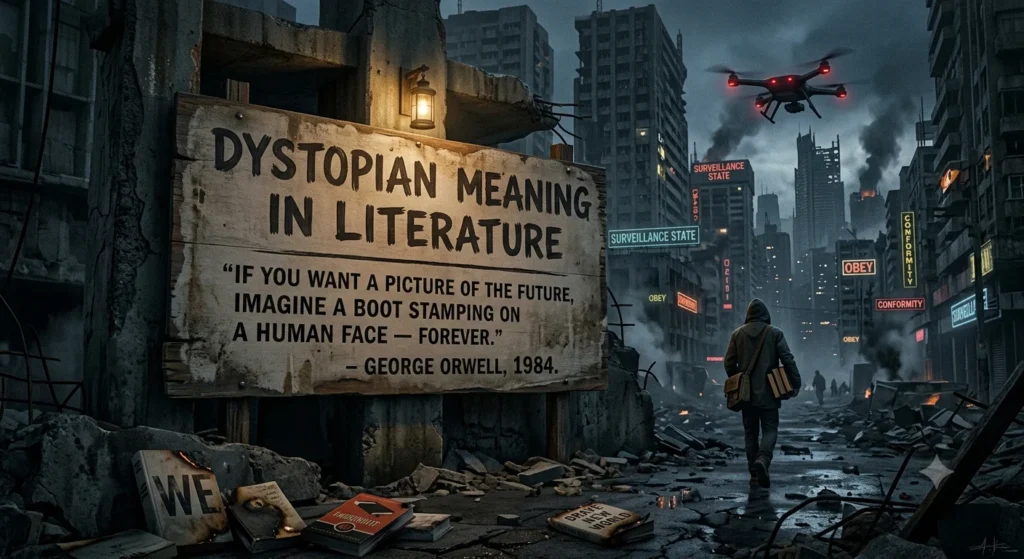
In literature, dystopian meaning refers to fictional worlds that explore the darker side of society.
Authors use dystopian settings to examine issues such as:
- Totalitarian governments
- Environmental disasters
- Social inequality
- Corporate power
- Technological dependence
- Loss of privacy
Dystopian literature often acts as a warning about what could happen if current problems become extreme.
Famous Dystopian Books
- 1984
- Brave New World
- Fahrenheit 451
- The Handmaid’s Tale
- The Hunger Games
- Divergent
These books remain popular because they address fears that continue to exist today.
Ornery Meaning Explained for Easy Understanding
Dystopian Meaning in Books
The dystopian book genre focuses on societies where freedom, equality, or justice has broken down.
Readers enjoy dystopian books because they:
- Explore powerful social issues.
- Present thought-provoking moral questions.
- Create suspenseful storylines.
- Reflect real-world concerns.
Many dystopian novels combine science fiction, political commentary, and psychological drama.
Dystopian Meaning in Movies
In film, dystopian worlds often appear visually striking and emotionally intense.
Popular Dystopian Movies
- The Hunger Games
- The Matrix
- Blade Runner 2049
- Children of Men
- Snowpiercer
- V for Vendetta
Common Themes in Dystopian Movies
- Surveillance states
- Artificial intelligence
- Authoritarian rule
- Social collapse
- Environmental destruction
- Corporate control
These films encourage viewers to think critically about the future.
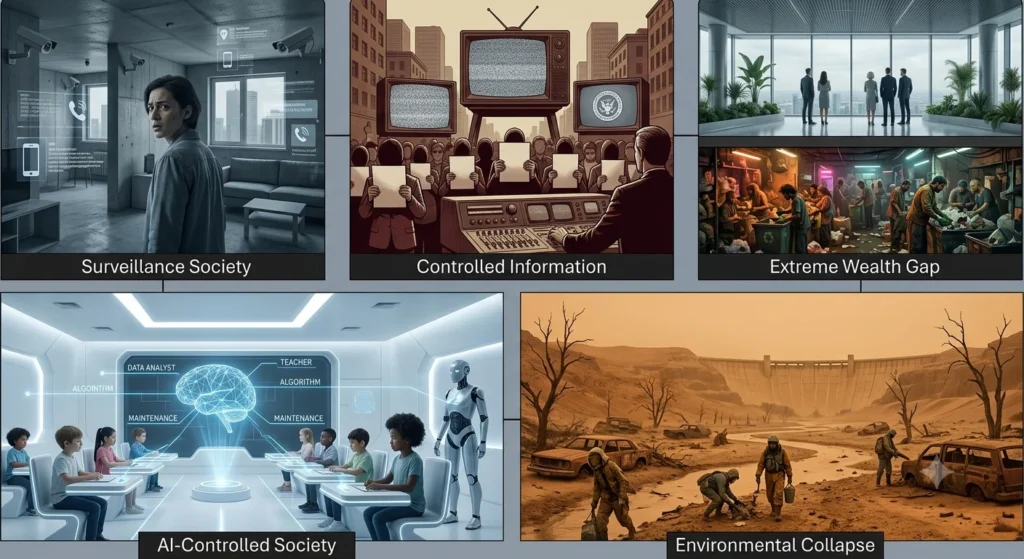
Dystopian Meaning and Examples
Understanding examples makes the concept much easier to grasp.
Example 1: Surveillance Society
Every text message, phone call, and online activity is monitored.
Example 2: Controlled Information
Citizens can only access government-approved information.
Example 3: Extreme Wealth Gap
A small elite controls most resources while everyone else struggles.
Example 4: AI-Controlled Society
Artificial intelligence determines education, careers, and social status.
Example 5: Environmental Collapse
Climate disasters create scarcity, conflict, and instability.
These examples represent classic dystopian scenarios.
Dystopian Future Meaning
A dystopian future is a vision of tomorrow where society has become oppressive, unequal, or dangerous.
Many dystopian stories imagine futures shaped by:
- Advanced surveillance technology
- Climate crises
- Artificial intelligence
- Corporate monopolies
- Political extremism
The purpose is not necessarily to predict the future but to warn about possible consequences of present-day choices.
Dystopian World Meaning
A dystopian world is a setting where everyday life is affected by fear, control, injustice, or social dysfunction.
Unlike ordinary fictional settings, dystopian worlds are designed to reveal the dangers of unchecked power and loss of freedom.
Dystopian Reality Meaning
When people say something feels like a dystopian reality, they usually mean it resembles situations commonly found in dystopian fiction.
For example:
- Excessive digital tracking
- Loss of privacy
- Government overreach
- Extreme censorship
The phrase is often used metaphorically rather than literally.
Presence Meaning: The Simple Definition Explained Clearly
Dystopian Vibes Meaning
The phrase dystopian vibes has become popular online.
It refers to situations that feel unsettling, unnatural, overly controlled, or strangely futuristic.
Example:
“The empty streets filled with surveillance cameras gave off dystopian vibes.”
Dystopian Feeling Meaning
A dystopian feeling is the emotional response people experience when something seems oppressive, artificial, or disturbing in a way that resembles dystopian fiction.
Common emotions include:
- Anxiety
- Unease
- Fear
- Helplessness
- Uncertainty
Can Real Life Be Dystopian?
This is one of the most frequently asked questions.
Most countries are not true dystopias. However, people sometimes use the term to describe real-world situations involving:
- Mass surveillance
- Authoritarian governments
- Censorship
- Social inequality
- Privacy concerns
The term is often used as a warning rather than a literal description.
Is Harry Potter a Dystopia?
No.
Harry Potter is primarily considered a fantasy series.
Although some parts involve corruption, discrimination, and abuse of power, the overall setting does not meet the definition of a dystopian society.
The series focuses on magic, adventure, friendship, and the struggle between good and evil.
Dystopian Meaning in Different Languages
Dystopian Meaning in Hindi
डिस्टोपियन का अर्थ है एक ऐसी समाज व्यवस्था जो दमनकारी, अन्यायपूर्ण या भय पैदा करने वाली हो।
Dystopian Meaning in Bengali
ডিস্টোপিয়ান বলতে এমন একটি সমাজকে বোঝায় যা অত্যাচারী, অন্যায্য বা ভীতিকর।
Dystopian Meaning in Arabic
يشير مصطلح ديستوبي إلى مجتمع قمعي أو غير عادل أو مليء بالخوف والسيطرة.
Dystopian Meaning in Farsi
دیستوپیایی به جامعهای گفته میشود که سرکوبگر، ناعادلانه یا ترسناک باشد.
Dystopian Meaning in Chinese
反乌托邦通常指一个充满压迫、不平等或社会控制的社会。
Dystopian Synonyms
Some common dystopian synonyms include:
- Oppressive
- Authoritarian
- Totalitarian
- Bleak
- Nightmarish
- Controlled
- Futuristic
- Post-apocalyptic
Why Are Dystopian Stories So Popular?
Dystopian stories remain popular because they explore important questions about humanity.
They encourage readers and viewers to think about:
- Freedom versus security
- Technology versus privacy
- Equality versus power
- Progress versus control
By imagining worst-case scenarios, dystopian fiction helps people understand real-world issues more clearly.
Frequently Asked Questions
What does dystopian mean?
Dystopian refers to a society that is oppressive, controlled, unequal, or deeply flawed.
What does dystopian mean in simple terms?
It means a bad or frightening society where people have limited freedom.
What is a dystopia in real life?
People use the term to describe situations that resemble themes found in dystopian fiction, such as mass surveillance or censorship.
What is the opposite of a dystopia?
The opposite of a dystopia is a utopia, an ideal society characterized by freedom, equality, and prosperity.
What is a dystopian novel?
A dystopian novel is a fictional story set in an oppressive or dysfunctional society.
What is dystopian meaning in literature?
In literature, dystopian refers to fictional worlds that warn readers about social, political, or technological dangers.
What is dystopian meaning in movies?
In movies, dystopian describes fictional societies affected by control, inequality, surveillance, or social collapse.
What does dystopian society mean?
A dystopian society is a community where freedom, privacy, and equality are significantly restricted.
What does dystopian future mean?
A dystopian future is a vision of tomorrow marked by oppression, inequality, or loss of freedom.
What does dystopian world mean?
A dystopian world is a fictional setting where society functions in harmful or oppressive ways.
Conclusion
The dystopian meaning extends far beyond a dictionary definition. It represents societies shaped by control, censorship, surveillance, inequality, and loss of freedom. Whether found in books, movies, or discussions about modern life, dystopian concepts serve as powerful warnings about the future.
By understanding what dystopian means, readers can better appreciate literature, analyze social issues, and recognize why dystopian stories continue to resonate across generations.

Dolly Parton is a professional content writer at maeningg.com, specializing in clear, engaging, and well-researched digital content. With strong expertise in writing about text slang, meanings, lifestyle, and informative articles, Dolly focuses on helping readers understand internet language in a simple and relatable way.