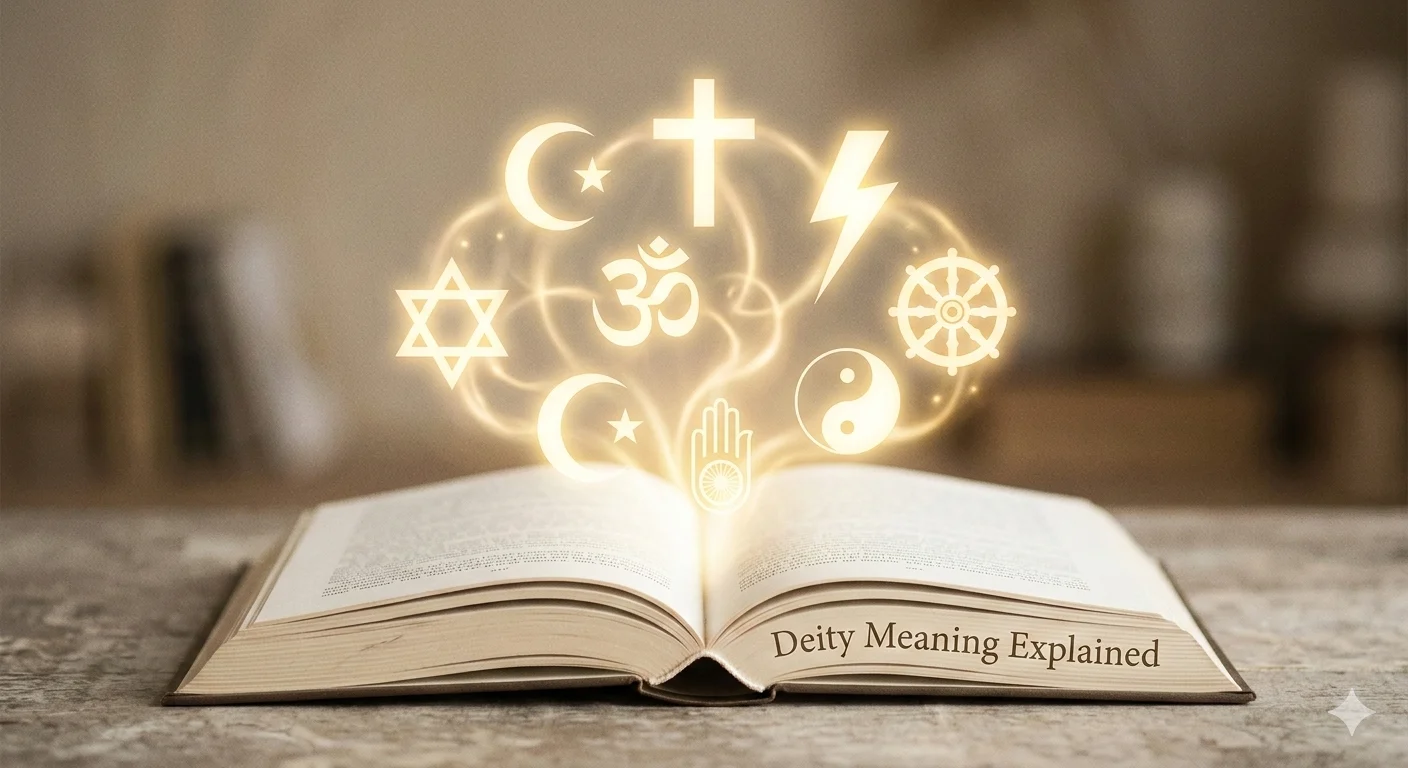
A “deity” isn’t just a word from old books—it’s a concept tied to power, worship, and the idea of something beyond human limits. You’ve probably heard it in mythology, religion, or fantasy stories, but the exact meaning can still feel a little unclear.
A deity is a god or goddess, or any divine being worshipped in a religion, mythology, or spiritual belief system. It can refer to a single supreme god or multiple gods depending on the tradition.
Here’s what makes it interesting: in some beliefs, a deity is the ultimate creator of everything, while in others, there are many deities, each controlling different forces like war, nature, or wisdom.
That’s why the word appears everywhere—from ancient temples and sacred texts to modern movies and fantasy worlds. In this guide, you’ll learn what deity means, how it’s used, different types of deities, and real examples from history and culture.
What Does “Deity” Mean in Simple English?
A deity is any god or divine being that is worshipped, revered, or recognized as holding supernatural power. The word is used as a neutral, scholarly term that covers divine beings from every religion and mythology — ancient or modern.
Simple definition of deity:
A deity is a higher power — a god, goddess, or divine spirit — that humans acknowledge, worship, or seek help from.
Deity examples in one line:
- Zeus (Greek mythology) → deity of thunder and the sky
- Vishnu (Hinduism) → deity of preservation and protection
- Allah (Islam) → the one supreme deity
- Jesus Christ (Christianity) → whose full deity is a central theological claim
- Ra (Ancient Egypt) → sun deity
Note on spelling: Many people search “diety meaning” or “dietity” or “deiety” — these are common misspellings of deity. The correct spelling is d-e-i-t-y. The “e” always comes before the “i,” from the Latin root deus.
Deity Meaning in English — Full Definition
Part of speech: Noun Plural: Deities Pronunciation: /ˈdiː.ɪ.ti/ → DEE-ih-tee
Dictionary-Level Definition of Deity
| Source | Definition |
|---|---|
| Merriam-Webster | “The rank or essential nature of a god; a god or goddess” |
| Oxford | “A god or goddess (in a polytheistic religion); divine status, quality, or nature” |
| Cambridge | “A god or goddess, or anything that is worshipped as divine” |
Deity as a Concept
Beyond dictionary definitions, deity captures the human recognition that something exists above and beyond the ordinary — a being or force that created, governs, or transcends the natural world. Every civilization in recorded history has had some concept of deity, making it one of the most universal words in human language.
How to Pronounce “Deity” (Pronounce Deity Meaning)
This is one of the most searched questions about the word. Here’s the complete breakdown:
- IPA phonetic: /ˈdiː.ɪ.ti/
- Say it as: DEE – ih – tee (3 syllables)
- Stress: First syllable — DEE-ih-tee
- Rhymes with: “see it” + “tea”
Wrong pronunciation: DAY-ih-tee (a common mistake influenced by the French deité) Right pronunciation: DEE-ih-tee
Plural (deities) pronunciation: DEE-ih-teez
Audio tip: Break it into three parts — DEE (like “see”) + ih (short “i”) + tee (like the letter T). Put it together: DEE-ih-tee.
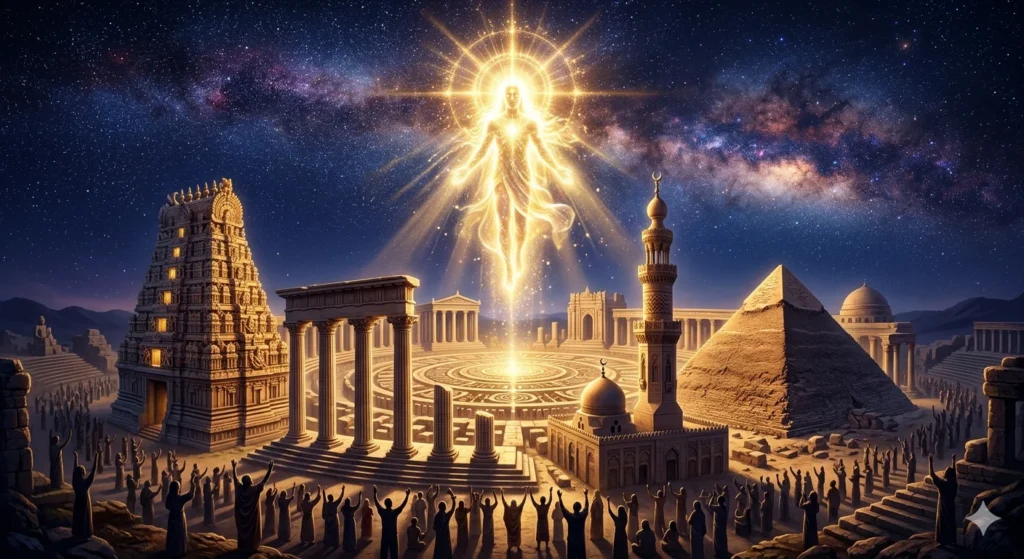
Etymology: Where Does the Word “Deity” Come From?
Understanding the origin of “deity” deepens your understanding of what it truly means.
Word origin chain:
Sanskrit: deva (divine, heavenly being) Latin: deus (god) → deitas (divine nature, godhood) Old French: deité Middle English: deite (14th century) Modern English: deity
The Latin deus is also the root of: divine, divinity, deify, diva, deus ex machina, and the Italian/Spanish word for God (Dio / Dios). The Greek parallel is theos → theology, theism, monotheism.
Historical Timeline
| Period | Development |
|---|---|
| Ancient times | Latin deus used in Roman religion and philosophy |
| 14th Century | Deity first recorded in English religious manuscripts |
| 17th–18th Century | Adopted in Christian theology and Enlightenment philosophy |
| 19th Century | Used in comparative religion to describe divine beings across all faiths neutrally |
| 2026 | Appears in religion, gaming, fiction, pop culture, philosophy, and interfaith dialogue |

Deity Meaning in the Bible — KJV, NIV, ESV, and Biblically
If you’ve searched “deity meaning in the Bible,” “deity meaning in the Bible KJV,” or “what does deity mean biblically,” this section answers every question.
Does the Word “Deity” Appear in the Bible?
The word “deity” does not appear in the King James Version (KJV) of the Bible. However, in modern translations like the NIV, ESV, and NASB, it appears most prominently in:
Colossians 2:9:
- NIV: “For in Christ all the fullness of the Deity lives in bodily form.”
- ESV: “For in him the whole fullness of deity dwells bodily.”
- KJV: “For in him dwelleth all the fulness of the Godhead bodily.”
The Greek word behind “deity” here is θεότης (theotēs) — meaning the complete, total essence of being God — not just godlike qualities, but the very nature of God Himself.
Deity Definition in the Bible (Biblical Meaning)
In the Bible, deity means:
- The divine nature of God — His essential, eternal, all-powerful being
- The fullness of Godhood — everything that makes God who He is
- The status of being worshipped — distinguishing the true God from false gods or idols
What Does “Deity of Jesus” or “His Deity” Mean Biblically?
The deity of Jesus Christ (also called the deity of Christ) is a core Christian doctrine asserting that Jesus is not merely a great moral teacher or prophet — He is fully God in human form.
Key Bible passages on the deity of Christ:
| Passage | Translation (paraphrased) | Significance |
|---|---|---|
| John 1:1 | “The Word was God” | Christ existed as God before creation |
| John 10:30 | “I and the Father are one” | Jesus claimed unity with God |
| John 20:28 | Thomas said “My Lord and my God!” | Disciples recognized His deity |
| Philippians 2:6 | “Being in very nature God” | Paul affirms Christ’s divine nature |
| Hebrews 1:3 | “The exact representation of His being” | Jesus mirrors God’s full nature |
| Colossians 2:9 | “The fullness of deity dwells in Him” | Strongest direct use of deity |
“His deity” therefore means the divine nature belonging to a specific male divine figure. In Christian theology, “his deity” refers to Jesus’s full status as God — not a demigod or semi-divine being, but fully, essentially divine.
False Deity Meaning in the Bible
In the Bible, a false deity refers to any god that is not the God of Israel — idols, pagan gods, or any being falsely elevated to divine status. The Ten Commandments address this directly: “You shall have no other gods before me” (Exodus 20:3).
The biblical stance is that false deities have no real divine power — they are human constructions or, in some theological interpretations, deceptive spiritual forces.
KJV vs Modern Translations: Deity vs. Godhead
| KJV Term | Modern Term | Greek Original | Meaning |
|---|---|---|---|
| Godhead (Romans 1:20) | Divine nature | θειότης (theiotēs) | Divine qualities |
| Godhead (Colossians 2:9) | Deity | θεότης (theotēs) | Full essence of God |
| Godhead (Acts 17:29) | Divine Being | θεῖον (theion) | The divine nature |
Deity Meaning in Islam
In Islam, the concept of deity is central to the entire faith — and it is absolute and exclusive.
The Islamic Definition of Deity
The Arabic word for deity is إله (ilāh) — meaning “a god” or “one who is worshipped.” The name الله (Allah) means “The God” — the definite, sole, supreme deity.
The foundational Islamic declaration of faith (the Shahada) states:
“Lā ilāha illā allāh, muḥammadun rasūlu llāh” “There is no deity but Allah, and Muhammad is His messenger.”
The word ilāh (deity) in this phrase is used to say: no being deserves worship except the one true God.
Key Points on Deity Meaning in Islam
1. Allah is the only true deity Allah is eternal, all-knowing, all-powerful, and without partners, children, or equals in the divine sense. He is the creator and sustainer of all existence.
2. Shirk — the gravest sin in Islam Assigning partners or equals to Allah (called shirk in Arabic) is considered the gravest sin in Islam. This includes worshipping multiple deities, idols, or elevating any human to divine status.
3. False deity (Tāghūt) In Islamic theology, a false deity is called tāghūt — anything that is worshipped, obeyed, or followed beyond the limits set by Allah. This includes idols, false gods, and even one’s own ego when elevated above divine guidance.
4. Angels and prophets are NOT deities In Islam, angels, prophets (including Jesus, Moses, and Muhammad), and saints are all created beings — honored but never worshipped. They hold no deity status.
Quranic Reference:
Surah Al-Ikhlas (112:1–4) affirms that Allah is “the One,” the “Eternal Refuge,” who “does not beget and was not begotten, and there is none comparable to Him.”
Surah Al-Baqarah (2:163):
“Your deity is one deity. There is no deity except Him, the Most Gracious, the Most Merciful.”
The deity meaning in Islam is therefore singular, exclusive, and absolute: Allah alone is worthy of worship, and recognizing any other deity is a fundamental theological error.
Deity Meaning in Farsi (Persian)
In the Farsi (Persian) language, “deity” is expressed through several words depending on context:
| Farsi Word | Transliteration | Meaning |
|---|---|---|
| خدا | Khoda | God / deity (general, widely used) |
| ایزد | Izad | Deity (classical/Zoroastrian context) |
| معبود | Ma’bood | “The worshipped one” — deity |
| الهه | Elāhe | Goddess (female deity) |
| خدایان | Khodāyān | Gods / deities (plural) |
| بغ | Bagh | Ancient Persian word for deity (archaic) |
Zoroastrian Deities in Farsi Culture
Persian culture has deep Zoroastrian roots. The supreme deity in Zoroastrianism is Ahura Mazda (اهورامزدا) — “the Wise Lord.” The faith also recognizes Yazatas — lesser divine beings who assist Ahura Mazda.
Example sentence in Farsi: “زئوس، ایزد آسمان در اساطیر یونانی است.” Translation: “Zeus is the deity of the sky in Greek mythology.”
Today, Persian speakers (in Iran, Afghanistan, and Tajikistan) most commonly use خدا (Khoda) to mean God/deity in everyday speech.
Deity Meaning in Chinese
In Mandarin Chinese, “deity” maps to several characters:
| Chinese | Pinyin | Meaning |
|---|---|---|
| 神 | Shén | Deity, god, spirit (most common) |
| 神灵 | Shénlíng | Divine spirit, deity |
| 神明 | Shénmíng | Wise deity (folk religion) |
| 天神 | Tiānshén | Heavenly deity |
| 女神 | Nǚshén | Goddess (female deity) |
| 神祇 | Shénqí | Deity (formal/literary) |
Chinese Deity Traditions
- Taoism: Deities like the Jade Emperor (玉皇大帝 Yù Huáng Dàdì) rule a celestial hierarchy
- Buddhism: Bodhisattvas like Guanyin (观音 Guānyīn) are revered as compassionate divine beings
- Folk religion: Local earth deities (土地公 Tǔdì Gōng) and kitchen gods are widely worshipped
Example: “观音是中国文化中广受崇拜的神灵。” Translation: “Guanyin is a widely revered deity in Chinese culture.”
Deity Meaning in Tamil
In Tamil (spoken in Tamil Nadu, India, and Sri Lanka), the word for deity is:
| Tamil | Transliteration | Meaning |
|---|---|---|
| கடவுள் | Kadavul | God / deity (primary word) |
| தெய்வம் | Theivam | Deity, divine being |
| தெய்வீகம் | Theiviham | Divine / sacred |
| தேவர் | Thevar | God, divine being (from Sanskrit deva) |
Tamil deity culture is ancient and rich. Tamil Hinduism venerates deities like Murugan (god of war and youth), Amman (mother goddess), and Ayyanar (village deity). The phrase “தெய்வம் தந்த பொருள்” (Theivam thantha porul) means “a gift from the deity.”
Deity Meaning in Urdu (With Examples)
In Urdu (spoken in Pakistan and India), the word for deity is:
| Urdu | Transliteration | Meaning |
|---|---|---|
| دیوتا | Deivta | Deity, god (Hindu context) |
| معبود | Ma’bood | “The worshipped one” — deity |
| خدا | Khuda | God / deity |
| بھگوان | Bhagwan | Hindu deity / God |
| الٰہ | Ilaah | Deity (Islamic context, from Arabic) |
Deity meaning in Urdu with example:
“ہندو مت میں گنیش جی ایک محبوب دیوتا ہیں۔” Translation: “In Hinduism, Ganesha is a beloved deity.”
In Islamic contexts in Urdu, الٰہ (Ilaah) is used — exactly matching the Arabic concept from the Shahada. “کوئی الٰہ نہیں سوائے اللہ کے” = “There is no deity except Allah.”
Deity Meaning in Bengali and Assamese
Bengali (বাংলা)
| Bengali | Transliteration | Meaning |
|---|---|---|
| দেবতা | Debota | Deity, divine being |
| ঈশ্বর | Iśwar | God / supreme deity |
| দেবী | Debi | Goddess (female deity) |
Bengali Hindu culture worships numerous deities. Durga Puja, the largest festival in West Bengal, celebrates the mother goddess Durga — a female deity representing power and the victory of good over evil.
Assamese (অসমীয়া)
| Assamese | Transliteration | Meaning |
|---|---|---|
| দেৱতা | Debota | Deity |
| ভগৱান | Bhagwan | God / deity |
| দেৱী | Debi | Goddess |
Assamese religious tradition includes both mainstream Hindu deities and indigenous tribal deities unique to Northeast India.
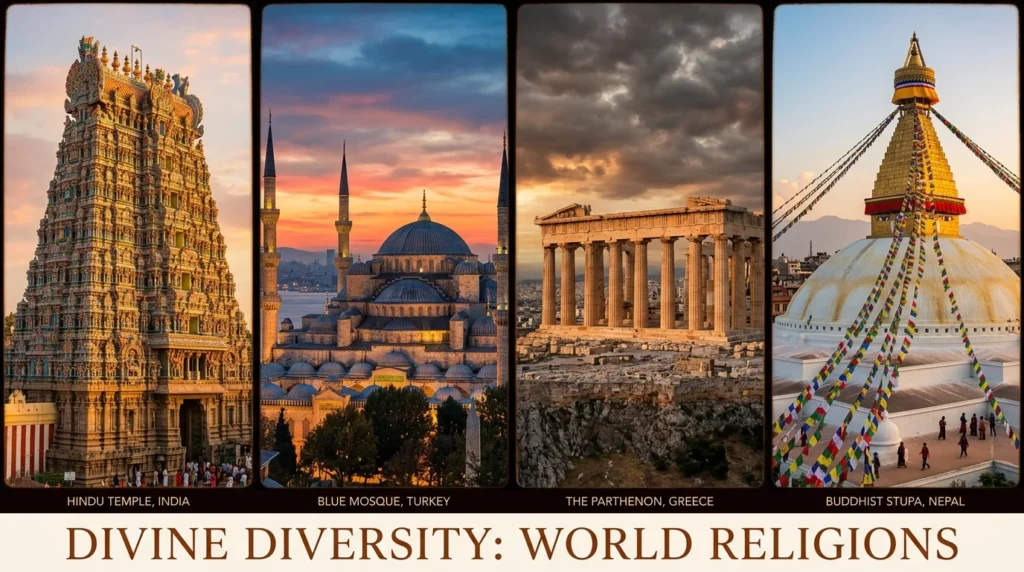
Deity Meaning in Religion: A World Overview
Hinduism — The Richest Deity Tradition
Hinduism has over 33 million deity forms (devatas), each representing a different aspect of the ultimate divine reality (Brahman).
Major deities in Hinduism:
- Brahma — creator deity
- Vishnu — preserver deity
- Shiva — transformer/destroyer deity (Trimurti)
- Lakshmi — deity of wealth and abundance
- Saraswati — deity of knowledge and arts
- Durga / Kali — fierce mother goddess deities
Kali deity meaning: Kali is the Hindu deity of time, destruction, and liberation. Her fearsome appearance represents the destruction of ego and the liberation of the soul. She is both destroyer and protector — a deity of transformation.
Ganesha deity meaning: Ganesha is the elephant-headed deity of new beginnings, wisdom, and the removal of obstacles. He is worshipped at the start of every important undertaking — a business launch, a marriage, a journey, or an exam.
Greek and Roman Mythology
Ancient Greek and Roman deities are among the most recognized worldwide:
| Greek Deity | Roman Equivalent | Domain |
|---|---|---|
| Zeus | Jupiter | Sky, thunder, king of gods |
| Athena | Minerva | Wisdom, warfare, crafts |
| Apollo | Apollo | Sun, music, prophecy |
| Poseidon | Neptune | Sea, earthquakes |
| Aphrodite | Venus | Love, beauty |
| Ares | Mars | War |
| Hades | Pluto | Underworld |
These are what most people picture when they hear “ancient deity.”
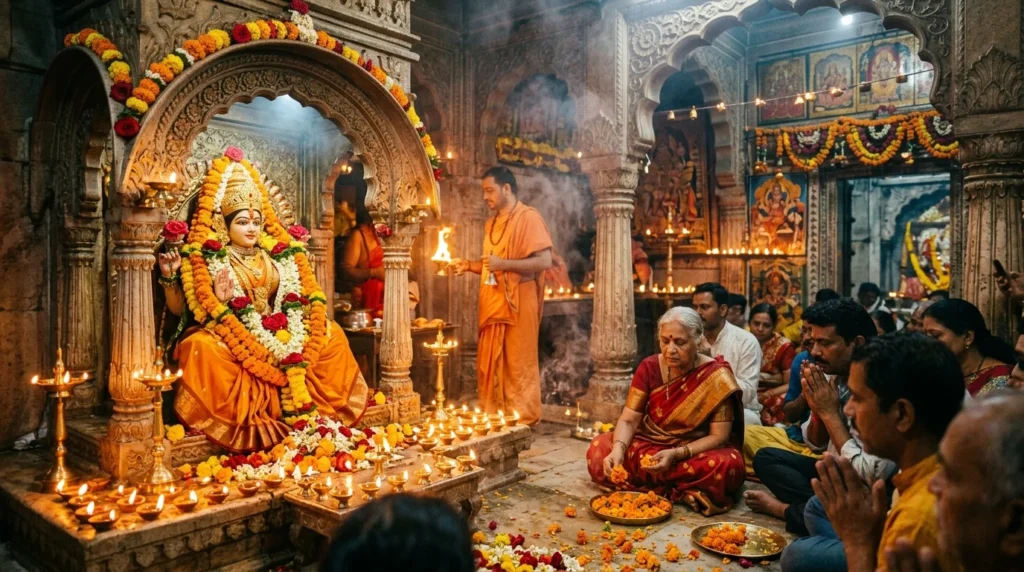
Yoruba / African Tradition — Orisha Deity Meaning
Orisha deity meaning: In the Yoruba religion of West Africa (and diaspora traditions like Candomblé and Santería), divine spirits called Orishas represent natural forces and human experiences.
- Shango — Orisha of thunder and justice
- Oshun — Orisha of rivers, love, and fertility
- Yemoja — Orisha of the ocean and motherhood
- Ogun — Orisha of iron, labor, and warriors
Orishas are not exactly gods in the Western sense — they are divine intermediaries between humans and the supreme deity (Olodumare). But in the context of comparative religion, they are classified as deities.
Egyptian Mythology
Ancient Egyptian deities were deeply tied to nature and cosmic order (Ma’at):
- Ra / Amun-Ra — sun deity, king of gods
- Osiris — deity of the afterlife and resurrection
- Isis — deity of magic and motherhood
- Anubis — deity of embalming and the dead
- Horus — sky deity, symbol of kingship
Norse Mythology
Norse deities (worshipped by Vikings) include:
- Odin — deity of wisdom, war, and death
- Thor — deity of thunder and strength
- Freya — deity of love, fertility, and war
- Loki — deity of mischief and chaos
Concept of Deity: The Philosophical Dimension
The concept of deity goes beyond religion into philosophy.
Monotheism vs. Polytheism vs. Pantheism
| Concept | Deity Belief | Examples |
|---|---|---|
| Monotheism | One supreme deity | Islam, Christianity, Judaism |
| Polytheism | Many deities | Greek, Hindu, Norse mythology |
| Henotheism | One chief deity among many | Early Vedic religion |
| Pantheism | Everything IS the deity | Some interpretations of Taoism, Spinozism |
| Deism | A deity created the world but doesn’t intervene | Enlightenment philosophy |
| Animism | Spirits in nature serve deity-like roles | Many indigenous traditions |
What Is the Difference Between a Deity and God?
“God” (capital G) = the supreme deity in monotheistic traditions; personal, singular, all-powerful. “deity” (lowercase) = any divine being across any tradition; broader and religiously neutral.
Every God is a deity. Not every deity is “God.”
What Is the Difference Between Deity and Divinity?
| Deity | Divinity | |
|---|---|---|
| What it is | A being (a god or goddess) | A quality or attribute |
| Example | “Vishnu is a deity” | “The divinity of Christ” |
| Can you see one? | Yes — in mythology, deities appear, speak, act | No — divinity is an abstract essence |
| Plural | Deities | — (divinity is uncountable) |
What Is the Difference Between a Deity and an Entity?
A divine entity is any supernatural being. A deity is specifically a divine being that is worshipped or held as sacred. All deities are divine entities, but not all divine entities are deities — a ghost, demon, or spirit is an entity but not necessarily a deity.
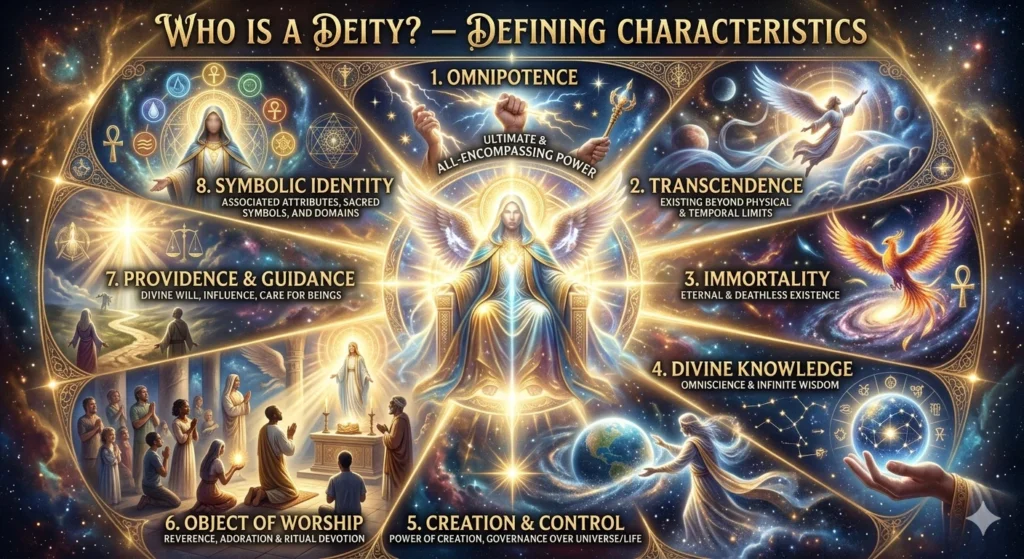
Who Is a Deity? — Defining Characteristics
For a being to qualify as a deity, it typically possesses several of these characteristics:
- Supernatural power — control over nature, fate, life, death
- Immortality or eternal existence
- Object of worship — people pray, offer, or sacrifice to this being
- Cosmic role — creator, destroyer, protector, judge
- Transcendence — exists beyond ordinary human reality
- Mythology or scripture — stories and texts that describe its nature and deeds
Not all deities possess all of these — some are local, minor, or morally ambiguous. But the combination of supernatural power and human reverence is what defines a deity.
CTFU Meaning: The Hidden Slang You Should Know
Family Deity Meaning
A family deity (also called:
- Kula Devata in Sanskrit/Hindi
- Clan deity in East Asian traditions
- Ancestral deity in various cultures)
…is a specific god or goddess that a family lineage has worshipped across generations, typically for protection, blessings, and ancestral honor.
How family deities work:
- The family deity is chosen (or inherited) based on family history, region, or caste
- Rituals are performed for the family deity at birth, marriage, death, and major life events
- Not worshipping one’s family deity is sometimes considered disrespectful to ancestors
Example: “Before moving to a new city, Priya’s family visited the temple of their family deity to seek blessings for the journey.”
Presiding Deity Meaning
A presiding deity is the principal, chief divine being of a specific temple, city, sacred site, or region.
- Tirupati Temple, India: Lord Venkateswara (Vishnu) is the presiding deity
- Vaishno Devi Temple: Goddess Vaishno Devi presides
- Athens, Greece: Athena was the presiding deity (the city is named after her)
In ancient city-states, the presiding deity was believed to spiritually protect and govern the entire region.
Spiritual Deity Meaning
In spiritual (non-institutional) contexts, a deity is understood as:
- An archetypal divine force — love, wisdom, creation, destruction — experienced as a living presence
- A patron deity — a specific divine being a person feels personally drawn to or guided by
- A cosmic energy — in New Age and neopagan traditions, deities are seen as personifications of universal energies rather than literal beings
Spiritual deity meaning in practice: Many modern spiritual practitioners (Wiccans, Pagans, Neo-Hindus) choose a deity to work with through meditation, ritual, and devotion. This chosen deity becomes a personal spiritual guide.
“Through years of meditation, she felt deeply connected to Saraswati as her spiritual deity.”
Deity in a Sentence — Real Examples
These examples cover every context and directly target the keyword “deity in a sentence” and “sentence with deity”:
- Basic: “Zeus is the most powerful deity in Greek mythology.”
- Biblical: “Colossians 2:9 speaks of the full deity of Christ dwelling in bodily form.”
- Islamic: “In Islam, Allah is the one and only deity worthy of worship.”
- Family: “Every year, the family travels to the temple of their ancestral deity to offer prayers.”
- Presiding: “Ganesha serves as the presiding deity at the entrance of most Hindu temples.”
- Female: “Durga is a powerful female deity who represents the triumph of good over evil.”
- Ancient: “The ancient Egyptians worshipped Ra as their supreme solar deity.”
- Spiritual: “She meditates daily and considers the moon a manifestation of her personal deity.”
- Metaphorical: “In basketball history, Michael Jordan is spoken of almost like a deity.”
- False deity: “The prophets of Israel repeatedly condemned the false deities of neighboring nations.”
“Deity” vs. Common Confusions
Deity vs. Idol
| Deity | Idol | |
|---|---|---|
| What it is | The divine being itself | A physical image/statue representing a deity |
| Worshipped? | Yes, directly | Not the idol itself — the deity it represents |
| Example | Ganesha | A clay Ganesha statue |
Deity vs. Prophet
A prophet is a human messenger chosen by a deity to deliver divine guidance. A prophet is not a deity — they are mortal, fallible, and die. Confusing prophets with deities is theologically significant in both Islam and Judaism.
Deity vs. Angel
An angel is a divine messenger or servant created by God/the deity. Angels are beings of immense power, but in most theological traditions (especially Islam and Christianity), they are created beings — not deities and not objects of worship.
Common Spelling Mistakes — And What They Mean
| Wrong Spelling | Correct | Notes |
|---|---|---|
| diety | deity | Most common typo — “e” before “i” |
| dietity | deity | Double error |
| deiety | deity | Extra “e” — common misspelling |
| dieties | deities | Wrong plural form |
| dities | deities | Severe misspelling |
| ditey | deity | Rearranged letters |
All of these are searches for the same word: deity. The correct spelling always follows the Latin root deus — keeping the “e” before “i.”
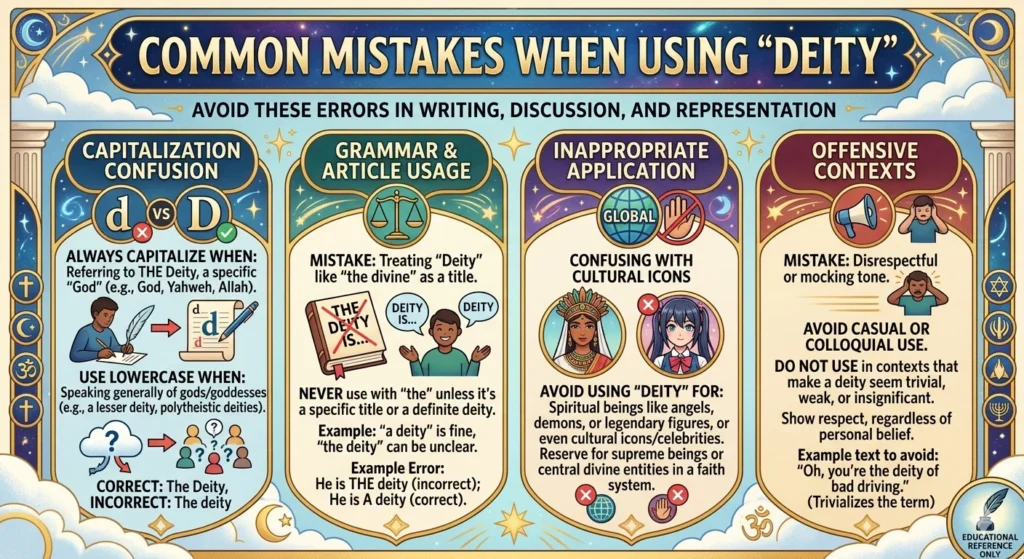
Common Mistakes When Using “Deity”
Mistake 1 — Confusing “deity” with “divinity” Deity = a being. Divinity = a quality. Saying “God’s deity” and “God’s divinity” are both used in theology, but they’re not interchangeable in every sentence.
Mistake 2 — Assuming all deities are benevolent Many deities are ambiguous, destructive, or morally complex — Kali, Loki, Set, Ares. Deities represent the full spectrum of cosmic power, not just goodness.
Mistake 3 — Using “deity” and “idol” interchangeably The idol is the statue; the deity is the divine being. In Islamic and Protestant theology, worshipping idols is forbidden — but the concept of “deity” itself is not.
Mistake 4 — Writing “diety” instead of “deity” Always: d-e-i-t-y. The “e” comes before “i.”
Mistake 5 — Using “deity” too casually Calling your friend “the deity of cooking” is humorous but imprecise. The word carries significant religious weight and should be used thoughtfully in serious contexts.
Frequently Asked Questions
What is the full meaning of deity?
A deity is a god, goddess, or divine being believed to hold supernatural power. The word comes from Latin deus (god) and covers divine beings from every religion and mythology — monotheistic, polytheistic, or spiritual.
Is a deity a god?
Yes. All gods are deities, but “deity” is the broader, neutral academic term. “God” (capital G) refers to the supreme deity in monotheistic faiths. “Deity” (lowercase) refers to any divine being — from God to Zeus to Ganesha.
What does “his deity” mean?
“His deity” refers to the divine nature or Godhood of a specific male divine figure. In Christian theology, “his deity” most commonly refers to the full divine nature of Jesus Christ — the doctrine that He is completely and essentially God.
What does deity mean biblically?
Biblically, deity means the complete, essential nature of God — His Godhood. In the KJV, “Godhead” is used; modern translations like the NIV and ESV use “deity” (Colossians 2:9). The biblical doctrine of the deity of Christ is foundational to Christianity.
What does deity mean in the Bible KJV?
The KJV uses “Godhead” rather than “deity.” In Colossians 2:9 (KJV): “For in him dwelleth all the fulness of the Godhead bodily.” Modern translations render this same Greek word (theotēs) as “deity.”
What is a false deity?
A false deity is any being worshipped as a god that is not recognized as the true God. In the Bible, false deities are the gods of pagan nations. In Islam, tāghūt (false deity) refers to anything wrongly elevated to divine status — including idols, false gods, or ego-worship.
What does deity mean in Islam?
In Islam, deity translates as ilāh (إله). The Shahada states there is no deity except Allah. Allah is the one, supreme, eternal deity with no partners or equals. False deities (tāghūt) are rejected entirely.
What is a family deity?
A family deity (kula devata) is a divine being that a family lineage has traditionally worshipped across generations for protection, blessings, and ancestral honor. Common in Hinduism and East Asian religious traditions.
What does deity mean spiritually?
Spiritually, a deity is any divine being worshipped or connected with — formally in religion, or personally in spiritual practice. In neopagan and New Age traditions, a deity may be an archetypal energy or personal spiritual guide.
What is the plural of deity?
The plural of deity is deities. Example: “Ancient Greek deities included Zeus, Athena, Apollo, and Poseidon.”
What is the difference between deity and divinity?
A deity is a being (a god or goddess). Divinity is the quality of being divine — an abstract attribute. You can say “Zeus is a deity” (being), and “the divinity of Zeus” (quality). They are related but not interchangeable.
What does the word “deities” mean?
Deities is simply the plural of deity. It refers to multiple gods or divine beings. “The ancient Greeks worshipped many deities” means they worshipped many gods.
Who is a deity?
A deity is any supernatural being that holds divine power and is the object of worship or reverence. This includes the God of monotheism, the gods of polytheistic traditions, and spiritual divine figures across all human cultures.
What is a presiding deity?
A presiding deity is the principal divine being of a specific temple, city, or sacred place. For example, Lord Venkateswara is the presiding deity of the Tirupati temple in India.
What are some examples of deity?
Examples of deities include: Zeus (Greek), Vishnu (Hindu), Allah (Islam — the one supreme deity), Ra (Egyptian), Odin (Norse), Ganesha (Hindu), Kali (Hindu), Guanyin (Buddhist/Chinese), and Oshun (Yoruba).
Conclusion
The word deity is three syllables that carry the weight of all human civilization behind them.
From the Latin deus to the Arabic ilāh, from Farsi Khoda to Tamil Kadavul, from Chinese 神 (Shén) to Urdu معبود (Ma’bood) — every human language has a word for deity because every culture has reached toward something greater than itself.
Whether you’re a Christian exploring the deity of Christ, a Muslim affirming there is no deity but Allah, a Hindu seeking blessings from a family deity, a student writing an essay who needs the word in a sentence, or simply someone who searched “diety meaning” and arrived here — now you know not just the definition, but the full, rich, cross-cultural depth of what a deity truly is.
To define it one final time:
A deity is any god, goddess, or divine being — recognized across any religion, mythology, or spiritual tradition — believed to hold supernatural authority, worthy of reverence, worship, or devotion.
That’s what “deity” means. In every language. In every tradition. Throughout all of human history.

Dolly Parton is a professional content writer at maeningg.com, specializing in clear, engaging, and well-researched digital content. With strong expertise in writing about text slang, meanings, lifestyle, and informative articles, Dolly focuses on helping readers understand internet language in a simple and relatable way.