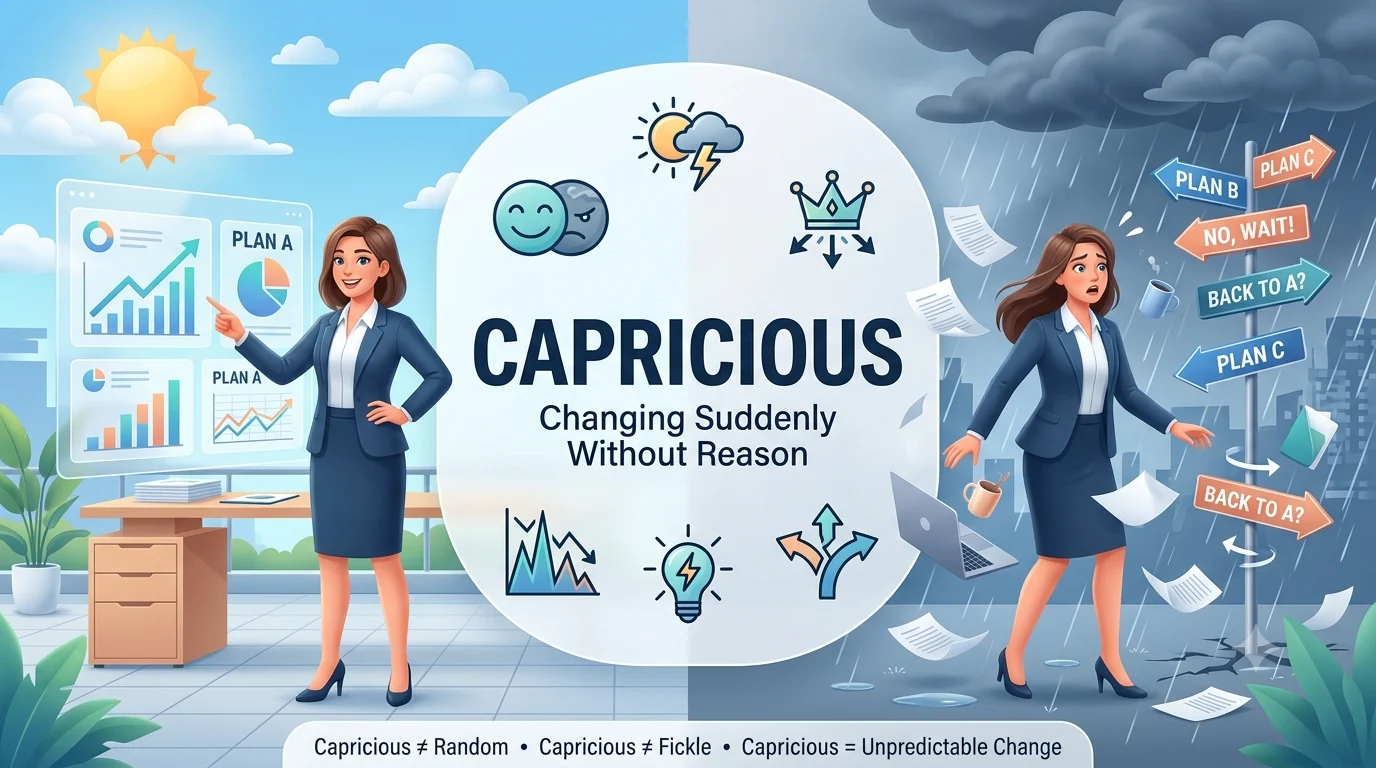
Have you ever been called “capricious” or seen the word in a book, conversation, or workplace discussion and wondered whether it was a compliment or criticism? Capricious (pronounced kuh-PRISH-us) is an adjective that describes someone or something that changes suddenly and unpredictably without a clear reason.
It often refers to a person’s behavior, mood, decisions, or personality, but it can also describe situations such as capricious weather or changing circumstances. Because the word usually suggests inconsistency or unreliability, it often carries a negative connotation, although context always matters.
In simple terms, capricious means unpredictable, changeable, or acting on sudden whims. This guide explains its meaning, pronunciation, origin, synonyms, examples, and how to recognize and use capricious correctly and confidently in different contexts.
Capricious at a Glance
| Feature | Details |
|---|---|
| Word | Capricious |
| Meaning | Changing suddenly without reason |
| Part of Speech | Adjective |
| Pronunciation | kuh-PRISH-us |
| IPA | /kəˈprɪʃəs/ |
| Tone | Usually neutral to slightly negative |
| Most Common Synonym | Unpredictable |
| Common Antonym | Predictable |
| Used For | People, behavior, weather, decisions, markets, leadership, emotions |
How to Pronounce Capricious
Many English learners recognize the word in writing but aren’t sure how to pronounce it.
Pronunciation
kuh-PRISH-us
IPA
/kəˈprɪʃəs/
Syllable Breakdown
kuh • PRISH • us
The stress falls on the second syllable:
PRISH
Pronunciation Tip
Think of the word “vicious.”
The ending sounds almost the same.
Part of Speech and Word Forms
Understanding related forms makes it easier to use the word naturally.
| Word Form | Part of Speech | Example |
|---|---|---|
| Capricious | Adjective | She has a capricious personality. |
| Capriciously | Adverb | He acted capriciously during the meeting. |
| Capriciousness | Noun | Everyone struggled to understand his capriciousness. |
What Does Capricious Mean in English?
The capricious meaning in English is someone or something that changes suddenly without a clear reason. Instead of following logic, routine, or consistency, a capricious person or situation is guided by changing emotions, impulses, or whims.
For example:
- A friend agrees to meet you today but cancels tomorrow without explanation.
- A company changes its policies every few weeks.
- The weather shifts from sunshine to a thunderstorm within minutes.
Each of these situations can accurately be described as capricious because they involve unexpected and unexplained change.
Unlike words such as random, capricious often implies that the changes are driven by personal feelings or sudden decisions rather than pure chance.
What Does It Mean If Someone Is Capricious?
A capricious person frequently changes their opinions, emotions, preferences, or decisions without warning. Their behavior may seem inconsistent or difficult to predict because it often depends on their current mood rather than careful reasoning.
For example, imagine a manager who approves a project on Monday but rejects the same idea on Tuesday without offering any explanation. That manager could reasonably be described as capricious.
Similarly, a friend who enthusiastically makes weekend plans but repeatedly cancels at the last moment because they “just don’t feel like it” may also be considered capricious.
People described as capricious are often:
- unpredictable
- impulsive
- inconsistent
- changeable
- difficult to anticipate
- guided by sudden whims
Although everyone changes their mind occasionally, a capricious person does so regularly and without an obvious reason.
Is Capricious a Negative Word?
The answer is:
Usually—but not always.
In most situations, capricious has a slightly negative meaning because it suggests inconsistency, unreliability, or poor judgment.
For example:
“The team’s success suffered because of the manager’s capricious leadership.”
Here, the word implies that the manager’s changing decisions created confusion.
However, there are situations where capricious can have a more positive or neutral meaning.
When discussing artists, musicians, writers, designers, or imaginative thinkers, the word may highlight creativity, originality, or spontaneous inspiration.
For example:
“Her capricious imagination helped her create unforgettable fantasy stories.”
Here, unpredictability becomes a creative strength rather than a weakness.
Positive vs. Negative Uses
| Positive Context | Negative Context |
|---|---|
| Creative imagination | Unreliable behavior |
| Artistic originality | Inconsistent decisions |
| Playful spontaneity | Emotional instability |
| Innovative thinking | Poor leadership |
Always pay attention to the context before deciding whether the word sounds complimentary or critical.
Origin and History of the Word “Capricious”
Learning where a word comes from often makes it easier to remember and understand.
The word capricious entered English during the late sixteenth century through the French word capricieux, which was derived from the Italian word capriccio.
Originally, capriccio referred to a sudden whim, fancy, or unpredictable impulse. Over time, English speakers adopted the word to describe people, actions, emotions, and situations that changed unexpectedly or appeared to lack consistent reasoning.
Today, capricious remains a popular word in many fields, including:
- Literature
- Journalism
- Psychology
- Business
- Economics
- Politics
- Administrative Law
- Education
Despite its centuries-old history, its central meaning has remained remarkably consistent: changing suddenly without a clear reason.
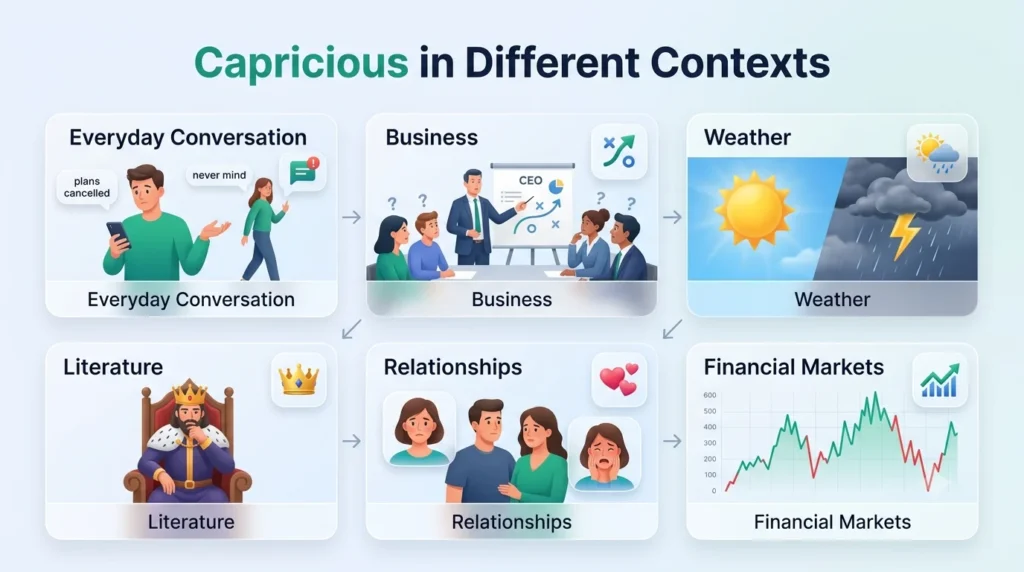
Capricious Meaning in Different Contexts
Although the core definition stays the same, capricious takes on slightly different shades of meaning depending on where it is used.
In Everyday Conversation
People often use capricious to describe someone whose moods, preferences, or plans change unexpectedly.
Example
“My cousin is so capricious that she changes vacation plans every weekend.”
In Business
Business professionals may use the word to describe inconsistent management, unstable consumer behavior, or unpredictable financial markets.
Examples include:
- capricious leadership
- capricious pricing decisions
- capricious market trends
Sentence
“Investors dislike capricious market conditions because they make future planning more difficult.”
In Literature
Novelists and poets frequently use capricious to describe fate, destiny, weather, rulers, or fictional characters whose actions surprise readers.
Example
“The capricious winds carried the ship into unfamiliar waters.”
In Nature
Weather is one of the most common things described as capricious.
Examples include:
- capricious weather
- capricious winds
- capricious climate
- capricious ocean currents
Sentence
“The hikers postponed their trip because of the capricious mountain weather.”
In Relationships
People sometimes describe romantic partners, friends, or family members as capricious when they frequently change their emotions or commitments.
Example
“Living with someone who is capricious can be emotionally exhausting because you never know what to expect.”
In Politics
Political commentators occasionally use capricious to describe leaders or policies that change suddenly without a clear explanation.
Example
“Businesses struggled to adapt to the government’s capricious policy changes.”
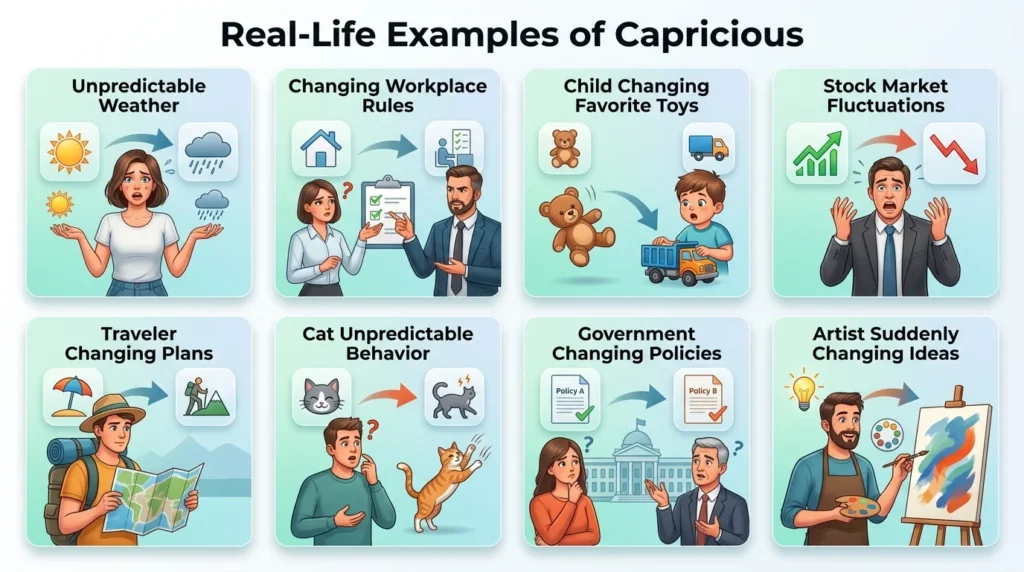
Real-Life Examples of Capricious
Seeing a word in context is one of the fastest ways to remember it.
Here are a few realistic examples:
- My cat is incredibly capricious—she wants attention one minute and disappears the next.
- The company’s capricious policies frustrated both employees and customers.
- Spring weather is famously capricious, so it’s always wise to carry an umbrella.
- Investors became nervous after several capricious market fluctuations.
- The novelist created a capricious queen whose unpredictable decisions kept readers guessing.
- His capricious personality made long-term planning almost impossible.
- The travel itinerary kept changing because of capricious weather conditions.
- The committee rejected the proposal after several capricious changes to its own rules.
These examples show how capricious naturally describes people, weather, decisions, leadership, and situations where sudden, unexplained change is the defining characteristic.
More Real-Life Examples of Capricious
The more examples you read, the easier it becomes to understand and remember the word capricious. Below are examples from everyday life, work, education, relationships, business, and literature.
Everyday Conversation
- My younger brother is so capricious that he changes his favorite sport every month.
- Her capricious shopping habits make it difficult to stick to a budget.
- The cat’s capricious behavior keeps everyone entertained.
Workplace
- Employees found it difficult to trust a manager with capricious decision-making.
- Frequent and capricious policy changes lowered team morale.
- Successful businesses avoid making capricious decisions because consistency builds customer trust.
School and Education
- The teacher was fair and consistent, never capricious in grading assignments.
- A capricious study routine often leads to poor academic performance.
- Students perform better when classroom rules are clear instead of capricious.
Relationships
- Dating someone who is capricious can feel emotionally exhausting.
- His capricious moods often confused his friends.
- Trust becomes difficult when promises are made and broken in a capricious way.
Weather and Nature
- The capricious spring weather forced hikers to cancel their trip.
- Farmers constantly adapt to capricious climate conditions.
- Sailors have respected the capricious nature of the sea for centuries.
Business and Finance
- Investors become cautious during capricious market conditions.
- The company’s capricious pricing strategy confused loyal customers.
- Economic uncertainty often creates capricious consumer spending.
Literature
- The novel portrayed fate as a capricious force that ignored human plans.
- Shakespearean characters are sometimes described as capricious because of their unpredictable choices.
- The queen’s capricious commands created chaos throughout the kingdom.
Capricious Meaning in a Sentence
If you’re searching for “What is the meaning of capricious in a sentence?”, these examples show how native English speakers naturally use the word.
- The capricious weather ruined our picnic.
- His capricious behavior made teamwork difficult.
- Investors dislike capricious financial markets.
- The CEO’s capricious decisions frustrated employees.
- She has a capricious personality that keeps everyone guessing.
- The judge criticized the agency’s capricious actions.
- Children’s interests can sometimes seem capricious.
- The author’s capricious imagination produced fascinating stories.
- Her capricious travel plans changed three times in one week.
- The customer’s capricious demands delayed the project.
Capricious Meaning Synonyms
Many readers search for capricious meaning synonyms to expand their vocabulary. Although these words are similar, each has a slightly different shade of meaning.
Common Synonyms
- Unpredictable
- Fickle
- Whimsical
- Erratic
- Impulsive
- Changeable
- Inconsistent
- Mercurial
- Volatile
- Unstable
- Variable
- Temperamental
- Flighty
- Inconstant
- Arbitrary (in some contexts)
Formal Synonyms
- Mutable
- Vacillating
- Impetuous
- Irregular
- Sporadic
Positive-Toned Alternatives
When describing creativity instead of unreliable behavior, these words may fit better:
- Imaginative
- Inventive
- Spontaneous
- Playful
- Free-spirited
Capricious Meaning Synonyms and Antonyms
Learning opposites helps you understand the word more clearly.
| Synonyms | Antonyms |
|---|---|
| Unpredictable | Predictable |
| Fickle | Reliable |
| Erratic | Consistent |
| Whimsical | Steady |
| Mercurial | Stable |
| Volatile | Dependable |
| Changeable | Constant |
| Arbitrary | Fair |
| Inconsistent | Trustworthy |
| Impulsive | Careful |
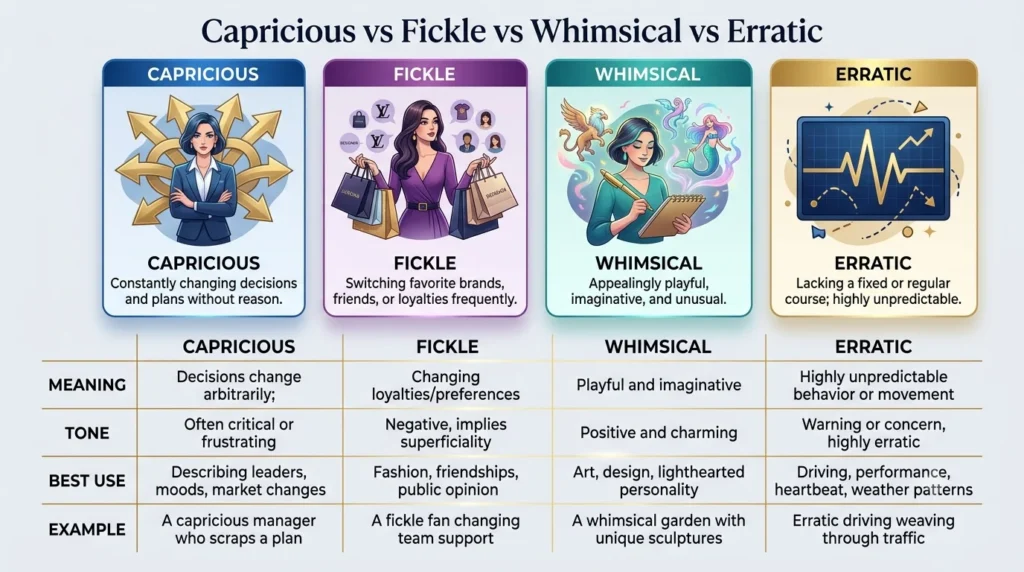
Capricious vs. Similar Words
Many English learners confuse capricious with similar adjectives. Understanding the differences will make your writing more accurate.
Capricious vs. Fickle
Both words describe change, but they focus on different things.
Capricious emphasizes sudden, unpredictable changes in behavior or decisions.
Fickle usually describes someone who frequently changes loyalties, preferences, or affections.
Examples
- A capricious manager changes company policies every week.
- A fickle customer keeps switching between brands.
Capricious vs. Whimsical
Although these words are related, their emotional tone is quite different.
Whimsical often has a positive meaning and suggests imagination, charm, or playful creativity.
Capricious usually highlights inconsistency or unpredictability that may create confusion.
Examples
- A whimsical artist creates magical fantasy worlds.
- A capricious leader changes important rules without explanation.
Capricious vs. Erratic
Erratic refers to something irregular or lacking a consistent pattern.
Capricious suggests behavior driven by sudden whims or changing moods.
Example:
- Erratic driving is dangerous.
- Capricious leadership creates uncertainty.
Capricious vs. Impulsive
An impulsive person acts quickly without thinking.
A capricious person repeatedly changes their mind or behavior without consistency.
In other words:
- Impulsive = one sudden action.
- Capricious = a repeated pattern of unpredictable actions.
Capricious vs. Arbitrary
These words overlap but are not identical.
Arbitrary means based on personal preference rather than objective rules or evidence.
Capricious means changing suddenly without a logical reason.
A decision can be arbitrary without changing often, while a capricious decision repeatedly changes without consistency.
PMO Meaning TikTok: The Viral Slang You Should Know
Arbitrary and Capricious Meaning
One of the most searched phrases online is “arbitrary and capricious meaning.”
This expression is especially common in legal writing.
When something is described as arbitrary and capricious, it means the decision was:
- unreasonable
- unpredictable
- unsupported by evidence
- made without consistent standards
- lacking logical justification
Example
“Employees challenged the company’s arbitrary and capricious policy changes because no clear explanation was provided.”
Although the two words are often used together, remember:
- Arbitrary focuses on the absence of fair reasoning.
- Capricious focuses on unpredictable or constantly changing behavior.
Capricious Meaning in Law
The capricious meaning in law is more specific than its everyday use.
In administrative law, courts sometimes review whether decisions made by government agencies or public authorities are arbitrary and capricious. If a decision ignores important evidence, lacks a reasonable explanation, or applies rules inconsistently, it may be challenged and even overturned.
For example, if a government agency suddenly changes a regulation without considering the facts or explaining its reasoning, a court may conclude that the action was arbitrary and capricious.
This legal phrase emphasizes that public decisions should be logical, evidence-based, and consistent rather than unpredictable or unsupported.
Capricious Meaning in the Bible
Many readers also search for capricious meaning in the Bible.
While capricious is not a common word in most English Bible translations, theologians and commentators sometimes use it when discussing human behavior.
For example, people may act capriciously by making inconsistent or impulsive choices. In contrast, many biblical teachings describe God as faithful, just, and consistent rather than capricious.
This comparison helps explain why reliability and wisdom are valued virtues throughout Scripture.
Capricious Meaning in Different Languages
Many people want to know how the word translates into other languages. Exact translations vary depending on context, but the central idea remains the same: unpredictable, changeable, or acting on sudden whims.
| Language | General Meaning |
|---|---|
| English | Unpredictable; changing without reason |
| Farsi (Persian) | Someone who frequently changes decisions or behavior without a clear reason |
| Arabic | Acting unpredictably or inconsistently |
| Chinese | Sudden, changeable, difficult to predict |
| Tagalog | Pabago-bago; hindi madaling hulaan |
| Tamil | அடிக்கடி காரணமின்றி மாறுபடும் தன்மை |
| Malayalam | കാരണം കൂടാതെ മാറിക്കൊണ്ടിരിക്കുന്ന സ്വഭാവം |
| Kannada | ಕಾರಣವಿಲ್ಲದೆ ಆಗಾಗ ಬದಲಾಗುವ ಸ್ವಭಾವ |
Note: Because every language has its own nuances, bilingual dictionaries may offer different translations depending on whether you’re describing a person, weather, or a decision.
Common Collocations with Capricious
Native English speakers naturally combine capricious with certain nouns. Learning these collocations will help your English sound more fluent.
The most common combinations include:
- capricious behavior
- capricious decision
- capricious personality
- capricious nature
- capricious mood
- capricious leader
- capricious ruler
- capricious weather
- capricious climate
- capricious government
- capricious policy
- capricious market
- capricious investor
- capricious customer
- capricious child
- capricious fortune
- capricious fate
Hatamoto Meaning: The Secret Rank in Samurai History
Common Grammar Patterns
Here are some grammar patterns that native English speakers commonly use:
- be + capricious
- The weather is capricious.
- become + capricious
- His behavior became increasingly capricious.
- remain + capricious
- Consumer demand remained capricious throughout the year.
- seem + capricious
- The new policy seemed capricious.
- capricious + noun
- capricious behavior
- capricious decisions
- capricious leadership
- capricious personality
Using these natural patterns will make your speaking and writing sound more fluent
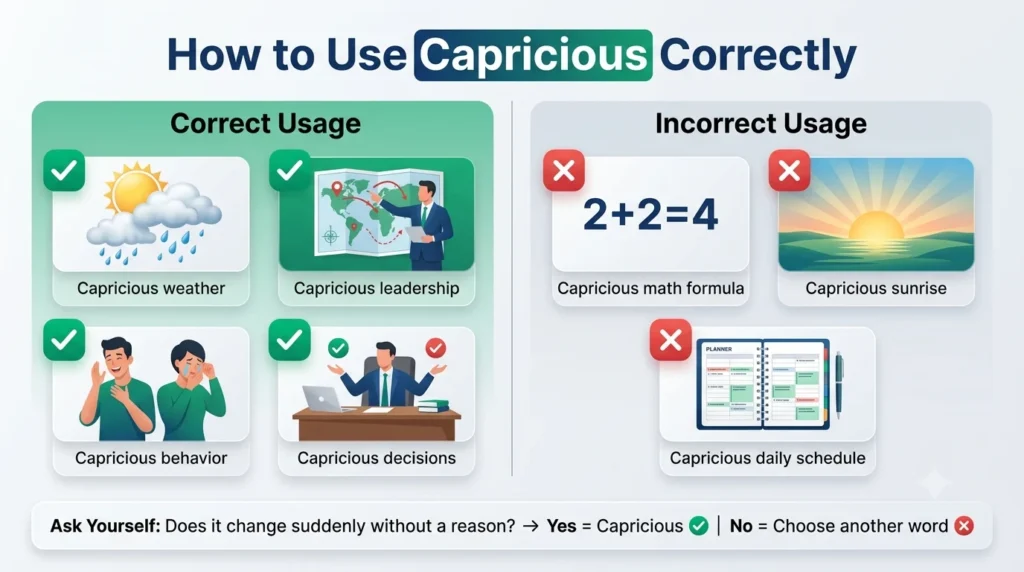
How to Use “Capricious” Correctly
Now that you understand the capricious meaning, the next step is learning how to use it naturally in everyday English. Although it isn’t an everyday word like happy or sad, it appears frequently in books, newspapers, business reports, academic writing, and legal discussions.
A good rule to remember is this:
Use “capricious” when someone or something changes suddenly without a logical or consistent reason.
It is commonly used to describe:
- People’s personalities
- Behavior
- Emotions
- Decisions
- Leadership
- Government policies
- Weather
- Markets
- Luck or fate
- Creative imagination
Correct Examples
✔ The manager’s capricious decisions confused the entire team.
✔ Spring weather can be incredibly capricious.
✔ Her capricious personality makes her difficult to predict.
✔ Investors dislike capricious market conditions.
✔ The king was famous for his capricious rule.
When NOT to Use “Capricious”
One mistake many English learners make is using capricious for anything unusual. However, the word specifically refers to unpredictable change, not simply something strange or unique.
Avoid using capricious when describing:
Predictable schedules
❌ The train follows a capricious timetable every morning.
✅ The train follows a regular timetable every morning.
Permanent facts
❌ The Earth has a capricious orbit.
The Earth’s orbit is consistent and predictable.
Stable personalities
If someone is calm, dependable, and consistent, capricious is the wrong word.
Instead use:
- reliable
- dependable
- consistent
- steady
Scientific facts
Natural laws do not suddenly change without reason.
Avoid using capricious to describe mathematics, physics, or scientific principles.
Common Mistakes and Misinterpretations
Even advanced English speakers occasionally misuse this word. Here are the most common mistakes.
Mistake 1: Thinking Capricious Means Happy
❌ Incorrect
Capricious means cheerful.
✅ Correct
Capricious means unpredictable or changeable, not joyful.
Mistake 2: Confusing It with Random
Random events happen by chance.
Capricious behavior usually reflects changing moods, whims, or impulses.
Mistake 3: Assuming It Is Always Negative
While capricious often has a negative tone, it can sometimes describe creativity.
Example:
The designer’s capricious imagination resulted in an award-winning fashion collection.
Mistake 4: Using It Too Often
Because capricious is a formal word, using it repeatedly in casual conversations can sound unnatural.
Sometimes these alternatives work better:
- unpredictable
- changeable
- inconsistent
- moody
Expert Tips for Using Capricious Naturally
Professional writers and native English speakers tend to use capricious in situations where precision matters.
Tip 1
Use it to describe repeated unpredictable behavior rather than one isolated action.
Tip 2
It sounds more natural in writing than in casual conversation.
Tip 3
It frequently appears in:
- novels
- journalism
- business articles
- legal writing
- academic essays
- opinion pieces
Tip 4
If you’re unsure whether to use capricious or whimsical, ask yourself:
Does the unpredictability create problems?
If yes,
Capricious is usually the better choice.
Key Takeaways
If you only remember a few things about this word, remember these:
✅ Capricious means changing suddenly without a clear reason.
✅ It is an adjective.
✅ It usually describes people, behavior, weather, decisions, leadership, or markets.
✅ It often has a slightly negative meaning.
✅ In creative contexts, it may suggest originality or spontaneity.
✅ The phrase “arbitrary and capricious” is especially important in legal English.
✅ Common synonyms include unpredictable, fickle, whimsical, erratic, and mercurial.
Frequently Asked Questions
1. What does capricious mean in simple words?
It means unpredictable or changing suddenly without an obvious reason.
2. What does it mean if someone is capricious?
A capricious person frequently changes opinions, emotions, or decisions without warning.
3. Is capricious a negative word?
Usually yes, although it can occasionally describe creativity in a positive way.
4. What is a synonym for capricious?
Some common synonyms are:
- unpredictable
- fickle
- whimsical
- erratic
- mercurial
- impulsive
5. What is the opposite of capricious?
Common antonyms include:
- predictable
- reliable
- dependable
- consistent
- steady
- trustworthy
6. What is the meaning of capricious in a sentence?
Example:
The capricious weather forced us to cancel our outdoor event.
7. What is the capricious meaning in English?
In English, capricious means changing unexpectedly without a logical reason.
8. What does arbitrary and capricious mean?
It describes actions or decisions that are unreasonable, inconsistent, and unsupported by facts or logical reasoning.
9. What is capricious meaning in law?
In law, the term often describes decisions made without reasonable justification or consistent standards, particularly in administrative law.
10. Is capricious the same as whimsical?
No.
Whimsical usually has a playful or imaginative tone.
Capricious usually emphasizes inconsistency or unpredictability.
11. Can weather be described as capricious?
Yes. Weather is one of the most common things described as capricious because it can change suddenly and unexpectedly.
12. Is capricious commonly used today?
Yes. Although it is more formal than everyday vocabulary, it still appears regularly in books, journalism, business writing, legal documents, and academic discussions.
13. Is capricious a compliment?
Usually not. It often suggests someone is unreliable or inconsistent. However, in artistic contexts it may praise originality or spontaneous creativity.
14. Can a decision be capricious?
Absolutely. A capricious decision changes without a logical explanation and may confuse the people affected by it.
15. How can I remember the meaning of capricious?
Think of someone who constantly changes their mind without warning. That image captures the essence of being capricious.
Conclusion
The capricious meaning is much more than simply “unpredictable.” It describes people, decisions, emotions, weather, markets, and situations that change suddenly without a clear reason or consistent pattern. While the word often carries a slightly negative tone because it suggests inconsistency or impulsiveness, context is important. In literature, art, and creative discussions, capricious can also highlight originality, imagination, and spontaneity.
By understanding its pronunciation, origin, synonyms, antonyms, legal meaning, and real-life usage, you’ll be able to recognize and use capricious with confidence. Whether you’re writing an essay, improving your English vocabulary, preparing for an exam, or simply curious about the word, knowing when to use capricious instead of more general terms like unpredictable or random will make your communication clearer and more precise.
The next time you encounter capricious in a novel, business report, legal document, or everyday conversation, you’ll not only understand its meaning but also appreciate the subtle differences that make it one of the English language’s most expressive adjectives.

Willie Nelson is a skilled and passionate content writer working as an expert author at maeningg.com. With strong knowledge of digital trends, slang meanings, and engaging online content, Willie focuses on creating clear, helpful, and reader-friendly articles.