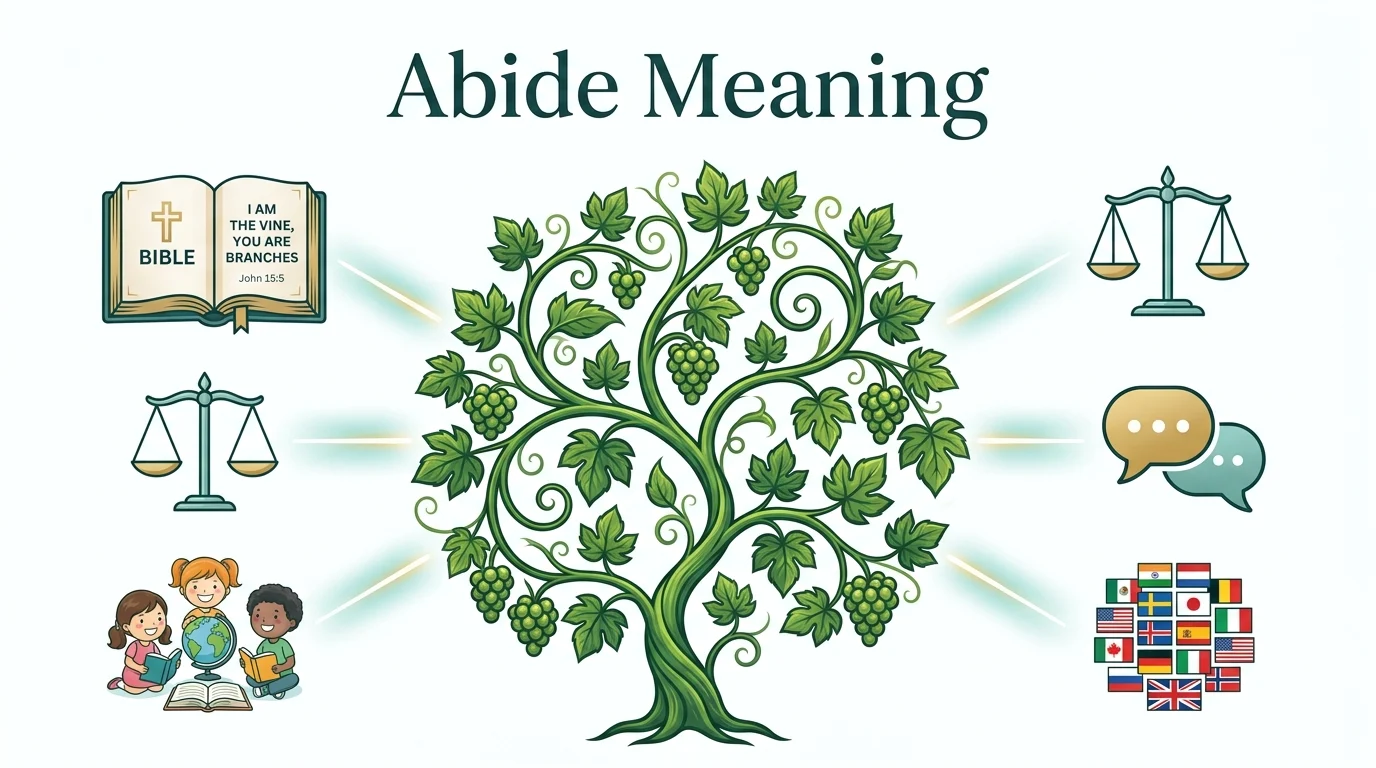
Have you ever seen a phrase like “abide by the rules” or “abide by the law” and wondered what abide actually means? Abide (pronounced uh-BYDE) most commonly means to accept, follow, or obey a rule, law, agreement, or decision. This is the meaning you’ll encounter most often in everyday English, especially in legal, professional, and formal situations where following rules or commitments is important.
In simple terms, to abide by something means to follow it. For example, if an employee agrees to abide by company policies, they agree to follow those policies. However, abide can also mean to tolerate or endure something, as in “I can’t abide dishonesty,” which means “I can’t tolerate dishonesty.” Because the word appears frequently in contracts, workplace policies, news articles, and common expressions, understanding its meaning can help you avoid confusion in both written and spoken English.
Whether you’ve encountered abide in a document, conversation, book, or news story, this guide explains its meaning, pronunciation, different uses, common phrases, and real-life examples so you’ll know exactly what it means and how to use it confidently in any context.
Abide Definition in English
The definition of abide varies slightly according to context, but the core idea remains the same.
Definition of Abide
Abide (verb): To remain, continue, dwell, tolerate, endure, accept, comply with, or act according to something.
Define Abide Simply
If someone asks you to define abide, you can say:
Abide means to stay, remain faithful, tolerate something, or follow rules and agreements.
What Does It Mean to Abide?
To abide often suggests more than simply staying. It carries ideas of:
- Loyalty
- Commitment
- Patience
- Endurance
- Perseverance
- Responsibility
- Obedience
This deeper meaning is one reason the word remains popular in both modern and traditional English.
Abide Meaning in English
Many learners search specifically for abide meaning in English.
In standard English, abide has three primary meanings:
1. To Remain or Stay
This meaning refers to continuing in a place, state, condition, or relationship.
Examples:
- Peace abides in the community.
- True friendship abides through difficult times.
- Hope continued to abide despite challenges.
2. To Tolerate or Endure
This meaning is common in conversational English.
Examples:
- I cannot abide dishonesty.
- She cannot abide rude behavior.
- They cannot abide unfair treatment.
3. To Follow or Obey
This is the most common modern usage.
Examples:
- Citizens must abide by the law.
- Employees must abide by company policies.
- Students should abide by school regulations.
Abide Pronunciation
Many people search for abide meaning pronunciation before using the word in conversation.
Pronunciation
Abide = uh-BYD
IPA
/əˈbaɪd/
Easy Pronunciation Tip
The word rhymes with:
- Guide
- Side
- Pride
- Wide
Example:
“We must abide by the agreement.”
Abide Meaning for Kids
Simple Definition for Children
Abide means to stay, wait patiently, or follow important rules.
Children can understand abide through simple examples.
Imagine a strong tree standing firmly during a storm. It remains rooted in the ground. The tree abides.
Imagine a student following classroom rules every day. The student abides by the rules.
Examples for Kids
- We abide by school rules.
- Good friends abide by their promises.
- The bird abides in its nest.
- We should abide by our parents’ guidance.
Easy Memory Trick
Think of abide as:
Stay + Be Patient + Do What Is Right
Abide Means More Than Just Obey
One reason the word is powerful is that it carries emotional and personal meaning beyond simple obedience.
When people use abide, they often imply:
- Commitment
- Loyalty
- Stability
- Consistency
- Perseverance
- Steadfastness
- Trustworthiness
For example:
“She abides by her values.”
This means more than following rules. It suggests staying true to principles even when life becomes difficult.
This deeper meaning makes abide popular in leadership, personal growth, faith, and self-development discussions.

Abide By Meaning
The phrase abide by is the most common form of the word today.
What Does Abide By Mean?
Abide by means to follow, obey, comply with, or act according to a rule, law, agreement, decision, or instruction.
Examples
- Drivers must abide by traffic laws.
- We agreed to abide by the contract.
- Employees must abide by workplace policies.
- Citizens should abide by national regulations.
Must Abide Meaning
When someone says:
“You must abide by the rules.”
It means:
You are required to follow the rules.
Strictly Abide Meaning
Strictly abide means:
To follow rules completely without exceptions.
Example:
All participants must strictly abide by competition guidelines.
Bound to Abide Meaning
Bound to abide means:
Legally or morally required to follow something.
Example:
The organization is bound to abide by the agreement.
Abide In Meaning
Another common search query is abide in meaning.
What Does Abide In Mean?
Abide in means:
To remain in, continue in, dwell in, or stay connected to something.
Examples:
- Abide in faith.
- Abide in love.
- Abide in peace.
- Abide in truth.
This phrase is especially common in religious and inspirational writing.
Abide With Meaning
What Does Abide With Mean?
Abide with means:
Stay with, remain with, accompany, or continue alongside.
Examples:
- May peace abide with you.
- Let wisdom abide with us.
- Her memory still abides with me.
This usage appears frequently in literature, poetry, hymns, and older forms of English.
Cannot Abide Meaning
One of the most common expressions is:
“I can’t abide it.”
Cannot Abide Meaning
Cannot abide means:
To strongly dislike or refuse to tolerate something.
Examples:
- I cannot abide dishonesty.
- She cannot abide bullying.
- They cannot abide corruption.
This meaning is still common in British and formal English.
Abides Meaning and Abided Meaning
What Does Abides Mean?
Abides is the third-person singular form of abide.
Examples:
- He abides by the rules.
- She abides in hope.
- Truth abides forever.
What Does Abides Mean?
It simply means:
Remains, continues, or follows.
What Does Abided Mean?
Abided is the modern past tense of abide.
Examples:
- They abided by the decision.
- We abided by the regulations.
- She abided by the agreement.
Meaning of Abided
Abided means:
Followed, obeyed, remained, or continued.
Abide Abode Meaning
Many learners wonder about abide abode meaning.
Historically, abode was the traditional past tense of abide.
Example:
He abode in the village.
Today:
- Abided = Modern English
- Abode = Literary or historical English
Because of this connection, the word abode (meaning a home or dwelling place) comes from the same linguistic family.

Origin and Etymology of Abide
The etymology of the word abide reveals why it has such rich meanings.
Abide Origin
The word comes from Old English:
ābīdan
Meaning:
- Remain
- Wait
- Stay
- Endure
Historical Development
Old English
Focused on waiting and remaining.
Middle English
Expanded to include endurance and perseverance.
Early Modern English
Became common in literature, religion, and philosophy.
Modern English
Most often means:
- Obey
- Follow
- Tolerate
- Remain
Abide Root Word
The root reflects ideas of patience, endurance, expectation, and steadfast commitment.
This is why words like loyalty, perseverance, stability, and faithfulness are closely connected to the meaning of abide.

Abide Meaning in the Bible
One of the most powerful uses of the word abide appears in the Bible. This is why searches such as abide meaning in the Bible, abide meaning Bible, abide meaning biblical, and abide meaning in John 15 have become increasingly popular.
In biblical language, abide means to remain, continue, dwell, stay connected, and live in close fellowship with God.
Unlike the modern legal use of the word, biblical abiding focuses on relationship rather than rules.
Why Biblical Abiding Matters
The Bible uses abide to teach:
- Faithfulness
- Trust
- Spiritual growth
- Obedience
- Perseverance
- Lasting commitment
A person who abides in God continues trusting Him even during difficult circumstances.
Abide Meaning in John 15
The most famous biblical use appears in John 15.
Jesus says:
“Abide in me, and I in you.”
John 15 Abide Meaning
In John 15, Jesus compares Himself to a vine and His followers to branches.
The lesson is simple:
- A branch cannot survive without the vine.
- Spiritual life cannot flourish apart from God.
- Remaining connected produces growth and fruitfulness.
What Does Abide Mean in John 15?
Abide in John 15 means:
To remain spiritually connected to Christ through faith, obedience, prayer, and trust.
Practical Ways to Abide Today
- Read Scripture regularly.
- Spend time in prayer.
- Follow biblical principles.
- Trust God during challenges.
- Stay connected to a faith community.
This passage is one reason the word abide carries such a deep spiritual meaning today.
👉 11:11 Meaning: The Hidden Message Behind This Powerful Number ✨
Abide Meaning in Hebrew
Many readers search for abide meaning in Hebrew because the Old Testament contains several Hebrew words that express the idea of remaining, dwelling, and living securely.
Abide Meaning Hebrew
In Hebrew thought, abiding often refers to:
- Dwelling securely
- Remaining faithful
- Living under God’s protection
- Continuing in a covenant relationship
Deeper Hebrew Concept
The Hebrew idea of abiding is not simply staying in one place.
It suggests:
Remaining secure, steadfast, and faithful while trusting God.
This connection between faithfulness and stability remains central to the biblical meaning of abide.
Abide Meaning in Greek
The New Testament was originally written in Greek.
The Greek word most commonly translated as abide is:
Menō (μένω)
Meaning:
- Remain
- Stay
- Continue
- Dwell
- Endure
- Persist
Abide Meaning in Greek
The Greek concept emphasizes:
- Continuity
- Lasting relationship
- Persistence
- Spiritual connection
This explains why biblical writers repeatedly use abide when describing faith and discipleship.

Abide Meaning in Law
In law, abide means:
To obey, comply with, accept, or act according to a rule, decision, judgment, contract, or agreement.
Examples
- Citizens must abide by the law.
- Both parties agreed to abide by the settlement.
- Companies must abide by industry regulations.
- Contractors must abide by legal requirements.
Why Lawyers Use the Word
The legal profession values clarity and obligation.
When courts state that parties must abide by a ruling, they mean:
The ruling must be accepted and followed.
Abiding Meaning
A surprisingly common search query is:
- What is the meaning of abiding?
- Abiding meaning
- Abiding love meaning
- Abiding faith meaning
Definition of Abiding
Abiding means:
Lasting, enduring, continuing, or remaining over time.
Examples
- An abiding friendship
- Abiding faith
- Abiding hope
- Abiding love
Abiding Love Meaning
Abiding love refers to:
Love that remains strong, loyal, and constant despite challenges.
Abiding Faith Meaning
Abiding faith means:
A lasting trust that continues through life’s difficulties.
Synonyms of Abide
Many users ask:
What Is the Synonym of Abide?
The answer depends on context.
Common Synonyms
- Remain
- Stay
- Dwell
- Endure
- Persevere
- Persist
- Continue
- Tolerate
- Accept
- Comply
- Follow
- Observe
- Adhere
- Uphold
Synonyms by Meaning
| Meaning | Best Synonym |
|---|---|
| Remain | Stay |
| Obey | Comply |
| Follow Rules | Adhere |
| Tolerate | Endure |
| Continue | Persist |
| Dwell | Reside |
Antonyms of Abide
Opposite words include:
- Leave
- Depart
- Quit
- Abandon
- Reject
- Refuse
- Ignore
- Violate
- Disobey
Example
Abide by the rules ↔ Break the rules
Remain faithful ↔ Abandon faith
Stay committed ↔ Walk away
👉 What Does WSG Mean? The Viral Text Slang Everyone Uses 📱🔥
Abide vs Tolerate vs Endure vs Comply
These words are related but not identical.
| Word | Primary Meaning | Typical Context |
|---|---|---|
| Abide | Remain or obey | Faith, law, values |
| Tolerate | Put up with | Annoyances |
| Endure | Survive hardship | Difficult situations |
| Comply | Follow instructions | Legal or professional |
Example
“I tolerate noise.”
“I endure hardship.”
“I comply with regulations.”
“I abide by my principles.”
Each sentence carries a different shade of meaning.
Abide vs Stay vs Remain vs Dwell
Abide
Often implies commitment or loyalty.
Example:
“I abide by my values.”
Stay
Usually refers to location.
Example:
“I stayed at a hotel.”
Remain
Means continue unchanged.
Example:
“She remained calm.”
Dwell
Means live somewhere.
Example:
“They dwell in the countryside.”
While these words overlap, abide often carries the strongest sense of commitment and perseverance.
Dwell and Abide Meaning
Many learners search for dwell and abide meaning.
Both words involve remaining somewhere.
However:
- Dwell usually focuses on location.
- Abide often includes commitment, endurance, or loyalty.
Example:
- They dwell in the city.
- They abide in faith.
Love Will Abide Meaning
The phrase love will abide appears in poetry, literature, songs, and inspirational writing.
Love Will Abide Meaning
It means:
Genuine love will continue, endure, and remain strong despite difficulties or changing circumstances.
The phrase emphasizes permanence and emotional loyalty.
And Did Thy Wealth on Earth Abide Meaning
This line appears in classic poetry and literature.
Meaning
The question asks:
Did your earthly wealth last forever?
The implied answer is usually no.
The phrase reminds readers that money and possessions are temporary, while values and character endure.
Meaning of Abide in Other Languages
Abide Meaning in Farsi
- ماندن (to remain)
- پایبند بودن (to stay committed)
Abide Meaning in Punjabi
- قائم رہنا
- برقرار رہنا
- پابندی کرنا
Abide Meaning in Arabic
- يلتزم (comply with)
- يبقى (remain)
Abide Meaning in French
- Demeurer (remain)
- Se conformer à (comply)
Abide Meaning in Chinese
- 遵守 (obey)
- 停留 (remain)
Abide Meaning in Russian
- Соблюдать (observe)
- Оставаться (remain)
Abide Meaning in Malayalam
- പാലിക്കുക (follow)
- തുടരുക (continue)
Abide Meaning in Tagalog
- Manatili (remain)
- Sumunod (obey)
Abide Artinya (Indonesian)
Artinya:
- Tetap tinggal
- Mematuhi
- Bertahan
Abide Betekenis (Dutch)
Betekenis:
- Blijven
- Naleven
- Volharden
Abide Jelentése (Hungarian)
Jelentése:
- Maradni
- Betartani
- Kitartani
Abide Μετάφραση (Greek Translation)
- Παραμένω (remain)
- Συμμορφώνομαι (comply)
Most Common Abide Expressions
Abide by the Rules
Meaning:
Follow the rules.
Abide by the Law
Meaning:
Obey legal requirements.
Abide by the Agreement
Meaning:
Honor a contract or promise.
Abide in Love
Meaning:
Remain in love and compassion.
Abide in Faith
Meaning:
Continue trusting God.
Abide With Me
Meaning:
Stay with me.
Cannot Abide
Meaning:
Cannot tolerate.
Rule Abider Meaning
A rule abider is:
Someone who consistently follows rules, laws, and guidelines.
Why Understanding Abide Matters
The word abide is much more than a simple vocabulary term. It combines ideas of loyalty, commitment, patience, perseverance, obedience, stability, and faithfulness.
Whether you encounter it in legal documents, workplace policies, books, religious teachings, or everyday conversation, understanding the meaning of abide helps you communicate more accurately and confidently.
Most importantly, the word reminds us that lasting success often comes from remaining committed to our values, relationships, responsibilities, and beliefs.

How to Use Abide Correctly
Understanding the meaning of a word is important, but knowing how to use it correctly is equally valuable. The word abide can be used in several ways depending on the context.
Rule 1: Use “Abide By” for Rules, Laws, and Agreements
This is the most common modern usage.
Examples
- We must abide by the law.
- Students should abide by school regulations.
- Employees must abide by company policies.
- Drivers must abide by traffic rules.
- All parties agreed to abide by the contract.
What Does Abide Mean Here?
In these examples, abide means:
To obey, follow, comply with, or act according to something.
Rule 2: Use “Abide In” for Faith, Values, and States of Being
Examples:
- Abide in faith.
- Abide in love.
- Abide in peace.
- Abide in truth.
- Abide in hope.
Here, abide means:
To remain connected to or continue within something.
Rule 3: Use “Abide With” to Mean Stay With
Examples:
- May wisdom abide with you.
- Peace abides with those who are patient.
- Her memory still abides with me.
Rule 4: Use “Cannot Abide” for Strong Dislike
Examples:
- I cannot abide dishonesty.
- She cannot abide bullying.
- They cannot abide corruption.
- We cannot abide injustice.
Here, abide means:
To tolerate or endure.
Common Mistakes to Avoid
Many English learners misuse the word because they understand the meaning but not the correct structure.
Incorrect
✘ We abide the law.
Correct
✔ We abide by the law.
Incorrect
✘ She abides the company rules.
Correct
✔ She abides by the company rules.
Incorrect
✘ I abide watching football.
Correct
✔ I enjoy watching football.
Incorrect
✘ They abide honesty.
Correct
✔ They value honesty.
Real-Life Examples of Abide
Here are practical examples showing how the word works in different situations.
Daily Life
- I cannot abide rude behavior.
- Good neighbors abide by community rules.
- Successful people often abide by strong principles.
School
- Students must abide by classroom expectations.
- Every child should abide by school policies.
Workplace
- Employees are required to abide by company guidelines.
- Managers must abide by workplace regulations.
Law
- Citizens must abide by national laws.
- Businesses must abide by legal requirements.
Faith
- Believers are encouraged to abide in God’s love.
- We should abide in faith during difficult seasons.
Relationships
- Trust abides when promises are kept.
- Healthy relationships abide through challenges
What Is Abide Mean?
Although grammatically incorrect, many people search:
“What is abide mean?”
The correct question is:
“What does abide mean?”
The answer is:
Abide means to remain, continue, tolerate, endure, or follow rules and agreements.
What Does Abide Mean in English?
In English, abide means:
- Stay
- Remain
- Continue
- Endure
- Tolerate
- Obey
- Follow
The exact meaning depends on the sentence.
Mini Dictionary of Common Abide Expressions
| Expression | Meaning |
|---|---|
| Abide | Remain or obey |
| Abide by | Follow rules |
| Abide in | Remain connected |
| Abide with | Stay with |
| Cannot abide | Cannot tolerate |
| Must abide | Required to obey |
| Strictly abide | Follow completely |
| Abiding | Lasting or enduring |
| Abides | Remains or follows |
| Abided | Followed or remained |
| Abode | Literary past tense of abide |
FAQ
What does abide mean?
Abide means to remain, continue, tolerate, endure, or obey depending on context.
What is the meaning of abide?
The meaning of abide includes staying, remaining faithful, following rules, and enduring circumstances.
What does abide mean in English?
In English, abide means remain, stay, endure, tolerate, or comply.
What is abide?
Abide is a verb used to describe remaining, enduring, or following something.
What is meant by abide?
To abide means to stay committed, remain connected, or obey rules and agreements.
What does abide by mean?
Abide by means to follow, comply with, or obey.
Does abide mean follow?
Yes. In the phrase “abide by,” it means follow or obey.
What does abide mean in law?
In law, abide means to comply with legal decisions, contracts, regulations, and court rulings.
What does abide mean in the Bible?
In the Bible, abide means remaining spiritually connected to God through faith and obedience.
What does abide mean in John 15?
It means remaining connected to Christ, just as branches remain connected to a vine.
What does abides mean?
Abides means remains, continues, or follows.
What does abided mean?
Abided means followed, obeyed, remained, or continued.
What is the meaning of abiding?
Abiding means lasting, enduring, or continuing over time.
What is abiding love?
Abiding love is love that remains constant and loyal.
What is abiding faith?
Abiding faith is lasting trust and confidence that continues despite difficulties.
What is strictly abide meaning?
Strictly abide means follow rules completely and without exception.
What is bound to abide meaning?
It means legally or morally required to follow something.
Conclusion
The word abide is one of those rare English words that combines simplicity with depth. Depending on the context, it can mean to remain, stay, continue, endure, tolerate, comply, or obey. Whether you encounter it in everyday conversations, legal documents, workplace policies, literature, or biblical teachings, the core idea remains the same: steadfast commitment over time.
Understanding the complete abide meaning, abide definition, pronunciation, origin, biblical significance, legal usage, and practical examples allows you to use the word confidently in speaking and writing. From phrases such as abide by the rules and abide by the law to spiritual expressions like abide in faith and abide in love, the word continues to play an important role in modern English.
Ultimately, to abide is more than simply staying—it is about remaining loyal, enduring challenges, honoring commitments, and holding firmly to what truly matters.

Dolly Parton is a professional content writer at maeningg.com, specializing in clear, engaging, and well-researched digital content. With strong expertise in writing about text slang, meanings, lifestyle, and informative articles, Dolly focuses on helping readers understand internet language in a simple and relatable way.