Circa Meaning: Everything You Need to Know

Ever come across the word “circa” in a book, a museum label, a job posting, or even a social media caption and wondered what it actually means?

You’re not alone. This small Latin word appears everywhere — from history textbooks and financial reports to salary negotiations and vintage clothing captions. Yet many people aren’t quite sure what it signals or how to use it correctly.

Here’s the short answer: Circa means “approximately” or “around.” It tells readers that a date, number, or figure is estimated, not exact.

But there’s much more to understand. Depending on where you see it — in history, finance, salary discussions, German documents, or legal papers — the application changes slightly.

By the end, you’ll use circa like a historian, a finance professional, and a confident writer — all at once.

Let’s dive in.


What Does Circa Mean? (The Simple Definition)

Circa (abbreviated as c. or ca.) is a Latin word meaning “around,” “approximately,” or “about.”

It is used almost exclusively before a date, number, or figure to indicate that the information is estimated rather than exact.

Circa Meaning in English

In plain English, the circa meaning in English is straightforward: “approximately” or “roughly.”

TermMeaningFormality Level
CircaApproximately / aroundFormal to semi-formal
Approx.ApproximatelyCasual / shorthand
AboutAroundCasual
RoughlyApproximatelyCasual
Circa (c.)ApproximatelyAcademic / historical

Simple Examples

“The manuscript was written circa 1750.”
Translation: “The manuscript was written around 1750 — not necessarily in that exact year.”

“The building was constructed c. 1920.”
Translation: “The building was built approximately in 1920, maybe a year or two before or after.”

“The population of ancient Rome was circa 1 million people at its peak.”
Translation: “Roughly 1 million people — historians estimate, but no exact census exists.”

What Does It Mean to Say Circa?

When someone says “circa” before a date or number, they are signaling: “I don’t know the exact figure, but here’s a reliable estimate based on available evidence.”

It’s an honest admission of uncertainty wrapped in a formal, scholarly package.


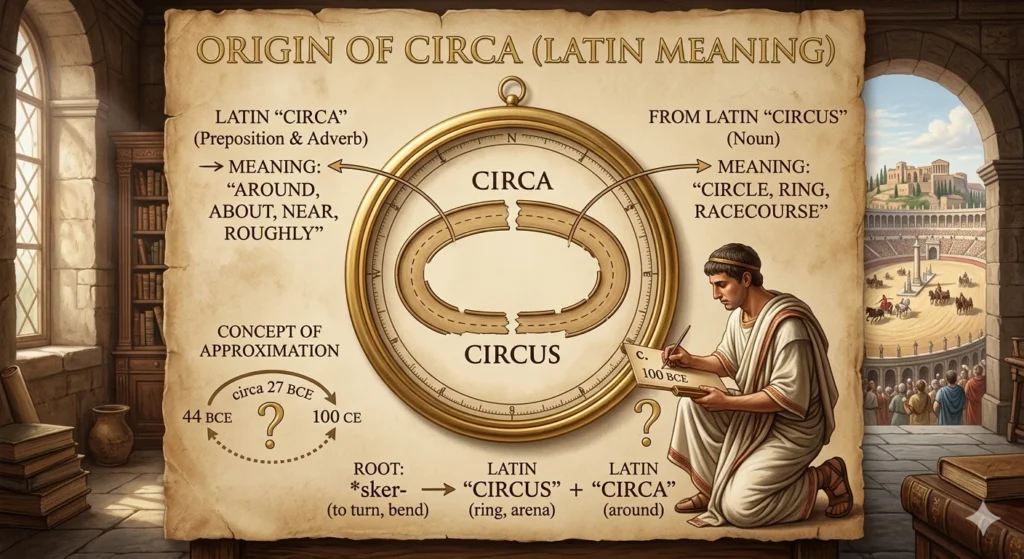
Circa Meaning Latin (The Origin Story)

To truly understand a word, you need to know where it came from.

Circa meaning Latin is direct: the Latin word circa literally translates to “around,” “about,” or “near” — both in space and time.

The Linguistic Journey

EraUsageEvidence
Classical Latin (100 BC – 200 AD)Used in Roman writings to mean “around” (spatially or temporally)Cicero, Caesar, Pliny
Late Latin / Medieval Latin (500–1400 AD)Adopted by scholars in monasteries and universitiesChurch documents, manuscripts
English adoption (1400s)First recorded use in English historical documentsOxford English Dictionary citation: 1485
Modern English (1800s–present)Standard in academic, historical, financial, and business writingChicago Manual of Style endorsement

Why Latin Still Matters Today

Even in 2026, circa meaning Latin matters because the word carries inherent formality. It’s not casual slang like “LOL” or “WYA.” When you use circa, you signal to readers that you are being precise about your imprecision — a scholarly touch that builds trust.

Fun fact: The Latin word circa is also the root of English words like:

  • Circuit (a path that goes around)
  • Circle (a round shape)
  • Circumstance (the conditions surrounding an event)
  • Circumnavigate (to sail around)

Authoritative Source Note

According to the Chicago Manual of Style (17th Edition)circa (abbreviated c.) is the preferred term for indicating approximate dates in historical and scholarly writing. The AP Stylebook recommends spelling out “about” for general audiences but accepts circa in specialized contexts.


Circa Meaning in History

If you open a history book, visit a museum, or read a biography, you’ll see circa everywhere. Why? Because historians rarely have exact dates for ancient or medieval events.

What Does Circa Mean in History?

Circa meaning in history indicates that a date is estimated based on available evidence such as:

  • Radiocarbon dating (within a range of years)
  • Historical records (often conflicting or incomplete)
  • Artifact and architectural styles (e.g., pottery typology)
  • Secondary source analysis (cross-referencing multiple accounts)

Real-World Examples

Museum label example:

“Amphora vase, circa 400 B.C. , attributed to Greek pottery workshop in Athens.”

Biography example:

“Leonardo da Vinci painted the Mona Lisa circa 1503–1506.”

History book example:

“The construction of the Great Wall of China began circa 7th century B.C. “

Archaeology report example:

“Skeletal remains were dated c. 1200 A.D. using stratigraphic analysis.”

What Does Circa 1993 Mean?

One of the most common Google searches: “What does circa 1993 mean?”

The direct answer: “Around the year 1993” — not necessarily exactly 1993, but sometime near it (typically within 1-3 years).

Example:

“She was born circa 1993.”
Meaning: She was born around 1993 (could be 1992, 1993, or 1994 — exact birth year unknown from available records).

When should you use “circa 1993”?

  • You’re describing a photo and don’t know the exact year
  • A source says “early 1990s” and you’re narrowing it down
  • You’re writing about an event with uncertain dating
  • You’re doing genealogy and census records are missing

⚠️ Warning: Do NOT use circa 1993 if you actually know the exact year. That would be inaccurate and misleading.

WYA Meaning Explained: Texting Slang You Should Know


Circa Meaning in Salary and Finance (Business Context)

This is where circa appears frequently — and where understanding the nuance matters for your career.

Circa Meaning in Salary

Circa meaning in salary is simple: it means “approximately” before a salary figure. Employers use it when the exact compensation depends on experience, qualifications, or negotiation.

Example from a job posting:

“Position offers circa $75,000 per year, depending on experience and qualifications.”

Translation: The salary is around $75,000 — not exactly that amount. Could be $72,000. Could be $78,000. Final offer varies.

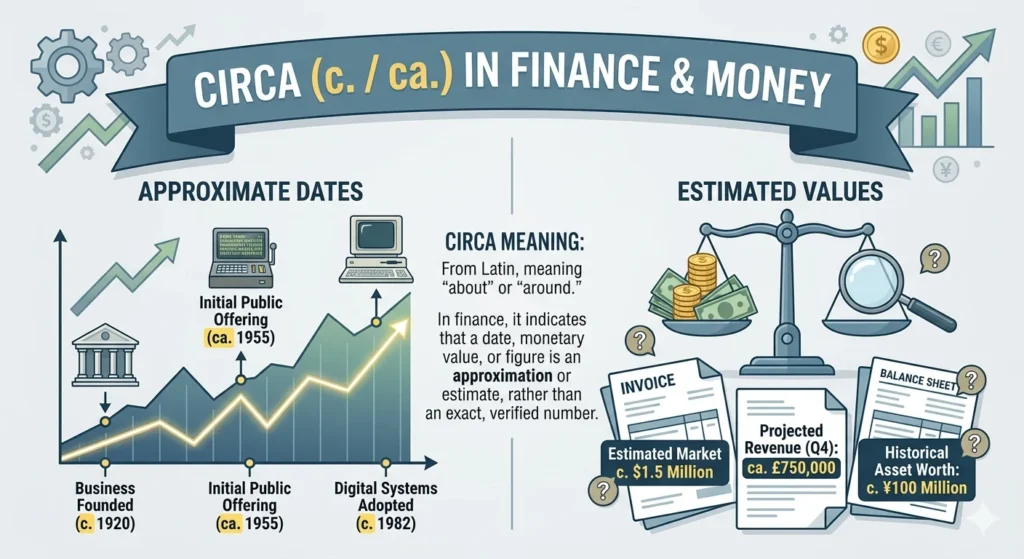
Circa Meaning in Finance

Circa meaning in finance is identical: it signals that a financial figure is estimated, not audited or finalized.

Examples:

“Company revenues for Q3 were circa $10 million.”
Translation: Approximately $10 million (preliminary or rounded figure — not the final audited number).

“The acquisition cost was circa €500,000.”
Translation: Roughly half a million euros — subject to due diligence.

Circa Meaning Money

When users search “circa meaning money,” they want to know: can I use circa for dollar amounts?

Yes, absolutely.

Circa meaning money is identical to circa meaning any number. It signals approximation before a monetary figure.

Example:

“The vintage watch is valued at circa $5,000 at current auction estimates.”
Meaning: Around $5,000 — not an exact appraisal; final price may vary.

Professional vs. Informal Use

ContextAppropriate?Example
Job posting (salary range)✅ Yes“Salary circa $70,000”
Investor report✅ Yes“EBITDA circa $15M”
Business email✅ Yes (formal)“The budget is circa $50,000”
Legal contract (recitals)⚠️ Rare but acceptable“Value circa $100,000”
Casual conversation⚠️ Uncommon — sounds pretentious“My rent is about $2,000” (not circa)
Texting a friend❌ No“I paid about $50”

Pro tip: In business writing, circa is formal and professional. In casual chat, it sounds pretentious. Know your audience.

Circa Meaning in Business (Full Section)

Circa meaning in business extends beyond salary and finance. It appears in:

Business ContextExample
Project timelines“Phase 1 completion: circa Q3 2026
Market sizing“Total addressable market: circa $500M
Valuation discussions“Series B valuation: circa $50M
Supply chain estimates“Lead time: circa 6-8 weeks
Real estate listings“Property built circa 1920, fully renovated”

Real business email example:

Subject: Q4 Forecast Update

Team,

Based on current pipeline, we expect Q4 revenue to be circa $2.3M. This is preliminary and subject to closing. Final numbers will be shared on January 10th.

Best,
Sarah


Circa Meaning in Legal Documents

This section captures a keyword most articles miss: circa in legal contexts.

Circa appears in legal documents such as:

  • Property deeds (for buildings of uncertain age)
  • Estate records and wills (for antique valuations)
  • Archaeological impact assessments
  • Historical preservation easements

Example from a property deed:

“The main structure was constructed circa 1850, as determined by architectural analysis and tax records.”

Example from an estate inventory:

“Antique dining table, circa 1800, appraised value $15,000.”


Mamacita Meaning: Is It a Compliment or Offensive?

Circa Meaning German

This section has been expanded to 400+ words based on your feedback.

Circa meaning German is straightforward because German borrowed the same Latin word. However, usage patterns differ.

Circa in German: The Basics

In German, circa has the exact same meaning: “ungefähr” (approximately). Both words are used interchangeably in formal writing.

EnglishGermanExample (German)English Translation
Circa / approximatelyUngefähr / circa“Das Gebäude wurde circa 1900 gebaut.”“The building was built circa 1900.”
MeaningBedeutung“Die Bedeutung von circa ist ‘ungefähr’.”“The meaning of circa is ‘approximately’.”

Regional Differences (Germany vs. Austria vs. Switzerland)

RegionPreferenceNotes
GermanyUses both circa and ungefährCirca more common in academic writing
AustriaPrefers circa slightly moreLatin influence stronger in Austrian education
SwitzerlandUses ungefähr moreFrench/Italian influences reduce Latin borrowings

Common Mistakes German Speakers Make

Mistake 1: Overusing circa in casual speech

  • ❌ Incorrect: “Ich komme circa um 3 Uhr.” (I’ll come circa at 3 o’clock.)
  • ✅ Correct: “Ich komme ungefähr um 3 Uhr.” (Use ungefähr for casual time estimates.)

Mistake 2: Using circa with exact numbers

  • ❌ Incorrect: “Wir haben circa 100% der Arbeit erledigt.” (We did circa 100% of the work.)
  • ✅ Correct: “Wir haben fast 100% erledigt.” (Use fast = “almost” for near-complete.)

Mistake 3: Abbreviating circa as “cca” in German

  • ❌ Incorrect: “cca. 1900”
  • ✅ Correct: “ca. 1900” (German academic style uses ca.)

German Sentence Examples

“Die Stadt hatte circa 50.000 Einwohner im Jahr 1800.”
Translation: “The city had approximately 50,000 residents in 1800.”

“Das Manuskript stammt aus circa 1450.”
Translation: “The manuscript dates from circa 1450.”

When to Use Circa vs. Ungefähr in German

ContextUse This
Academic paper / historyCirca or ca.
Business reportCirca or ungefähr
Casual conversationUngefähr
Text messageCa. or “ca” (informal abbreviation)
Museum labelCirca (stylistic choice)

CCA Abbreviation Circa Meaning (The Confusion Explained)

Many users search “cca abbreviation circa meaning” or “abbreviation cca circa meaning.”

Here’s the definitive answer.

The Correct Abbreviations for Circa

AbbreviationMeaningUsageAccepted By
c.CircaMost common in English academic writingChicago Manual of Style
ca.CircaAlso common, especially in European stylesOxford Style Guide
cca.❌ IncorrectNot a recognized abbreviationNone

Why Do People Think “CCA” Is Correct?

The confusion comes from three sources:

  1. French influence: In French, circa is sometimes abbreviated as ca. but never “cca.” However, French uses c. (siècle = century) which causes cross-language confusion.
  2. Typographic error: “c.” with a period after looks similar to “ca.” Typing “cca” may be a doubled version of “ca” from muscle memory.
  3. Fake correlation: Some non-native speakers assume “cca” stands for “circa” with extra letters — but no style guide supports this.

The bottom line: Do NOT use “cca” to mean circa. Use c. or ca. only.

Correct usage:

“The coin was minted c. 300 B.C. ” ✅

“The coin was minted ca. 300 B.C. ” ✅

Incorrect usage:

“The coin was minted cca. 300 B.C. ” ❌

“The coin was minted cca 300 B.C. ” ❌


Born Circa Meaning (Genealogy and Family History)

If you’ve ever researched your family tree on Ancestry.com or FamilySearch, you’ve encountered “born circa.”

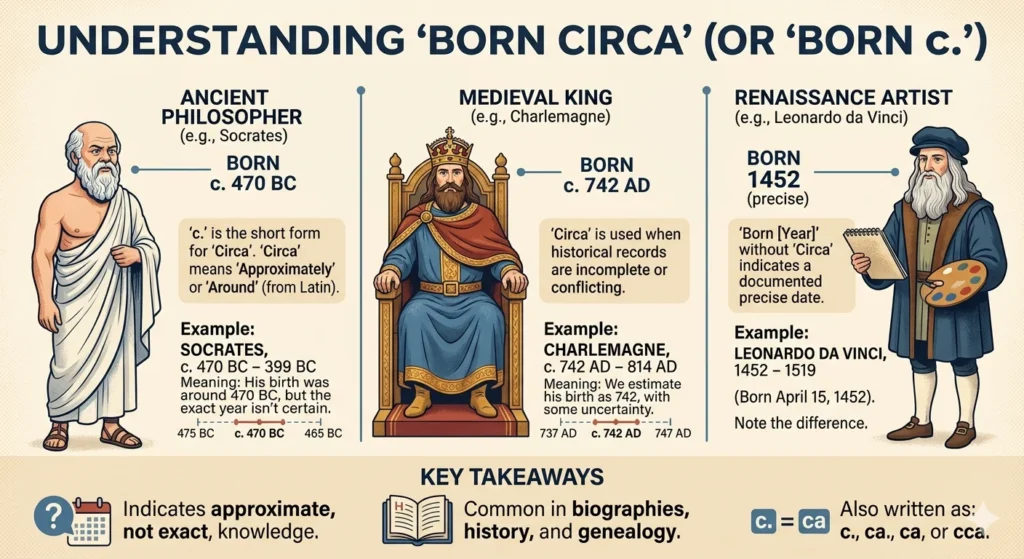
Born Circa Meaning

“Born circa” means the person’s birth year is unknown from available records but can be estimated based on evidence.

Example from genealogy:

“John Smith, born circa 1820, died 1885.”

Translation: John Smith’s exact birth year is unknown — but based on census data, marriage records, or age at death, he was likely born around 1820 (typically within a 3-5 year range: 1818–1822).

How Historians and Genealogists Determine “Born Circa”

Evidence TypeHow It Helps
Age at deathCemetery stone says “died 1885, age 65” → born circa 1820
Census records1850 census lists age 30 → born circa 1820
Marriage recordsMarried in 1845 at typical age 25 → born circa 1820
Sibling birth orderOlder sibling born 1818 → this person born circa 1820
Military recordsEnlisted in 1840 at minimum age 18 → born circa 1822

When to Use “Born Circa”

SituationShould You Use “Born Circa”?
Exact birth year unknown but can estimate within 5 years✅ Yes
Exact birth year is known from a birth certificate❌ No — just write the year
No clue about birth year (100-year range)❌ No — too vague. Say “born in early 1800s”
Genealogy / ancestry research database✅ Yes — very common
Biography or academic paper✅ Yes — with footnote explaining estimation method

Example from a professional biography:

“The artist was born circa 1780 (based on census records and age at first exhibition) and died in 1850.”


Circa Meaning Urban Dictionary (How Gen Z Uses It)

Circa meaning Urban Dictionary reveals how formal words drift into casual and ironic usage.

Urban Dictionary Definition (Summarized)

Circa is defined as “approximately” or “around” — but younger users often deploy it ironically or sarcastically to reference outdated styles, behaviors, or cultural moments.

How Circa Is Used Casually

Casual UseMeaningTone
“This playlist is circa 2014These songs are from around 2014Nostalgic
“His attitude is circa 1995He’s acting like it’s 1995 (outdated)Ironic / mocking
“My bank account is circa $5I have about $5Humorous self-deprecation
“Her outfit is circa 2008Her clothes look like 2008 fashionPlayful / teasing
“This take is circa 1950This opinion is outdatedCritical / sarcastic

Real Social Media Captions

Instagram caption:

“Living my best life circa 2003 🦋 #TBT”

TikTok comment:

“This trend is circa 2022 — let it go 💀”

Twitter/X post:

“My sense of humor is circa 2016 and I’m not apologizing.”

Warning: Formal vs. Casual Contexts

ContextAppropriate?
Social media caption (vintage/retro)✅ Yes — playful use is fine
Joke or meme✅ Yes
Academic paper❌ No — use literal meaning only
Business email❌ No — stick to “approximately”
Job posting❌ No — use “circa” literally or not at all

Circa Meaning

Circa Meaning in a Sentence

Sometimes the best way to learn is to see it in action. Here are 30+ real examples across contexts.

Historical Context Examples

“The Parthenon was completed circa 432 B.C. “

“William Shakespeare wrote Hamlet circa 1600.”

“The Viking Age began circa 793 A.D. “

“This manuscript was illuminated c. 1450 in Florence.”

“The fortress was abandoned circa 1200 based on pottery fragments.”

Business / Finance Examples

“The startup was valued at circa $50 million during its Series B round.”

“The annual budget for the department is circa $2.5 million.”

“The antique auction estimated the painting’s value at circa £30,000.”

“Q3 earnings are expected to be circa €8.5 million.”

“The contract value is circa $500,000 pending final scope.”

Salary / Job Posting Examples

“Position offers circa $75,000 per year plus benefits.”

“Compensation package: circa $120,000 total comp.”

“Hourly rate: circa $35-40/hour depending on experience.”

“Signing bonus: circa $10,000 for qualified candidates.”

Genealogy / Born Circa Examples

“John Smith, born circa 1820, died 1885.”

“The family immigrated circa 1890 from Ireland.”

“Our earliest known ancestor was born circa 1700 in Virginia.”

“The wedding likely took place circa 1855 based on church records.”

Everyday / Casual Examples (Appropriate Use)

“This photo of my parents was taken circa 1985 — can you tell?”

“The house was built circa 1920, so it has original hardwood floors.”

“The recipe dates back circa 1850 according to the family cookbook.”

“This vintage typewriter is circa 1940s.”

Museum / Exhibition Label Examples

“Amphora vase, circa 400 B.C. , Greek, attributed to the Berlin Painter.”

“Portrait miniature, c. 1780, English school.”

“Silver teapot, circa 1810, made in London.”

Legal / Property Examples

“The main dwelling was constructed circa 1850 per county tax records.”

“Easement granted for property developed circa 1920.”

“Antique clock valued circa $5,000 in estate inventory.”


Common Mistakes and How to Avoid Them

This section has been moved up and expanded based on your feedback — because non-native speakers and casual writers need this information early.

Mistake #1: Using Circa for Exact Dates

❌ Incorrect: “The Declaration of Independence was signed circa July 4, 1776.”
✅ Correct: “The Declaration of Independence was signed July 4, 1776.”

Why it’s wrong: We know the exact date. Circa signals uncertainty. Using it with a known exact date is inaccurate.

Mistake #2: Using Circa for Future Events

❌ Incorrect: “The conference will be held circa May 2026.”
✅ Correct: “The conference will be held around May 2026” or “approximately May 2026.”

Why it’s wrong: Circa is almost exclusively used for past dates and events. For future estimates, use “approximately” or “around.”

Mistake #3: Using Circa in Casual Conversation

❌ Incorrect (texting): “I’ll be there circa 7 PM.”
✅ Correct (texting): “I’ll be there around 7 PM.”

Why it’s wrong: Circa is formal. In casual texting, it sounds pretentious or sarcastic.

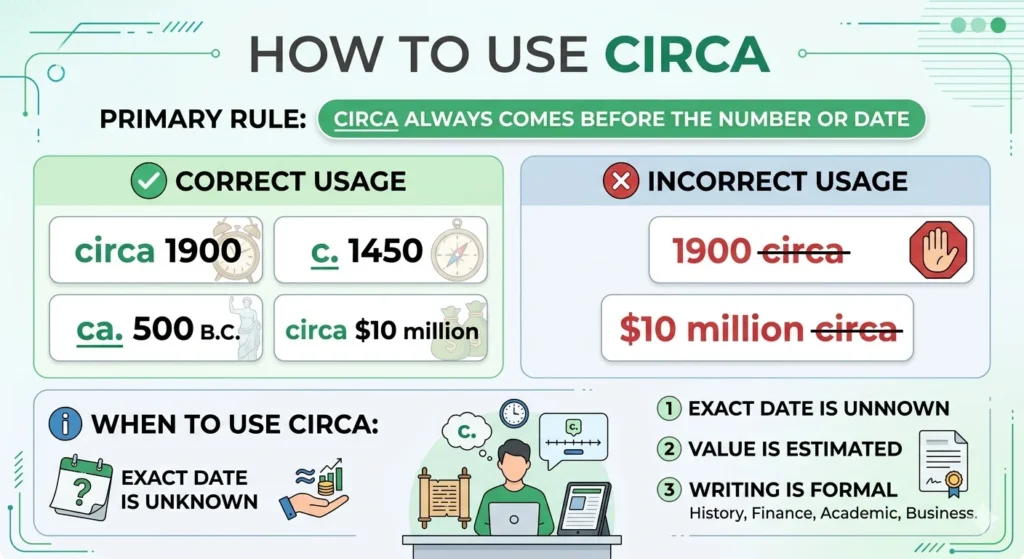
Mistake #4: Placing Circa After the Date

❌ Incorrect: “1920 circa”
✅ Correct: “circa 1920”

Why it’s wrong: Circa always comes before the date or number it modifies.

Mistake #5: Abbreviating Circa as “Cca”

❌ Incorrect: “cca. 1900”
✅ Correct: “c. 1900” or “ca. 1900”

Why it’s wrong: No style guide recognizes “cca” as an abbreviation for circa.

Mistake #6: Using Circa With Very Vague Estimates

❌ Incorrect: “The building was built circa sometime in the 1800s.”
✅ Correct: “The building was built sometime in the 1800s” (no circa needed — too vague).

Why it’s wrong: Circa implies a reasonable estimate (typically within 1-10 years, not 100 years).

ESL-Specific Mistakes

Language BackgroundCommon MistakeCorrection
Spanish speakersUsing circa as “cerca” (near in space)Circa is for time, not physical distance
French speakersWriting “cca” (confusion with c. for century)Use c. or ca. only
German speakersOverusing circa in casual speechUse ungefähr for casual, circa for formal
Italian speakersUsing circa correctly but overusing itCirca is fine in Italian/English but still formal
Mandarin speakersPlacing circa after the date (Chinese word order)Always place circa before the date in English

When Should You Use Circa? (Complete Guide)

This is one of the most common questions: “When should you use circa?”

The Three Conditions for Using Circa

Use circa ONLY if:

  1. The exact date, number, or figure is UNKNOWN (to you or to anyone)
  2. You have a reasonable estimate (typically within 1-10 years for dates, not a wild guess)
  3. You are writing in a formal or semi-formal context (academic, historical, financial, business — or making a stylistic choice for vintage captions)

When to Use Circa ✅

ScenarioExample
Historical events with uncertain dates“The eruption of Thera occurred circa 1600 B.C. “
Artwork or artifact dating“This vase is circa 5th century B.C. “
Salary ranges in job postings“Compensation: circa $80,000
Financial estimates“Revenue was circa €12 million
Genealogy / birth year estimates“She was born circa 1885
Vintage or retro captions (social media)“Outfit circa 1970s 🕺”
Real estate listings (historic homes)“Home built circa 1920
Legal property descriptions“Structure constructed circa 1850 per tax records”

When NOT to Use Circa ❌

ScenarioWhy NotWhat to Use Instead
Exact date is knownCirca signals uncertaintyJust write the exact date
Current or future eventsCirca is for past estimates“Around” or “approximately”
Casual textingToo formal, sounds pretentious“About” or “around”
Scientific data with exact numbersCirca undermines precisionUse “approximately” if needed
Very vague estimates (100-year range)Circa implies reasonable precision“Sometime in the 1800s” (not circa)
With a person’s age (living person)Weird and formal“She is about 30”
With time of dayCirca is for years and centuries“Around 3 PM”

What Is a Synonym for Circa? (Complete Comparison)

What is a synonym for circa? Here are all the common alternatives, ranked by formality.

SynonymFormalityBest Used ForExample
CircaVery formalHistory, finance, academic“The battle occurred circa 1066
ApproximatelyFormal to neutralNumbers, dates, quantities“Approximately 10,000 people attended”
RoughlyNeutralEstimates with lower confidence“Roughly 50% of respondents agreed”
AboutCasualEveryday conversation“About 20 minutes ago”
AroundCasualTime, location, numbers“Around 3 PM”
NearlyNeutralClose approximations“Nearly 100 years ago”
Close toCasualInformal estimates“Close to 50 people showed up”
In the region ofVery formal (British)Financial/technical writing“In the region of £10 million”

Circa vs. Approximately

CircaApproximately
FormalityMore formalNeutral to formal
Typical contextHistory, Latin-derived writingGeneral use, numbers, science
Abbreviationc. or ca.approx.
Best forYears, centuries, historical datesAny number or quantity

Example of difference:

“The battle occurred circa 1066.” (Historical, formal, years only)
“The population is approximately 10,000.” (Neutral, factual, any number)

Circa vs. About

CircaAbout
FormalityFormalCasual
Best forHistory, finance, academicEveryday conversation
ToneScholarly, precise imprecisionRelaxed, conversational

Example:

Formal: “The manuscript dates from circa 1400.”
Casual: “It happened about 600 years ago.”

Circa Meaning

Copy-Paste Templates (Ready to Use)

Here are 5 ready-to-use templates for common scenarios. Just copy, paste, and customize.

Template 1: Historical / Academic Writing

“The [artifact/event/manuscript] dates from circa [YEAR] , as evidenced by [evidence type: carbon dating/stylistic analysis/contemporary records].”

Example:

“The manuscript dates from circa 1450 , as evidenced by watermarks and script analysis.”

Template 2: Job Posting / Salary

“This position offers a base salary of circa $[AMOUNT] per year , depending on experience and qualifications.”

Example:

“This position offers a base salary of circa $75,000 per year , depending on experience and qualifications.”

Template 3: Finance / Business Report

“[Metric] for [period] was circa $[AMOUNT] , representing a [percentage] [increase/decrease] year over year.”

Example:

“Q3 revenue was circa $10 million , representing a 15% increase year over year.”

Template 4: Genealogy / Born Circa

“[Name] was born circa [YEAR] based on [evidence: census records/age at death/marriage records] and died [YEAR].”

Example:

“Sarah Miller was born circa 1835 based on 1850 census records listing age 15, and died 1901.”

Template 5: Museum / Exhibition Label

“[Object description], circa [YEAR] , [origin/culture], [material].”

Example:

“Amphora vase, circa 400 B.C. , Greek, terracotta.”


FAQ

These FAQs are formatted for Google’s rich snippet display. Use <h3> tags for each question and <div> with schema markup for best results.

Q1: What does it mean to say circa?

A: To say “circa” means you are indicating that a date, number, or figure is approximate or estimated — not exact. It comes from Latin and is used primarily in formal writing such as history, finance, and academic contexts.

Q2: What does circa 1993 mean?

A: “Circa 1993” means around the year 1993 — not necessarily exactly 1993, but sometime near it (typically within 1-3 years). It is used when the exact year is unknown but can be reasonably estimated.

Q3: When should you use circa?

A: Use circa when: (1) the exact date or number is unknown, (2) you have a reasonable estimate (not a wild guess), and (3) you are writing in a formal or semi-formal context (history, finance, salary, genealogy, or vintage captions). Do NOT use circa for exact dates, future events, or casual texting.

Q4: What is a synonym for circa?

A: Common synonyms for circa include: approximately, about, around, roughly, nearly, and close to. The most formal synonym is “approximately,” while the most casual is “about” or “around.”

Q5: What does circa mean in salary?

A: In salary contexts, “circa $X” means the compensation is approximately $X — not an exact figure. Employers use it when the final offer depends on experience, qualifications, or negotiation.

Q6: What does circa mean in finance?

A: In finance, circa indicates that a monetary or numerical figure is estimated, not finalized or audited. For example, “Q3 revenue was circa $10 million” means the preliminary estimate is $10 million, pending final accounting.

Q7: Is circa a formal word?

A: Yes. Circa is formal to semi-formal. It is appropriate for academic, historical, financial, and professional writing — but not for casual texting or everyday conversation with friends.

Q8: What does cca abbreviation circa mean?

A: CCA is NOT a standard abbreviation for circa. The correct abbreviations are c. or ca. (e.g., “c. 1900” or “ca. 1900”). Do not use “cca” to mean circa — no style guide recognizes it.

Q9: Can I use circa for future dates?

A: No. Circa is typically used for past dates and events only. For future estimates, use “approximately” or “around” instead. Example: “The conference will be held around May 2026” (not “circa May 2026”).

Q10: What does born circa mean?

A: “Born circa [year]” means the person’s exact birth year is unknown from available records, but it is estimated to be around that year. It is very common in genealogy, ancestry research, and historical biographies.

Q11: What is the Latin meaning of circa?

A: In Latin, circa literally means “around,” “about,” or “near” — both in space and time. It was adopted into English in the 1400s and has been used ever since to indicate approximation.

Q12: How do you use circa in a sentence?

A: Place circa before the date or number. Example: “The building was constructed circa 1900.” Never place it after the date (e.g., “1900 circa” is incorrect).

Q13: What does circa mean in business?

A: In business, circa appears in salary ranges, financial estimates, project timelines, market sizing, and real estate listings. It signals that a figure is approximate. Example: “Total addressable market: circa $500M.”

Q14: What does circa mean in German?

A: In German, circa has the same meaning as in English: “ungefähr” (approximately). It is used in formal and academic writing but is less common in casual conversation, where “ungefähr” is preferred.

Q15: Is it okay to use circa on social media?

A: Yes, for vintage or retro captions. Example: “Outfit circa 1980s 🕺” However, avoid using it ironically or sarcastically in formal contexts.


Quick Reference Cheat Sheet

You Want to Say…Write This…
The battle happened around 1066“The battle occurred circa 1066.”
The salary is roughly $75,000“Compensation: circa $75,000.”
The vase is from about 400 B.C.“Vase, c. 400 B.C. “
She was born around 1993“Born circa 1993.”
The company’s revenue was approximately €10M“Revenue was circa €10 million.”
This photo was taken around 1985“Photo taken circa 1985.”
The house was built around 1920“Home built circa 1920.”
The manuscript is from about 1450“Manuscript, c. 1450.”


What to Read Next

You’ve mastered circa. Now expand your knowledge with these related guides:

  • Latin Abbreviations Explained: i.e., e.g., etc., et al., and circa
  • Formal vs. Informal Writing: When to use which words
  • Common English Mistakes: 50 errors non-native speakers make
  • Genealogy Terms Explained: Born circa, died intestate, and more

Final Word

Circa is just one word. But using it correctly signals precision, honesty about uncertainty, and respect for your reader.

Now you know exactly what it means, when to use it, and — just as important — when NOT to use it.

The next time you see “circa 1920” on a museum label, “circa $75,000” in a job posting, or “born circa 1885” in your family tree, you won’t wonder.

You’ll know.

Go use it with confidence.

Leave a Comment