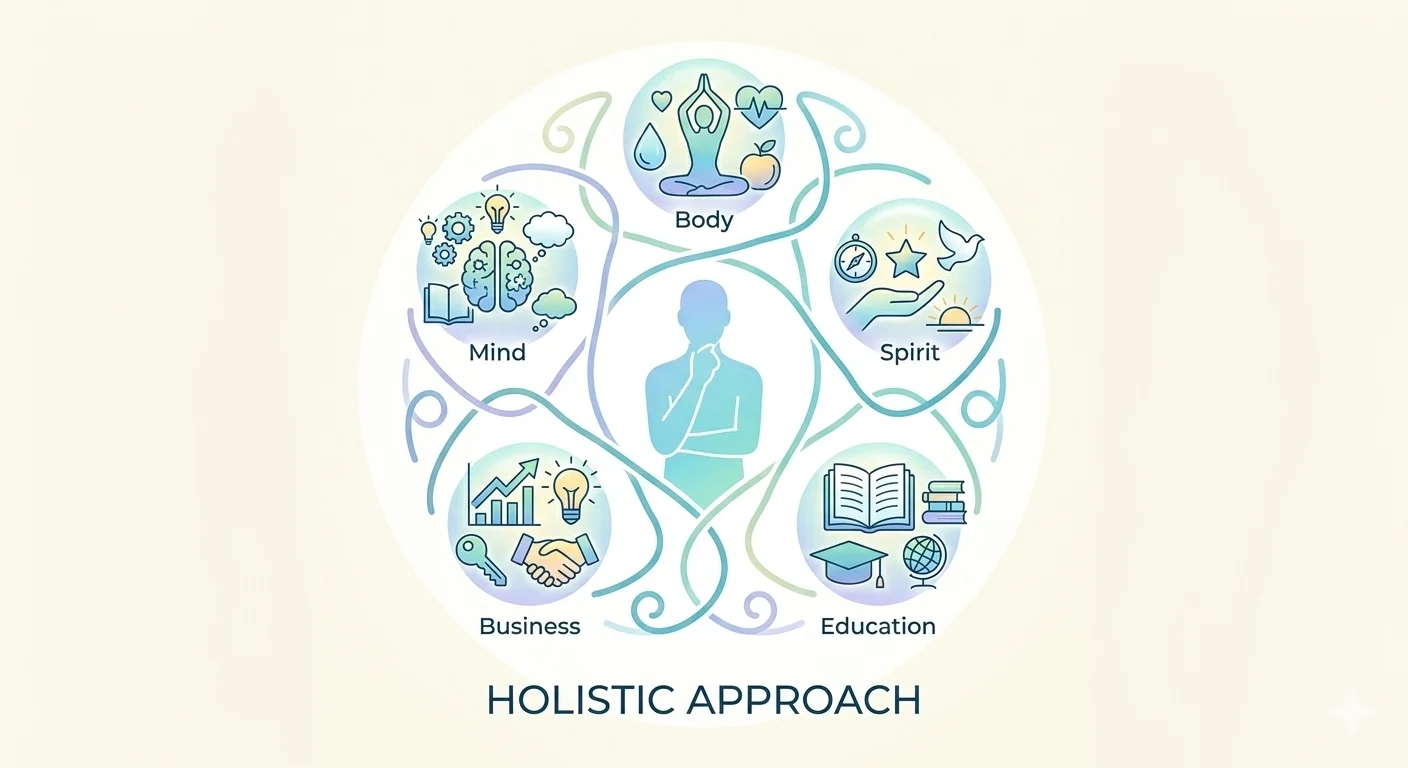
Holistic meaning refers to an approach that looks at the whole system rather than focusing on individual parts. It emphasizes how different elements are connected and work together to create balance, understanding, or results.
Have you ever tried fixing one small problem, only to realize the real solution required looking at the bigger picture? That idea perfectly explains the holistic meaning.
The term holistic comes from the idea that everything is interconnected. Instead of analyzing parts separately, a holistic approach studies how all pieces interact to form a complete system.
For example, in holistic health, doctors consider a person’s mind, body, emotions, and lifestyle rather than treating only one symptom. This broader perspective is also used in education, psychology, business, and personal development.
In simple terms, holistic meaning is about understanding the complete picture instead of focusing on just one part.
What Does Holistic Mean?
Holistic is an adjective that refers to an approach or perspective that considers the whole system rather than just individual parts.
- Type: Standard English term (not slang)
- Usage: Commonly used in wellness, education, mental health, and business contexts
Example:
- “A holistic health plan focuses on mind, body, and spirit for overall well-being.”
Origin and Popularity
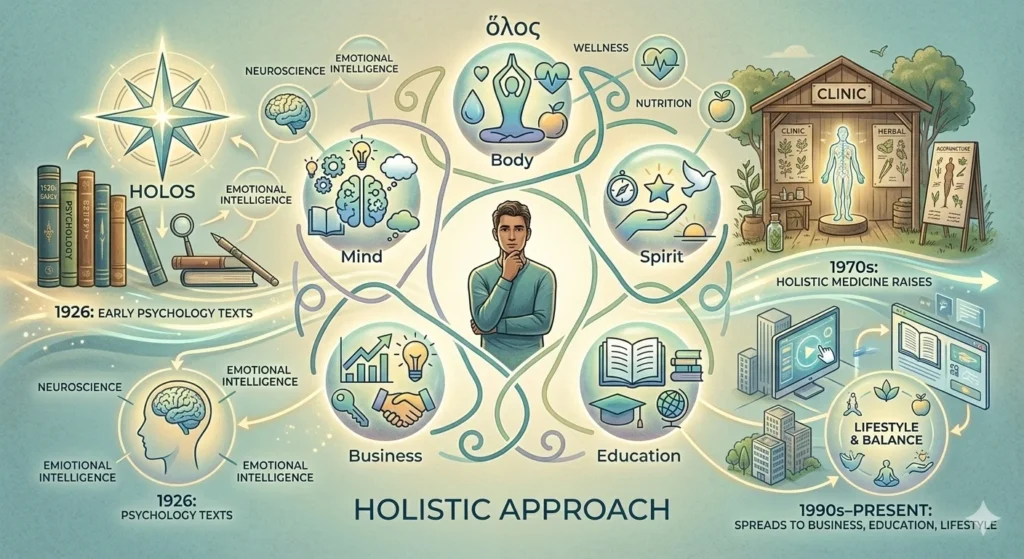
The word holistic comes from the Greek word ‘holos’, meaning whole or entire. It was first popularized in the 20th century with the rise of holistic medicine and psychology, emphasizing the interconnection of mental, physical, and spiritual health.
Timeline & Pop Culture Moments:
- 1926: Holistic ideas appear in early psychology texts
- 1970s: Holistic medicine gains traction in the U.S. as an alternative to conventional treatments
- 1990s–Present: The term spreads to business, education, and lifestyle communities as a philosophy of balance and integration
Today, holistic thinking is widely recognized in healthcare, corporate strategy, and personal development.
Holistic Meaning in Different Contexts
In Wellness & Health
- Focuses on overall well-being: physical, mental, emotional, and spiritual
- Example: “Yoga is a holistic practice that strengthens both body and mind.”
In Education
- Considers emotional, social, and cognitive development of students
- Example: “The school follows a holistic approach, nurturing creativity alongside academics.”
In Business & Leadership
- Looks at the organization as a whole, including culture, employees, and operations
- Example: “Holistic management strategies improve productivity and employee satisfaction.”
| Context | Meaning | Example |
| Wellness | Whole-person health | Holistic nutrition plans |
| Education | Whole-child development | Holistic learning strategies |
| Business | Whole-system management | Holistic leadership approach |
Examples of Holistic in Conversations
Casual:
- Friend 1: “I’ve started seeing a holistic therapist.”
- Friend 2: “Oh nice! How’s it helping you?”
Professional:
- Manager: “We need a holistic strategy for improving team performance.”
Wellness Focused:
- Yoga Instructor: “This routine takes a holistic approach, balancing strength and relaxation.”
Similar or Related Terms
Expanding your vocabulary can help you understand and use holistic better:
| Term | Meaning |
| Integrative | Combines multiple methods or practices |
| Comprehensive | Includes all necessary parts or elements |
| Mind-body-spirit | Focuses on mental, physical, and spiritual health |
| All-encompassing | Covers all aspects, not just parts |
How to Use Holistic Correctly
✅ Do’s:
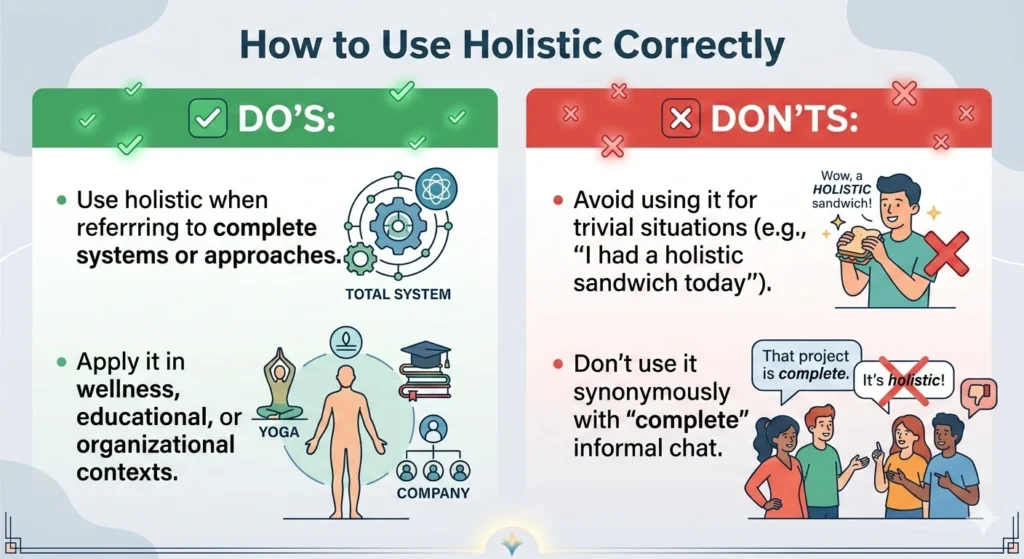
- Use holistic when referring to complete systems or approaches
- Apply it in wellness, educational, or organizational contexts
❌ Don’ts:
- Avoid using it for trivial situations (e.g., “I had a holistic sandwich today”)
- Don’t use it synonymously with “complete” in informal chat
Common Mistakes or Misinterpretations
Many people mistakenly think holistic only refers to health or alternative medicine, but it actually applies broadly:
- Incorrect: “I have a holistic breakfast.”
- Correct: “We need a holistic review of our company’s policies.”
Another common confusion is equating holistic with comprehensive, which is close but not always exact—the key difference is interconnection and balance, not just completeness.
FAQ Section
1. What does holistic mean in wellness?
Holistic in wellness refers to practices that consider the whole person—mind, body, and spirit—rather than just treating specific symptoms.
2. Is holistic a slang or formal term?
Holistic is a formal English term commonly used in professional, academic, and health contexts.
3. How does holistic differ from comprehensive?
Comprehensive focuses on including all parts, while holistic emphasizes the interconnectedness and balance of those parts.
4. Can holistic be used in business?
Yes, holistic approaches in business consider the organization as a whole, including employees, processes, and culture.
5. How do you apply holistic thinking in daily life?
Consider all aspects of a situation—mental, physical, emotional, and environmental—before making decisions or forming strategies.
6. Where is holistic most used?
It is widely used in wellness, education, business, and personal development contexts.
Conclusion
Now that you know the holistic meaning, you can confidently use it in conversations, writing, and professional settings. From health and education to business strategies, a holistic approach ensures that you consider the full picture, not just the parts.
Next time someone mentions taking a holistic approach, you’ll know it’s about balance, interconnectedness, and overall well-being. Keep exploring these terms to communicate clearly and effectively in today’s interconnected world.

Willie Nelson is a skilled and passionate content writer working as an expert author at maeningg.com. With strong knowledge of digital trends, slang meanings, and engaging online content, Willie focuses on creating clear, helpful, and reader-friendly articles.