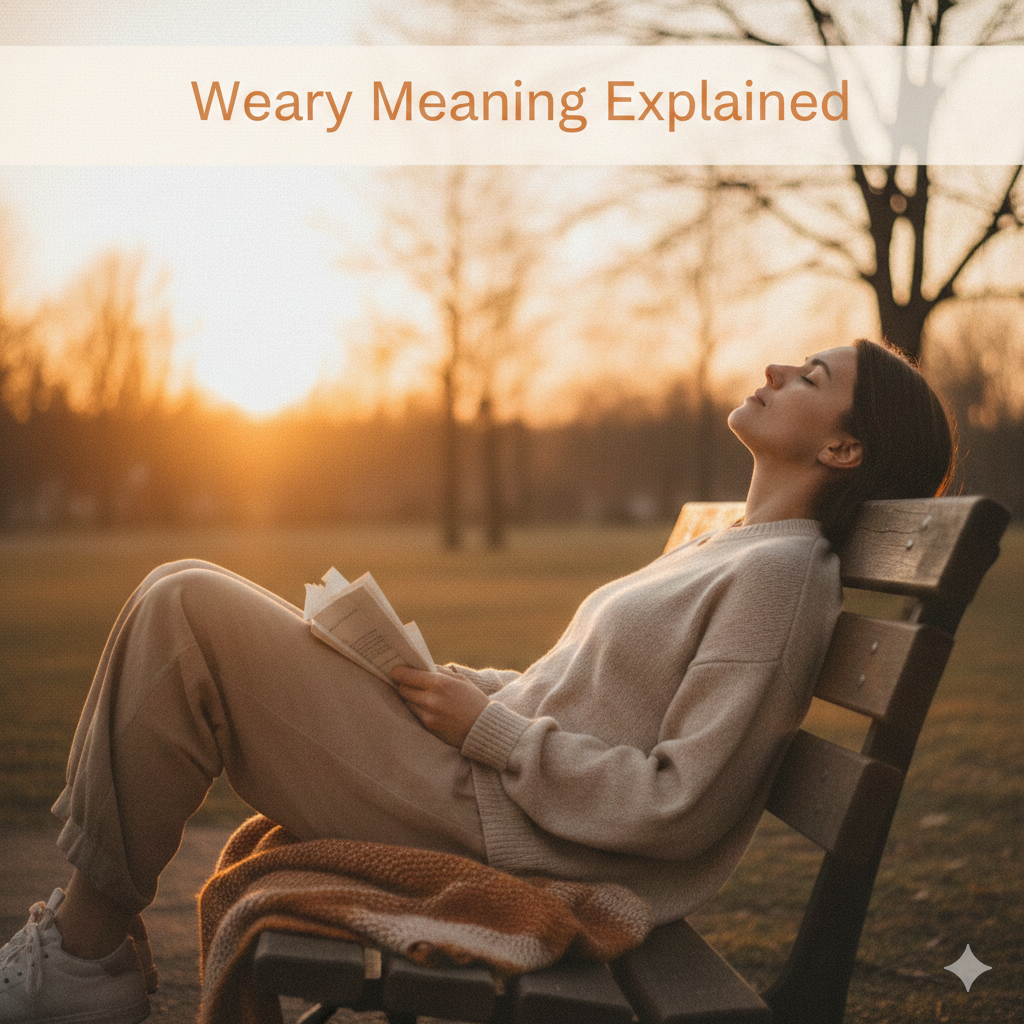
Have you ever felt tired in a way that sleep alone doesn’t fix? That deep, worn-down feeling is exactly what weary describes. Unlike ordinary tiredness, being weary often comes from long effort, ongoing stress, or emotional pressure, not just lack of rest.
You’ll see this word in books, exams, conversations, and even motivational quotes because it captures a sense of fatigue that builds over time. Understanding the meaning of weary helps you describe exhaustion more accurately and sound more natural in English.
If the cause is physical work, mental overload, or emotional struggle, weary signals the need for rest, relief, and recovery.
Weary means feeling extremely tired, exhausted, or mentally drained due to physical effort, stress, or emotional strain.
🧩 What Does Weary Mean?
Weary means feeling or showing tiredness, especially as a result of excessive work, stress, or lack of rest.
It describes both physical fatigue and emotional exhaustion.
👉 In simple words:
“Weary” means very tired or worn out — either in body, mind, or spirit.
It’s commonly used in everyday English, literature, and even motivational writing to describe exhaustion that goes deeper than just being sleepy.

📜 Origin and Popularity
The word “weary” comes from the Old English word “wērig,” which meant tired, exhausted, or fatigued.
It has been part of the English language for over 1,000 years, appearing in ancient poetry, Shakespearean plays, and modern speech.
Quick Timeline
- Old English (before 1150): “Wērig” — meaning tired or fatigued
- Middle Ages: Used in literature to express deep emotional fatigue
- Modern English: Used in daily life to show both physical and emotional tiredness
The phrase “growing weary” became especially common in literature to express emotional struggles — for example, “She grew weary of waiting.”
HY Meaning: What “HY” Stands For in Texting & Social Media for 2026

🌍 Weary Meaning in Different Contexts
| Context | Meaning of “Weary” | Example Sentence |
| In Everyday Speech | Feeling tired after effort or work | “I’m too weary to go out tonight.” |
| In Literature or Poetry | Emotional exhaustion or sorrow | “He was weary of life’s endless trials.” |
| In Work or Study | Mentally drained or losing motivation | “After long hours of studying, she felt weary.” |
| In Religion or Philosophy | Spiritual fatigue or loss of hope | “Even the faithful grow weary sometimes.” |
The tone of “weary” can range from gentle fatigue to deep, soulful exhaustion, depending on context.
TBH Meaning in Text : Explained By Example with uses for 2026
💬 Examples of Weary in Conversations
Here are a few real-life examples of how people use “weary” in everyday talk:
Example 1 – Casual:
Friend 1: You look tired today.
Friend 2: Yeah, I’m a bit weary from all the meetings.
Example 2 – Emotional:
“She felt weary of pretending everything was okay.”
Example 3 – Inspirational:
“Don’t grow weary of doing good; your effort will pay off.”
Example 4 – Literary:
“The weary traveler rested beneath the oak tree.”
These examples show how “weary” conveys both physical tiredness and emotional depth — making it a powerful word for writers and speakers alike.
🔗 Similar or Related Terms
Here are a few related words and how they differ:
| Word | Meaning | Difference from “Weary” |
| Tired | General fatigue after activity | “Weary” is deeper and often emotional. |
| Exhausted | Complete lack of energy | Stronger than “weary,” purely physical. |
| Fatigued | Medical or technical term for tiredness | Less emotional, more clinical. |
| Worn out | Slang for extreme tiredness | Informal and casual version of “weary.” |
✍️ How to Use Weary Correctly
✅ Do’s:
- Use “weary” when describing long-term tiredness.
- Use it for both physical and emotional fatigue.
- Great for literary writing or expressive dialogue.
❌ Don’ts:
- Don’t use it casually when you just mean “sleepy.”
- Avoid overusing it in short texts or slang — it sounds formal.
Example:
✅ “She was weary after working for twelve hours.”
❌ “I’m weary, need a nap.” (Better: “I’m tired.”)
⚠️ Common Mistakes or Misinterpretations
Many people confuse “weary” with “wary” — but they mean completely different things!
| Word | Meaning | Example |
| Weary | Tired or exhausted | “He grew weary of waiting.” |
| Wary | Cautious or careful | “Be wary of strangers.” |
🧠 Quick Tip:
If you’re tired, you’re weary.
If you’re careful, you’re wary.
❓ FAQ Section
1. What does “weary” mean in simple words?
It means very tired or worn out, either physically or emotionally, after a long period of work, stress, or waiting.
2. Is “weary” slang or formal?
“Weary” is a formal English word, not slang. It’s used in writing, literature, and polite speech.
3. What’s the difference between “weary” and “tired”?
“Weary” describes deep fatigue or emotional exhaustion, while “tired” usually means short-term physical tiredness.
4. Can “weary” describe emotions?
Yes. For example, “She was weary of fighting,” means she felt emotionally drained.
5. Where is “weary” most used?
It’s common in English literature, motivational writing, and daily conversations to express exhaustion.
6. How do you pronounce “weary”?
It’s pronounced /ˈwɪəri/ — sounds like “weer-ee.”
🏁 Conclusion
Now you know that “weary” doesn’t just mean tired — it captures emotional, physical, and even spiritual exhaustion. From ancient poetry to modern conversations, this timeless word expresses the deeper layers of human fatigue and perseverance.
So, next time you feel drained, you can say you’re weary — and you’ll know exactly what it means!
💡 Now that you know the weary meaning, keep exploring our site for more insightful definitions and trending language guides.

Kris Kristofferson is a professional content writer at maeningg.com, specializing in clear, engaging, and well-researched digital content. With strong expertise in writing about text slang, meanings, lifestyle, and informative articles, Kris focuses on helping readers understand internet language in a simple and relatable way.