Ever heard someone say “voila!” and wondered why it sounds so fancy? You’re not alone—this French word has become popular in English, but many people aren’t sure what it truly means.
Voila means “there it is” or “here it is”, used to highlight something just completed, revealed, or achieved.
For example: “And voila! The cake is ready.” It adds flair, drama, and a sense of accomplishment whenever something is presented successfully.
💡 Pro Tip: Use voila in informal conversations, presentations, or writing—it gives your reveal a stylish, sophisticated touch.
What Does “Voila” Mean?
Voila is a French exclamation meaning “here it is” or “there you go”, often used to draw attention to something that has just been completed or revealed.
- Type: Phrase / Exclamation
- Usage: Casual conversation, texting, social media captions, and presentations
- Example: “I added the finishing touches to the cake—voila! It’s ready to serve!”
Origin and Popularity
Voila originated in French centuries ago, combining voi (“see”) and là (“there”), literally translating to “see there!”.
- Timeline & Pop Culture:
- Used in French literature and daily speech for hundreds of years.
- Became popular in English-speaking countries in the 20th century through cooking shows, theater, and television.
- Often used in social media captions today to add flair or emphasize a reveal.
- Used in French literature and daily speech for hundreds of years.
Its popularity stems from its elegant, slightly dramatic tone, making it a favorite among influencers, chefs, and writers.
“Voila” Meaning in Different Contexts
In Texting:
- Used casually to show completion or reveal:
“Finished your surprise gift—voila!”
On Instagram / TikTok:
- Often paired with images or videos to dramatize a reveal or achievement:
“New art project complete—voila! ✨”
In Business / Formal Chats:
- Rarely used, but can be appropriate in presentations to highlight results:
“Our new marketing strategy is live—voila!”
| Platform | Meaning / Usage | Tone |
| Texting | Completion / reveal | Casual |
| Social Media | Dramatic reveal / showcase | Playful / Chic |
| Business / Formal | Highlighting a result | Professional |
Examples of “Voila” in Conversations
Casual Chat:
Friend 1: Finished the homework?
Friend 2: Yup, voila! All done.
Texting a Friend:
Friend 1: Can you send the pics?
Friend 2: Uploaded them to the drive—voila!
Social Media Caption:
Just baked my first sourdough loaf—voila! 🥖
Formal Usage Example:
“We’ve completed the report on time—voila! The results are ready for review.”
Similar or Related Terms
| Term | Meaning | Usage |
| Voilà (alternate spelling) | Same as “voila” | French & English writing |
| Ta-da! | Expression of completion or surprise | Casual, playful |
| Behold | Emphasis on revealing something | Formal or literary |
| Presto! | Suddenly, magically (used in cooking, magic tricks) | Casual / Dramatic |
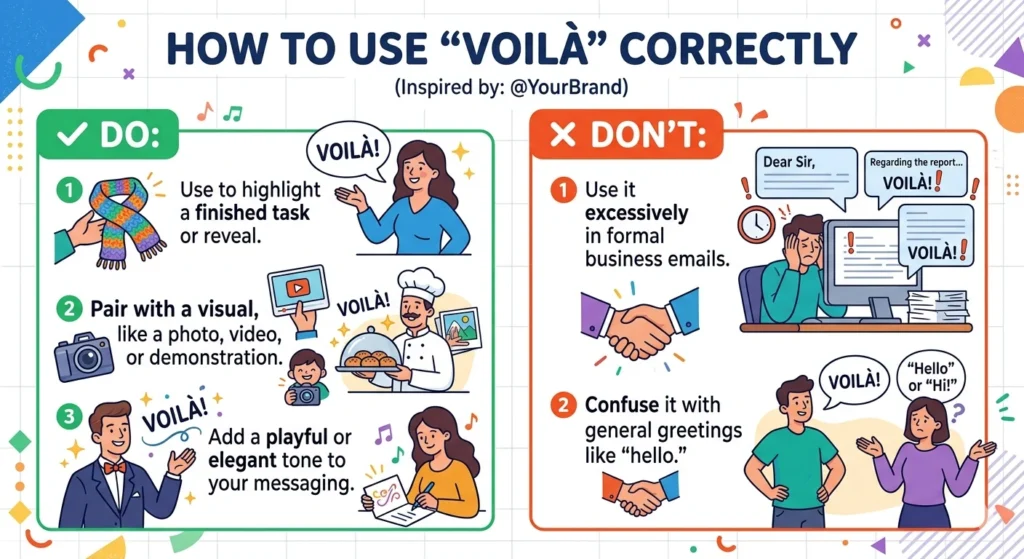
How to Use “Voila” Correctly
✅ Do:
- Use to highlight a finished task or reveal.
- Pair with a visual, like a photo, video, or demonstration.
- Add a playful or elegant tone to your messaging.
❌ Don’t:
- Use it excessively in formal business emails.
- Confuse it with general greetings like “hello.”
Common Mistakes or Misinterpretations
- Misinterpretation: Some people think it’s just a fancy “wow” — but it actually means “here it is” or “there you go.”
- Confusion with Ta-da!: While similar, ta-da! is more playful and dramatic, whereas voila emphasizes completion or reveal.
FAQ Section
1. What does “voila” mean in texting?
In texting, voila is used to show that something has been completed, delivered, or revealed. For example, “Finished the assignment—voila!” signals completion clearly.
2. Is “voila” slang or formal?
It is neither slang nor informal. Voila is a French word adopted into English and can be playful, casual, or even semi-formal depending on context.
3. What’s the difference between “voila” and “ta-da”?
Both are used for reveals. Voila is more elegant and indicates completion, while ta-da! is playful and theatrical.
4. How do you reply to “voila”?
Usually, a simple acknowledgment like “Awesome!” or “Nice work!” works. It’s less about replying and more about celebrating the reveal.
5. Where is “voila” most used?
It’s popular on social media, cooking shows, and casual conversation, especially when showing a completed task, product, or creative work.
6. When should you not use “voila”?
Avoid using it in formal emails unless giving a presentation or report. It can feel too casual or theatrical in strictly professional contexts.
Conclusion
Now you know the meaning, origin, and proper usage of voila. Whether you’re texting a friend, posting on Instagram, or presenting a project, this word adds a touch of elegance and fun.
Voila! You’ll never be confused about this classic French exclamation again. Keep exploring our site for more trending phrases, internet slang, and interesting language insights.

Willie Nelson is a skilled and passionate content writer working as an expert author at maeningg.com. With strong knowledge of digital trends, slang meanings, and engaging online content, Willie focuses on creating clear, helpful, and reader-friendly articles.