Ever come across the word moniker and felt confused about its meaning? You’re not alone—many people see it online or in conversations and aren’t sure how to use it correctly.
Moniker meaning is simple—it refers to a name or nickname used instead of someone’s real name.
But why do people use “moniker” instead of just saying “nickname”? The word is often used for celebrities, gamers, or social media users who create a unique identity. For example, a rapper or gamer name can be their moniker.
Understanding this word helps you avoid confusion and makes your English sound more natural and polished in real-life conversations and online use.
💡 Tip: Use moniker when you want a smarter, more stylish way to say “nickname.”
What Does Moniker Mean?
A moniker is a nickname or a familiar name used to refer to someone or something, often instead of their official name. It’s not slang or an acronym; it’s a formal English term widely used in writing, conversation, and media.
Where it’s used:
- Casual conversation
- Writing (articles, books, blogs)
- Online discussions or social media
Example:
“The rapper’s moniker is Drake, but his real name is Aubrey Graham.”
Origin and Popularity
The word “moniker” has a fascinating history. It originated in 19th-century American English and is believed to have roots in Irish or Romani slang. Originally, it was used to refer to a name, nickname, or alias, often in playful or informal settings.
Timeline of popularity:
- 1800s: Term appeared in newspapers and literature.
- 1920s–1950s: Used in informal American English to refer to nicknames.
- 2000s–present: Gained renewed use online and in pop culture as people discuss pseudonyms, online handles, and stage names.
Today, it’s common across writing, journalism, and social media, and occasionally in casual conversation.
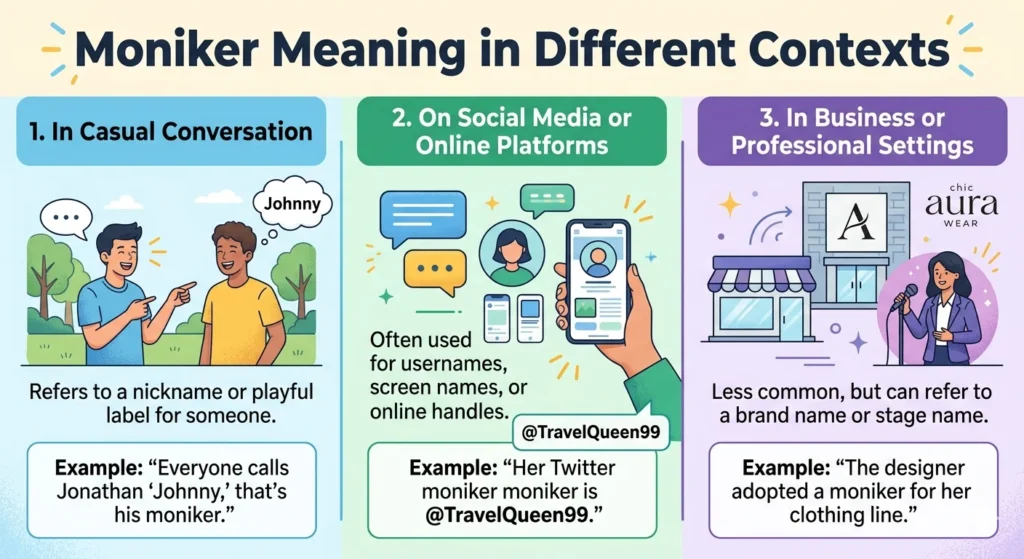
Moniker Meaning in Different Contexts
In Casual Conversation
- Refers to a nickname or playful label for someone.
- Example: “Everyone calls Jonathan ‘Johnny,’ that’s his moniker.”
On Social Media or Online Platforms
- Often used for usernames, screen names, or online handles.
- Example: “Her Twitter moniker is @TravelQueen99.”
In Business or Professional Settings
- Less common, but can refer to a brand name or stage name.
- Example: “The designer adopted a moniker for her clothing line.”
Table: Moniker Usage Across Platforms
| Platform / Context | Meaning & Use | Example |
| Conversation / Friends | Nickname or informal name | “His moniker is ‘Big Mike.’” |
| Social Media / Gaming | Online username or handle | “Her Instagram moniker is @SunnyVibes.” |
| Business / Creative Work | Brand or professional alias | “The artist’s moniker is Banksy.” |
Examples of Moniker in Conversations
Casual chat examples:
Friend 1: “Do you know his moniker?”
Friend 2: “Yeah, everyone calls him ‘Ace.’”
Social media example:
“Follow me on Twitter under my moniker @NatureLover88!”
Formal usage example:
“The author published under a moniker to protect their privacy.”
Similar or Related Terms
Understanding related terms helps you use “moniker” correctly and naturally.
| Term | Meaning | Example |
| Nickname | Informal name for a person | “His nickname is ‘Sammy.’” |
| Alias | Name used instead of real name | “She wrote under an alias.” |
| Pseudonym | Pen name or professional name | “Mark Twain is a famous pseudonym.” |
| Handle | Online username | “His Instagram handle is @FoodieFan.” |
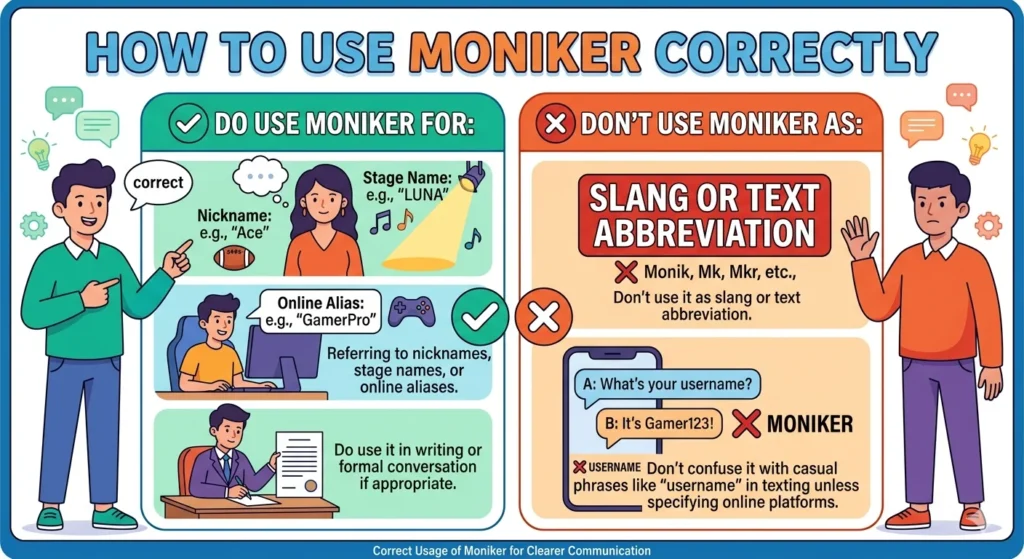
How to Use Moniker Correctly
✅ Do use it when referring to nicknames, stage names, or online aliases.
✅ Do use it in writing or formal conversation if appropriate.
❌ Don’t use it as slang or text abbreviation.
❌ Don’t confuse it with casual phrases like “username” in texting unless specifying online platforms.
Tip: Moniker sounds formal, so it works best in written or semi-formal contexts.
Common Mistakes or Misinterpretations
Many people confuse moniker with slang or casual abbreviations. Common mistakes include:
- Using it as an acronym (it’s not).
- Assuming it only applies to social media usernames (it also applies to nicknames and aliases).
- Misusing it in informal texting where simpler words like “nickname” work better.
Remember: A moniker is simply another name for someone or something, nothing more mysterious.
FAQs About Moniker
1. What does moniker mean in casual conversation?
It refers to a nickname or familiar name someone uses instead of their official name. For example, “His moniker is ‘Johnny.’”
2. Is moniker slang or formal?
It’s formal English, not slang, but can be used in casual conversation to refer to nicknames.
3. What’s the difference between a moniker and a pseudonym?
A pseudonym is usually a professional or pen name, while a moniker can be any nickname or alias.
4. How do you reply if someone asks about your moniker?
Simply state the nickname or alias you use. Example: “My moniker is Alex.”
5. Where is moniker most used?
It’s used in conversations, writing, social media handles, and occasionally in professional or artistic contexts.
6. When should you not use moniker?
Avoid using it in casual texting or where “nickname” would be more natural.
Conclusion
Now you know the meaning of moniker, its origin, and the best ways to use it in conversation, writing, and online. Whether it’s a friend’s nickname, a social media handle, or an artist’s stage name, understanding this term helps you communicate clearly and confidently.
Now that you know what a moniker is, you’ll never be confused again! Keep exploring our site for more internet slang, trending phrases, and fascinating language insights.

Willie Nelson is a skilled and passionate content writer working as an expert author at maeningg.com. With strong knowledge of digital trends, slang meanings, and engaging online content, Willie focuses on creating clear, helpful, and reader-friendly articles.